

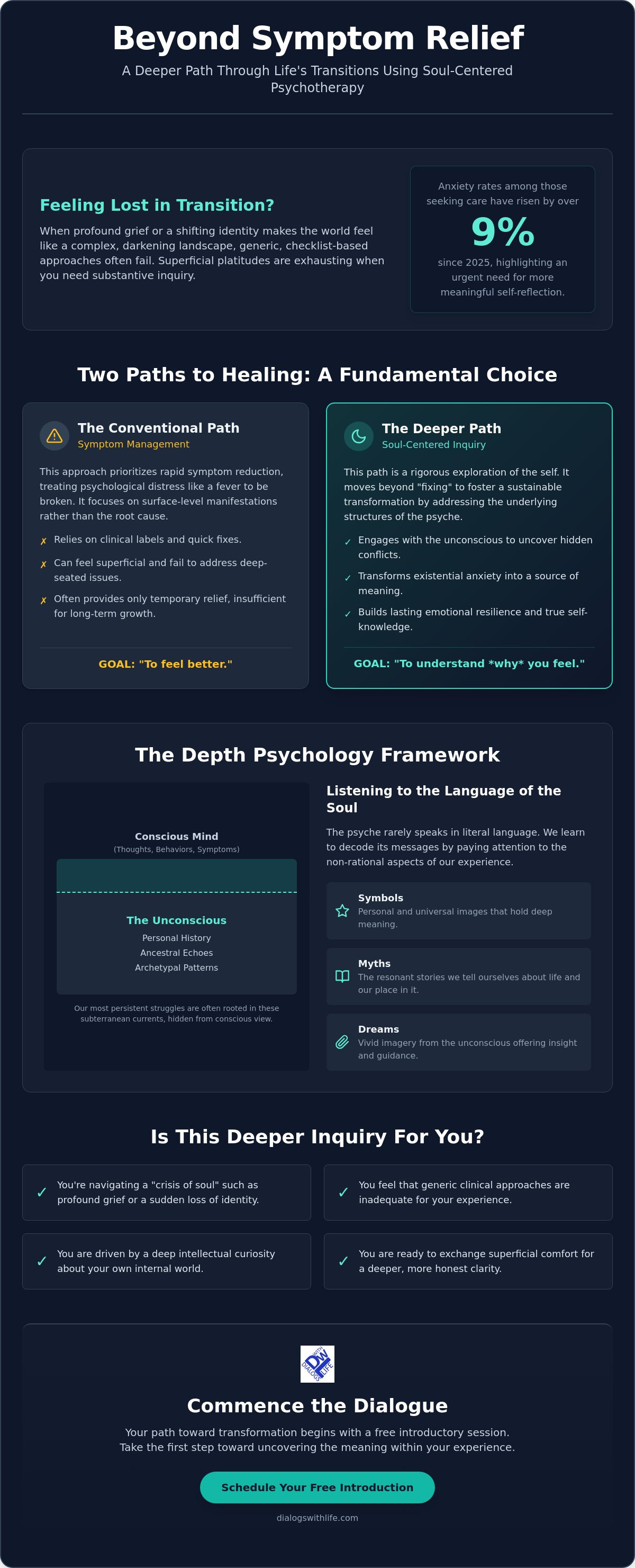
What if the persistent ache of a life transition isn't a clinical symptom to be suppressed, but a vital signal from a self waiting to be understood? You might feel that generic, checklist-based approaches fail to capture the gravity of your experience, especially when dealing with profound grief or a shifting sense of identity. It's exhausting to be met with superficial platitudes when your internal world feels like a complex, darkening landscape. In a time where anxiety rates among those seeking care have risen by over nine percent since 2025, the need for a more substantive inquiry has never been more urgent.
By engaging in specialized individual psychotherapy, you can move beyond simple symptom management into a deeper, more rigorous exploration of your own unconscious. This article will show you how to navigate life's most demanding transitions with clarity and philosophical depth. We'll discuss the path toward emotional resilience, the importance of uncovering hidden internal conflicts, and how a committed, soulful dialog can transform existential anxiety into a foundation for meaningful self-reflection.
Key Takeaways
- Reframe your journey from a search for quick fixes to a rigorous inquiry of the self, moving beyond superficial clinical labels toward true self-knowledge.
- Explore how depth psychology provides a framework for engaging the unconscious, allowing you to confront the profound complexities of grief and existential change.
- Gain a deeper understanding of how specialized individual psychotherapy serves as a vital tool for navigating the heavy landscapes of identity loss during major life transitions.
- Understand the clinical and ethical advantages of the direct-pay model, which preserves your autonomy and ensures the therapeutic process remains unburdened by institutional constraints.
- Identify the signs that you are ready for a more profound level of inquiry and learn how to initiate this transformative dialog through a free introductory session.
What is Individual Psychotherapy? A Return to Self-Knowledge
At its core, individual psychotherapy is a deliberate, one-on-one engagement between a therapist and a seeker. It’s an intentional space, set apart from the noise of daily life, where the focus remains entirely on the internal world of the individual. While many view psychotherapy as a tool for clinical intervention, we approach it as a rigorous inquiry into the self. This isn't a mechanical process designed to "fix" a defective part of the psyche. Instead, it’s a disciplined return to self-knowledge; the therapist acts as a witness and a guide through the more difficult, often avoided aspects of the human experience.
The therapeutic relationship serves as a safe container. It allows for the emergence of difficult truths that might be too heavy for social circles or casual friendships. Unlike general counseling or social support, this practice demands a specific type of depth. It requires a commitment to looking at the shadows and the light with equal sincerity. It's a professional alliance built on the understanding that the most profound healing comes from being truly seen and heard in one's complexity. The intentionality of this work creates a boundary where the logistical and the existential can finally meet.
The Distinction Between Symptom Relief and Soul-Centered Work
The modern medical model often prioritizes symptom reduction, treating psychological distress like a fever to be broken. While relief is necessary, it’s often insufficient for long-term growth. A depth model focuses on the root of internal conflict rather than just the surface manifestations. By addressing the underlying structures of the psyche, we foster a more sustainable transformation. This process is central to the work at Dialogs with Life, Inc., where we facilitate an active engagement with your own narrative. We move beyond simply feeling better to understanding why we feel at all.
Who Seeks This Path of Inquiry?
Those who find themselves drawn to individual psychotherapy are often navigating what might be called "crises of soul." These are significant life shifts, such as the weight of profound grief or a sudden loss of identity, that generic clinical approaches can't fully hold. You don't need a formal clinical diagnosis to benefit from this work. Many seekers are driven by a deep intellectual curiosity about their own internal world. They’re individuals who recognize that life’s transitions require more than just coping; they require meaning. This path is for the person who is ready to exchange superficial comfort for a deeper, more honest clarity.
The Depth Psychology Framework: Engaging the Unconscious
To understand the architecture of our suffering, we must look beyond the immediate symptoms that disrupt our days. While many perspectives on individual therapy prioritize the correction of observable behaviors, depth psychology invites us to peer beneath the surface of our conscious thoughts. This framework suggests that our most persistent struggles are often rooted in subterranean currents. These are the parts of the psyche that remain hidden from view yet exert an inexorable pull on our emotional lives. Depth psychology is the study of the soul’s interiority and its influence on modern living.
When we encounter profound grief or sudden life changes, our reactions are rarely just logical responses to external events. They are shaped by the unconscious, a reservoir of personal history, ancestral echoes, and archetypal patterns. By acknowledging these deeper layers, individual psychotherapy becomes more than a clinical exercise; it becomes a way to integrate the spiritual dimensions of being human. This work does not require adherence to a specific religious doctrine. Instead, it respects the inherent mystery of the human spirit and the ways we search for meaning in a world that often feels fragmented and indifferent.
Engaging with Symbol, Myth, and Dream
In this tradition, we recognize that the soul rarely speaks in the literal language of facts and figures. It expresses itself through symbols, myths, and the vivid imagery of our dreams. By "listening" to these ignored parts of ourselves, we begin to decode the messages our psyche is trying to send. This practice of spiritual psychotherapy honors the non-rational aspects of our experience. It allows us to find resonance in the stories we tell ourselves, transforming a chaotic internal state into a coherent, albeit complex, narrative of self-discovery.
Moving Beyond Cognitive Behavioral Approaches
Many individuals find that standard "top-down" approaches, such as Cognitive Behavioral Therapy, feel insufficient when facing deep trauma or existential despair. While managing thoughts is a valuable skill, it can sometimes bypass the raw intensity of the pain. The focus here is on "being" with the difficulty rather than just attempting to manage it away. In the practice of individual psychotherapy, the therapist serves as a steady witness to your internal world. If you find yourself seeking a space that honors this complexity, you might consider how spiritual and depth psychology can offer a more resonant path forward. This approach values the slow, methodical process of reflection over the quick fix, ensuring that healing is as deep as the wounds it addresses.
Navigating the Weight of Loss and Major Life Transitions
We often encounter loss as if it were a temporary detour from a normal life. Yet, for many, a major transition feels less like a detour and more like a collapse of the world as they knew it. Whether it's the end of a long career or the dissolution of a marriage, these moments carry a profound existential weight that cannot be dismissed with simple platitudes. Individual psychotherapy provides a necessary sanctuary to honor the gravity of what has ended. It isn't about rushing toward a new beginning; it's about staying present with the "no longer" while the "not yet" slowly takes shape. This practice allows for a slow, methodical processing of the self that is being left behind.
Grief and Loss: Honoring the Absence
Popular culture often speaks of "moving on" as the ultimate goal of bereavement. This suggests that loss is something to be left behind, a burden to be discarded so we can return to a state of productivity. In contrast, depth psychology views grief as a process of integration. We don't move on from those we have lost; we learn to carry them differently. Bereavement is a transformative encounter with our own mortality. It forces us to confront the fragility of our attachments and the reality of our finite existence.
When you sit in individual psychotherapy, you aren't seeking to erase the pain. You're seeking to understand it as a testament to your capacity for meaning. The depth of your sorrow is often a mirror of the depth of your love, and honoring that absence is a vital part of the healing journey. By looking directly at the void left by loss, we find that the absence itself has a shape and a voice that can teach us how to live more deeply in the present.
Life Transitions as Rites of Passage
Major shifts like retirement or mid-life relocation are more than just logistical adjustments. They are psychological thresholds, or rites of passage, that demand a new understanding of the self. This is where existential anxiety often surfaces, signaling that the old identity no longer fits. You might feel a disorienting loss of purpose or a sudden questioning of lifelong values. Navigating these thresholds requires a dedicated space for reflection where the logistical and the existential are inextricably linked.
To explore how these shifts can become catalysts for growth, you might consider the framework of Life Transitions Therapy. By treating these moments as sacred transitions rather than mere inconveniences, we allow ourselves to be reshaped by the experience. This journey toward a new self-understanding is rarely easy, but it is the path toward a more authentic way of being in the world. We honor the threshold by refusing to cross it too quickly, allowing the wisdom of the transition to reveal itself in its own time.
The Practice of Autonomy: Why Direct-Pay Therapy Matters
The choice of how one pays for individual psychotherapy is not merely a financial transaction. It's a statement of clinical and personal sovereignty. Dialogs with Life, Inc. operates on a direct-pay model because the therapeutic process should be governed by the needs of the soul, not the administrative mandates of an insurance provider. When care is dictated by a third party, the rhythm of the work is often forced to conform to predetermined timelines and symptom-based metrics. This can stifle the slow, methodical exploration required for true self-knowledge. Insurance companies typically demand a medical necessity for treatment, which forces a practitioner to pathologize what may simply be a profound response to life’s inherent difficulties.
By removing the intermediary, we ensure that the pace of our inquiry remains flexible and client-centered. You aren't a case file to be managed; you're a person navigating a complex internal landscape. This model allows us to sit with the difficult truths of your experience without the pressure of proving your worth to an auditor. The logistical and the existential are inextricably linked. Choosing to pay directly is an act of reclaiming your own narrative from a system that often values efficiency over depth.
Prioritizing Privacy and Confidentiality
Confidentiality is a cornerstone of deep psychological work. When you use insurance, providers often require sensitive clinical data, including specific diagnoses and treatment plans, to justify reimbursement. This means a permanent mental health label is attached to your medical record. Such labels can have unforeseen implications for future insurance coverage or certain professional paths. Engaging in individual psychotherapy through a direct-pay model bypasses this requirement. It allows you to speak freely, knowing your narrative remains strictly between you and your therapist. You hold the autonomy to determine the length and frequency of your care, ensuring the work ends only when the dialog has reached its natural conclusion.
Investing in Clinical Depth
There is a unique psychological weight to making a direct financial investment in your own growth. It signals a profound commitment to the work, moving it from a passive service into an active, shared endeavor. This model supports a level of clinical depth that is often lost in high-volume, insurance-based practices. It allows for a more rigorous engagement with the unconscious, free from the distraction of billing disputes or coverage limits. It's important to clarify that our practice focuses exclusively on this depth-oriented dialog. We don't provide insurance billing services or psychiatric medication management. Instead, we offer a dedicated, unhurried space for those ready to confront the existential weight of their lives. If you seek a therapeutic alliance built on intellectual bravery and professional expertise, you can begin your process here.
Commencing the Dialog: Your Path Toward Transformation
Choosing to begin individual psychotherapy is a decision to stop looking away. It's an invitation to confront the persistent echoes of your history and the quiet anxieties of your future with a new level of intellectual bravery. This path isn't for those seeking a temporary distraction or a curated set of affirmations. It's for the searcher who recognizes that their current way of being has reached a limit. The atmosphere of our work is intentionally contemplative and serious. It's a space where we respect the weight of your experience, providing a deeply empathetic witness to the complexities that others might find too heavy or too obscure to address.
For residents of California ready to engage in this rigorous process, the next step is a methodical one. We don't rush into deep psychological waters without first establishing a foundation of trust and clarity. The logistical and the existential meet here; we ensure that the framework of our sessions supports the profound nature of the inquiry. This is a commitment to your own interiority, a dedicated hour where the noise of the world is silenced so the voice of the soul can finally be heard.
The Importance of the "Right Fit"
The primary predictor of success in any therapeutic endeavor is the resonance between the therapist and the client. This isn't about mere likability; it's about a shared capacity for depth and a mutual understanding of the work's gravity. We offer a free introductory session specifically to assess this clinical fit. Think of this meeting as a mutual inquiry rather than an interview. It's an opportunity for you to feel the rhythm of the conversation and to trust your intuition. If the dialog feels grounded and the silence feels safe, we've found the starting point for your transformation.
Preparing for Your First Session
Before you begin, you might find it helpful to sit with a few reflective questions. What is the narrative you've been carrying that no longer feels true? What are the transitions you're currently navigating that feel like thresholds you cannot cross alone? It's natural to feel a sense of anxiety about "starting from the beginning," but in depth work, we don't just recount facts. We look for the patterns and symbols that have always been there. You don't need to have all the answers ready; you only need the willingness to ask the difficult questions. When you're ready to move beyond superficial comfort toward a deeper understanding of your own life, you can schedule your free introductory session with Dialogs with Life, Inc.
Reclaiming Your Narrative Through Deep Inquiry
The journey toward self-knowledge requires a willingness to dwell in the complexity of your own internal world. We've explored how individual psychotherapy serves as a rigorous container for this exploration, moving beyond the limitations of standard clinical models to engage the unconscious directly. By prioritizing your autonomy through a direct-pay structure and honoring the spiritual dimensions of your experience, you reclaim the power to define your own healing. This process is not a quick fix; it's a methodical integration of your history and your potential.
At Dialogs with Life, Inc., our California-based practice is specialized in spiritual and depth psychology. We provide dedicated support for those navigating the heavy landscapes of grief and major life transitions. This work is a serious commitment to the truth of your existence, offered with professional expertise and intellectual bravery. If you're ready to commence this dialog and move toward a more profound clarity, we invite you to Schedule a Free Introductory Session. Your path toward transformation is a patient, intentional process, and it begins with the courage to be seen in your entirety.
Frequently Asked Questions
What is the difference between individual psychotherapy and talking to a friend?
Psychotherapy is a disciplined, one-on-one engagement that prioritizes your internal world without the social obligations of friendship. While friends offer vital support, a therapist provides a professional distance and clinical expertise that allows for the exploration of difficult truths. This intentional space ensures that the dialog remains focused on your self-knowledge rather than mutual exchange. It's a structured inquiry designed to uncover subterranean patterns that casual conversation often misses.
How long does depth psychology therapy typically last?
The duration of depth-oriented work varies significantly because it respects the slow, methodical pace of the unconscious. Unlike short-term interventions that target surface symptoms, this approach seeks a more profound integration of the self. Some seekers find clarity in a few months; others commit to a longer dialog spanning years. The work ends only when the internal inquiry has reached its natural conclusion and you feel a sustainable sense of clarity.
Do you accept insurance for individual psychotherapy in California?
We don't accept insurance billing for individual psychotherapy in California, as we operate exclusively on a direct-pay model. This decision preserves your clinical autonomy and ensures that your sensitive data isn't shared with third-party payers. By avoiding mandatory mental health labels, we maintain a higher standard of privacy and confidentiality. This allows the therapeutic process to be guided by your actual needs rather than institutional metrics or reimbursement codes.
Can I seek therapy for "life transitions" if I don’t have a mental health diagnosis?
You don't need a formal clinical diagnosis to engage in this path of inquiry. Many individuals seek support during major life shifts, such as retirement or career changes, which often trigger existential anxiety. We view these transitions as thresholds that demand new self-understanding rather than as pathologies to be fixed. Our work honors the "crises of soul" that accompany these shifts, providing a space for meaningful reflection outside the medical model.
What should I expect during the free introductory session?
The free introductory session is a mutual inquiry designed to assess clinical fit and resonance. You can expect a serious, contemplative atmosphere where we discuss your current challenges and what you hope to gain from the process. It's an opportunity for you to experience the rhythm of the work and determine if our approach feels like the right container for your needs. We use this time to ensure that our expertise aligns with your search.
Is individual psychotherapy appropriate for dealing with spiritual crises?
Individual psychotherapy is exceptionally well-suited for spiritual crises and existential questioning. Our practice specializes in Spiritual and Depth Psychology, recognizing that psychological distress is often inextricably linked to a search for meaning. We don't require adherence to any religious doctrine. Instead, we honor the mystery of the human spirit and help you navigate the profound complexities of being human in a world that can feel fragmented or indifferent.
How does depth psychology help with the grieving process?
Depth psychology approaches grief as a landscape to be integrated rather than a problem to be solved. We don't view bereavement through a stage-based lens that demands you move on. Instead, we help you integrate the loss into your life, recognizing that your sorrow is a testament to your capacity for meaning. This work allows you to honor the absence while slowly uncovering a new way to carry the weight of what has been lost.
What is the "rigor" involved in individual psychotherapy?
Rigor in individual psychotherapy refers to the intellectual and emotional bravery required to confront the unconscious. It involves a disciplined commitment to self-reflection and a willingness to look at the parts of ourselves we often ignore. This isn't a passive process; it's an active, shared endeavor that demands honesty and sincerity. We move beyond superficial comfort to engage in a sophisticated inquiry that respects the true weight of your internal world.


