

What if the disorientation you feel right now isn't a symptom to be cured, but a threshold to be crossed? When the pillars of your world shift, whether through the end of a career, the loss of a partner, or a fundamental shift in identity, the resulting void often feels like an existential rupture. You've likely noticed that typical self-help clichés feel hollow, offering little solace when your very sense of self is at stake. Engaging in psychotherapy for major life changes provides a necessary container for this weight. It's an approach that honors the gravity of your transition rather than rushing toward a sanitized or superficial resolution.
It's understandable to feel unmoored when the map of your life no longer matches the terrain. You deserve more than just practical strategies to simply "get through it." This exploration offers a depth-oriented perspective on transitions, moving beyond basic coping mechanisms to help you find profound meaning within the upheaval. We'll examine the process of integrating your old self with your new reality. By facing the finality of certain chapters, you can move toward a state of intellectual and spiritual clarity that respects both what was lost and what's yet to be born.
Key Takeaways
- Reframe life transitions as existential thresholds rather than logistical problems, allowing for a deeper integration of the "old self" with your new reality.
- Understand how depth-oriented psychotherapy for major life changes addresses the unconscious roots of anxiety that surface when familiar structures dissolve.
- Examine how major shifts like career loss or divorce serve as catalysts for profound identity reconstruction and philosophical inquiry.
- Learn to utilize contemplative reflection to navigate the finality of life chapters and reclaim a sense of agency in the face of the unknown.
Beyond Stress Management: Understanding the Existential Weight of Life Transitions
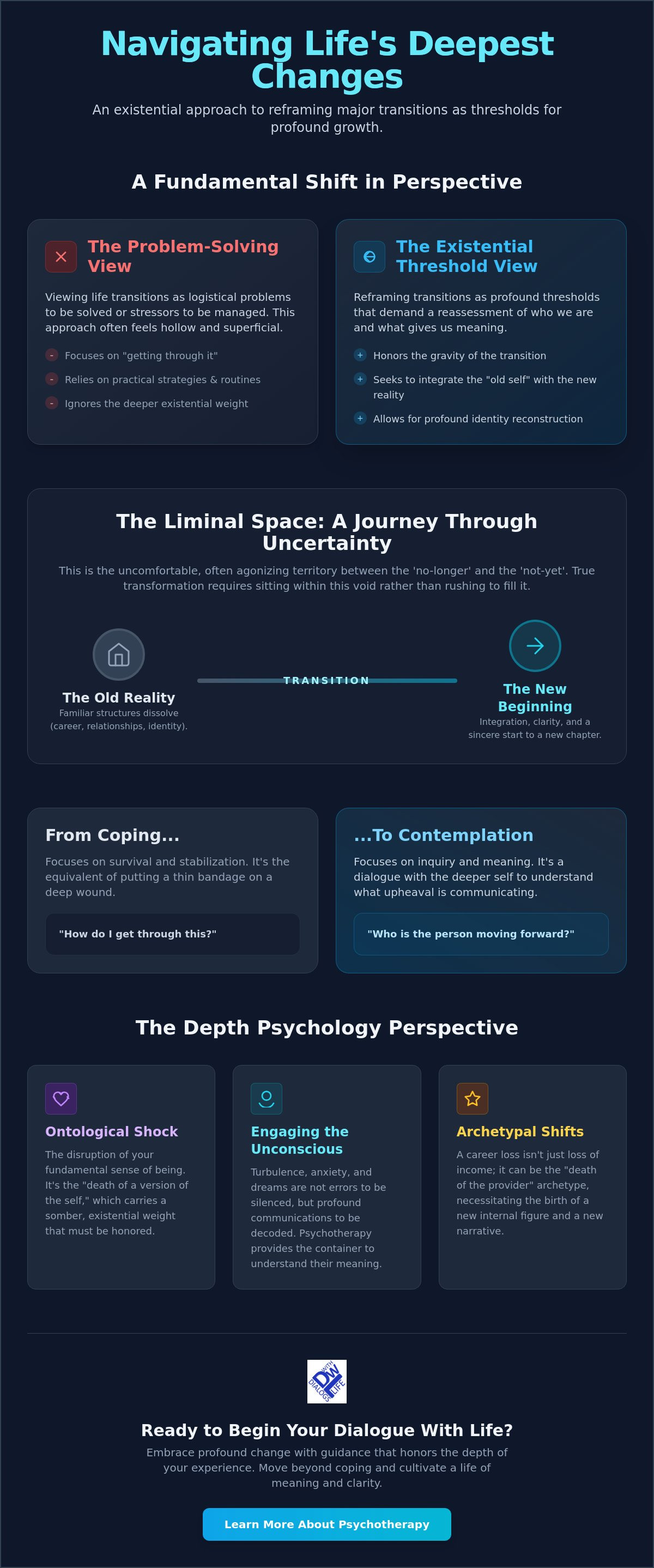
To view a profound life shift as merely a logistical problem to be solved is to ignore the gravity of the human experience. Most contemporary advice treats these moments as "stressors" that require better time management or a revised routine. However, when the external structures of our lives, the careers we've built, the marriages we've nurtured, or the health we've taken for granted, suddenly dissolve, we aren't just facing a change in schedule. We are facing a rupture in our psychic architecture. This is why standard self-help often feels like a thin bandage on a deep wound. Engaging in psychotherapy for major life changes acknowledges that these transitions are not hurdles to jump over, but thresholds that demand a fundamental reassessment of who we are.
At the heart of this experience lies the "liminal space." This is the uncomfortable, often agonizing territory between the no-longer and the not-yet. It's a period of profound uncertainty where the old maps no longer work, and new ones haven't been drawn. While situational adjustment focuses on the "how" of moving forward, internal transformation asks "who" is doing the moving. This distinction is vital. One can move to a new city and remain entirely unchanged internally; another can experience a quiet shift in perspective that alters the entire trajectory of their life. True transformation requires us to sit within the void of the liminal space rather than rushing to fill it with distractions.
The Ontological Shock of Change
Major life shifts often trigger what can be described as ontological shock, a disruption of our fundamental sense of being in the world. When a significant chapter ends, it isn't just a loss of a role; it's the death of a version of the self. This carries a somber, existential weight that demands a high degree of intellectual and emotional rigor to process. We must be willing to witness the finality of what has passed. Ignoring this weight leads to a fragmented existence where the "old self" haunts the "new reality," preventing a true integration of experience. Honoring the gravity of these endings is the first step toward a sincere beginning.
Moving from Coping to Contemplation
Standard behavioral interventions have their place, but they often prove inadequate for an existential crisis born from profound change. Coping is about survival and stabilization; contemplation is about inquiry and meaning. In the context of psychotherapy for major life changes, we move toward a dialogue between the ego, which seeks safety and predictability, and the deeper self, which often uses upheaval to signal a need for growth. This process requires us to look past the symptoms of anxiety or grief to see what they're communicating about our values and desires. Existential transition is a fundamental reorientation of the soul.
The Depth Psychology Perspective: Engaging the Unconscious in Times of Change
Depth psychology rejects the notion that psychological distress is merely an error in cognition or a failure of willpower. It views the turbulence accompanying significant life transitions as a profound communication from the unconscious. When we engage in psychotherapy for major life changes, we aren't seeking to silence the anxiety; we're attempting to decode it. Psychotherapy can help individuals confront these internal shadows, turning what feels like a chaotic collapse into a structured descent toward self-knowledge.
In times of upheaval, the ego often clings to old narratives for safety. This resistance creates friction, manifesting as a deep, pervasive dread that colors every interaction. By working with symbols and archetypes, we find a language for the experience that moves beyond literal facts. A career loss isn't just an end of income; it might be the "death of the provider" archetype, necessitating the birth of a new internal figure. We don't rush to fix these states. We bear witness to them, allowing the internal narrative to unfold without the pressure of immediate resolution. This patient observation is what allows the psyche to find its own way through the darkness.
The Unconscious as a Source of Guidance
During crises, the unconscious often speaks through dreams and spontaneous imagery. These aren't random firings of a tired brain but are attempts by the psyche to reorient itself. By uncovering the hidden scripts we follow, we begin to see how our past influences our present reactions to change. Contemplative inquiry helps reveal these suppressed fears, allowing us to move forward with greater consciousness. This internal adjustment is slow, methodical, and essential for lasting stability.
Depth vs. Breadth in the Therapeutic Process
Long-form individual psychotherapy offers a unique container for this work. Unlike short-term clinical interventions that prioritize rapid symptom reduction, depth work values soulful integration. It's a methodical process that respects the time required for a psyche to reorganize. This isn't about checking boxes or achieving milestones; it's about a rigorous path to self-knowledge that demands honesty and courage. Engaging in psychotherapy for major life changes ensures that the transition isn't just survived, but fully inhabited. If you find yourself at such a threshold, a free introductory session may offer the space needed to begin this deeper inquiry.
Navigating Specific Thresholds: From Career Shifts to the Weight of Grief
While society often categorizes life transitions into neat boxes, the internal experience of these shifts is rarely so orderly. Career loss, for instance, is frequently misdiagnosed as a simple economic setback when it's actually a crisis of social purpose and identity. Similarly, the dissolution of a marriage represents more than the end of a legal contract; it's the collapse of a shared narrative that once provided a framework for the future. Utilizing psychotherapy for life changes allows for a rigorous examination of these specific thresholds, acknowledging that the pain stems from the loss of a world, not just a role.
In midlife, these ruptures often coalesce into a broader existential search for meaning. The transition into the second half of life requires a different set of tools than the first. It's no longer about accumulation or external achievement; it's about distillation and the search for an authentic core. Psychotherapy for major life changes provides the necessary space to confront the "weight of absence" that accompanies these shifts, ensuring that the silence left behind by a career or a relationship becomes fertile ground for new growth rather than a vacuum of despair. This work respects the gravity of the change without rushing toward a forced resolution.
The Threshold of Identity
When a major role is stripped away, the immediate question is "Who am I now?" This isn't a rhetorical inquiry but a fundamental crisis of self. Therapy for loss of identity focuses on the parts of the self that were previously discarded or overshadowed by the demands of the old role. By integrating these fragments into a new, more comprehensive whole, we move toward a sense of self that is resilient because it's no longer tied to a single external title. It's a process of reclamation that honors the complexity of the human spirit and the diverse narratives we contain.
Grief as an Existential Teacher
Traditional models often suggest that grief is a process to be "completed" through specific stages. Depth psychology offers a more somber, realistic perspective, recognizing that profound loss isn't something one gets over, but something one learns to carry. We honor the permanence of loss and the weight of absence it leaves in its wake. Grief counseling serves as a witness to the finality of what has passed. This witnessing is essential, as it validates the reality of the rupture and prevents the individual from feeling isolated in their somber reflection. Through this recognition, we find a way to live with the loss rather than attempting to bypass it.
Cultivating Resilience through Philosophical Reflection and Spiritual Inquiry
Resilience is frequently mischaracterized as a simple return to a previous state of being. In the wake of profound upheaval, however, there is no "back" to return to. True resilience requires a courageous integration of new, often difficult, realities. This process is deeply supported by psychotherapy for major life changes, which blends modern clinical expertise with the timeless traditions of spiritual and philosophical inquiry. By moving beyond surface-level coping, we begin to develop the intellectual bravery necessary to face truths that the ego would rather avoid. This isn't about finding quick relief; it's about establishing a sense of purpose that remains stable even when external circumstances are in flux.
Philosophical reflection allows us to place our individual suffering within the broader context of the human condition. It transforms a personal crisis into a universal inquiry into meaning, mortality, and agency. When we stop asking "Why is this happening to me?" and start asking "What is this calling me toward?", we shift from a position of victimhood to one of active participation in our own evolution. This shift requires a willingness to sit with existential anxiety rather than attempting to medicate or distract it away. It's a rigorous discipline that demands both sincerity and a commitment to deep, meaningful engagement with one's internal world. Psychotherapy for major life changes ensures that this engagement is both structured and transformative.
Meaning-Centered Inquiry
The search for meaning acts as a vital buffer against the despair that often accompanies a major life rupture. We reframe the "crisis" as a "call," viewing it as the soul's demand for fundamental growth. Contemplative psychotherapy facilitates this inner transformation by helping individuals identify values that transcend their immediate roles or titles. This meaning isn't found in a textbook. It's uncovered through a patient, honest dialogue with the self. It's the difference between merely surviving a transition and being profoundly changed by it.
The Discipline of Reflection
Healing requires a methodical approach to internal exploration that honors the need for silence and a slower pace. Our culture values rapid consumption and immediate answers, but the psyche moves at a different rhythm. By practicing the discipline of reflection, we move from reactive stress to proactive self-discovery. This intentionality creates a safe space for complex emotions to emerge and be understood. If you are ready to engage in this rigorous work, you can explore our approach to Spiritual & Depth Psychology to begin your own process of inquiry.
Individual Psychotherapy in California: Beginning Your Dialogue with Life
The decision to seek psychotherapy for major life changes is often born from a realization that the old ways of being are no longer sustainable. In California, where the pace of cultural and personal change is relentless, finding a depth psychologist requires looking past the surface of clinical credentials. It demands a focus on the therapeutic "fit," that subtle resonance between two individuals that allows for a truly transformative dialogue. This is not a passive service but an active commitment to a path of rigorous self-inquiry. It's an invitation to witness your own internal evolution with a sense of gravity and intellectual bravery.
Prioritizing Clinical Autonomy
The direct-pay model at Dialogs with Life, Inc. serves as a vital protection for the integrity of depth work. When therapy is constrained by insurance requirements, the focus often shifts toward rapid symptom reduction and standardized billing codes. This can sanitize the therapeutic experience, stripping it of its existential weight. By prioritizing clinical autonomy within psychotherapy for major life changes, we ensure that the work remains focused on your unique internal world. This approach provides a higher level of privacy, as your records aren't subject to the scrutiny of insurance adjusters. The absence of external interference allows for a more soulful integration of the "old self" with your current reality.
Your First Step Toward Integration
Beginning this process doesn't require you to have all the answers. In fact, it often starts with the most difficult questions. The free introductory session at Dialogs with Life, Inc. is designed to explore whether our approach aligns with your specific needs. It's a space to discuss the weight of your current transition and the sense of being "lost" that often accompanies it. We focus on the therapeutic alliance, recognizing that the quality of this connection is the primary driver of successful outcomes. This initial meeting is an opportunity to move from the isolation of your crisis into a collaborative search for meaning. You are invited to schedule your free introductory session to begin the dialogue and start the methodical work of reclamation. Emotional healing is a slow, intentional process, but it begins with the courage to speak your truth.
Reclaiming Meaning within the Void
Navigating the threshold of a major life transition requires more than a temporary adjustment of habits; it demands a fundamental reorientation of the soul. By moving beyond surface-level coping to engage with the unconscious, you allow for a deeper integration of your past experiences with your current reality. This path honors the somber weight of ending a significant chapter while fostering the intellectual bravery needed to face the unknown. Engaging in psychotherapy for major life changes provides a rigorous, contemplative container for this work, ensuring that your search for meaning remains grounded in clinical expertise and philosophical inquiry.
Dialogs with Life, Inc. offers California-based individual psychotherapy through a lens of spiritual and depth psychology. We prioritize a contemplative, intellectually rigorous approach to healing that respects the complexity of your internal world. If you're ready to move toward a state of spiritual clarity and reclaimed agency, we invite you to take the first step. You can Schedule a Free Introductory Session with Dialogs with Life, Inc. to explore how a depth-oriented perspective can support your evolution. The disorientation you feel doesn't have to be a permanent state; it can be the beginning of a deeper dialogue with life itself.
Frequently Asked Questions
How is psychotherapy for major life changes different from standard counseling?
Psychotherapy for major life changes differs from standard counseling by addressing the existential rupture of identity rather than focusing solely on logistical stress management. While general counseling might provide practical coping strategies, a depth-oriented approach examines how a transition disrupts your fundamental sense of being. It invites a rigorous exploration of the unconscious and the search for profound meaning within the upheaval. This process respects the gravity of the change.
Does Dialogs with Life, Inc. accept insurance for individual psychotherapy?
Dialogs with Life, Inc. does not accept insurance billing services. We operate as a direct-pay practice to prioritize clinical autonomy and ensure the highest level of privacy for our clients. This model allows the therapeutic process to remain focused on soulful integration and deep inquiry without the interference of insurance company requirements or standardized billing codes. It fosters an honest human encounter that respects the complexity of your experience.
How long does the therapeutic process for a major life transition usually take?
The duration of the therapeutic process varies based on the complexity of the transition and the depth of the internal rupture. Unlike short-term interventions, depth work is methodical and intentional; it often requires months or years to fully integrate a new reality. We respect the slow pace of the psyche, allowing for a steady and unhurried exploration that honors the weight of the experience and the time needed for self-discovery.
What is the difference between depth psychology and cognitive behavioral therapy (CBT)?
Cognitive Behavioral Therapy (CBT) primarily targets symptom reduction through the modification of thought patterns and behaviors. In contrast, depth psychology addresses the why of suffering by engaging the unconscious, symbols, and archetypes. While CBT seeks to correct cognitive errors, depth work views psychological distress as a meaningful communication from the soul. This requires patient witnessing and interpretation rather than immediate correction or simple behavioral adjustments.
Can I seek therapy for a "positive" life change like a new career or marriage?
Yes, positive life changes like a new career or marriage often trigger significant existential anxiety and identity shifts. Even desired transitions represent the finality of a previous chapter and the dissolution of a familiar self-narrative. Engaging in psychotherapy for major life changes during these times provides a necessary container to process the complexity of these positive ruptures and integrate your new roles authentically into a coherent sense of self.
What happens during the free introductory session?
During the free introductory session at Dialogs with Life, Inc., we begin a preliminary dialogue to assess the therapeutic fit between practitioner and client. You'll have space to describe the life transition you're facing and the internal disorientation you're experiencing. This meeting is an opportunity to determine if our contemplative, intellectually rigorous approach aligns with your search for deeper understanding and emotional healing. It's a methodical first step toward a more integrated life.
Is depth psychology effective for grief and loss?
Depth psychology is profoundly effective for grief and loss because it honors the permanence of the absence rather than rushing toward closure. Our approach to grief counseling serves as a witness to the finality of what has passed, allowing you to carry the loss with dignity. It provides a somber space where the weight of grief is respected as an existential teacher, moving beyond the simple stages of mourning.
How do I know if I need a depth psychologist vs. a general therapist?
You might benefit from a depth psychologist if practical self-help advice feels hollow or if your life change feels like a crisis of identity. If you're seeking more than just a service and desire a deeper understanding of your internal world, a depth-oriented approach is appropriate. This work is for those ready for a serious inquiry into the broader human condition and the difficult, often avoided aspects of life.


