

A therapist’s expertise alone can’t create the conditions for change. Building a strong therapeutic alliance means developing a working relationship in which you and your therapist can establish trust, agree on meaningful goals, and understand the work involved. It’s a shared process, shaped by both people, not a feeling you’re expected to produce on your own. I always introduce myself to clients by emphasizing that I take them seriously, I take the work we do together seriously, but I don't take myself too seriously. I invite clients to practice three principles in the work I do with them: 1.) Rather than pondering right or wrong just step back and be curious, 2.) Be available to what your curiosity reveals, 3.) give yourself permission to act based upon what your curiosity and availability reveal.
It makes sense to wonder whether you feel safe, heard, and able to speak honestly in therapy. This article explains what a therapeutic alliance is, how to assess trust and connection with your therapist, and how the relationship is associated with psychological well-being and life satisfaction. It also looks at what can happen when the relationship feels strained, and how an open conversation may help clarify what you need from therapy.
Key Takeaways
- Notice whether you and your therapist share an understanding of your goals and the work involved in pursuing them.
- Trust can grow through empathy, attentive listening, and feeling able to speak about difficult experiences.
- If you feel misunderstood or withdrawn, raising the strain can help clarify what needs to change in the therapeutic work.
- A constructive therapeutic relationship is associated with wellbeing and life satisfaction, though it is one part of a larger picture.
How can you assess the strength of your relationship with your therapist?
Assess whether you share goals, the tasks feel workable, and disagreement feels possible to discuss. Building a strong therapeutic alliance also means considering how cultural expectations shape trust. The Substance Abuse and Mental Health Services Administration notes that clients may ask counselors personal questions as a way to establish trust.
Shared Goals and Expectations
Shared goals and expectations clarify the outcomes you are working toward and each person’s responsibilities in therapy. They matter because a working alliance needs a shared purpose and clear expectations about each person’s role. For example, you may want to focus on sleep while your therapist focuses on grief. Naming both aims helps determine whether treatment reflects your priorities.
Collaborative Goal Setting
Collaborative goal-setting can turn broad hopes into SMART goals: specific, measurable, achievable, relevant, and time-bound. These provide a reference point, not a deadline for difficult feelings. You might track a recurring trigger between sessions, then review whether the task was useful and manageable. Any task should fit your abilities and circumstances.
Joint Treatment Planning
Joint treatment planning connects goals with clinical tasks, methods, and review. Building a strong therapeutic alliance includes discussing why a technique is proposed and how it serves your goal. You and your therapist can consider whether the plan feels workable. If a task feels burdensome, raising the concern creates room to adjust it; simply complying does not measure how connected you feel to treatment.
Mutuality Across Cultural Backgrounds
Mutuality means that your cultural knowledge and your therapist’s clinical perspective both shape treatment. A therapist can ask how identity, language, family roles, or community expectations affect what you feel able to say, and check whether their interpretation fits your experience. This helps avoid assuming one framework explains every life. Differences can then be discussed directly.
What Is A Therapeutic Alliance?
Therapists build rapport through attentive listening, clear boundaries, and honest responses. Trust can grow when you feel able to question an interpretation. Cultural assumptions, feeling unheard, and unclear expectations can all get in the way. In teletherapy, you and your therapist can also discuss whether pauses, privacy, or technology are affecting your connection.
Empathic Attunement and Active Listening
Empathic attunement means noticing and reflecting your feelings, meanings, and emotional shifts. Warmth and acceptance can help make difficult material easier to examine. For example, your therapist might reflect the grief beneath your anger, then ask whether that understanding fits. This kind of active listening gives you room to correct a mistaken interpretation.
Rapport and Trust
Rapport and trust develop through consistent attention, respect, and a therapist’s willingness to respond without judgment. If you describe shame, notice whether your therapist listens before interpreting or redirects too quickly. Trust does not require agreeing with every clinical view. It includes room to question a conclusion and understand the reasoning behind it.
Feedback and Rupture Repair
Feedback and rupture repair involve noticing strain and working together to understand it. A rupture may show up as withdrawal, irritation, or disagreement after a comment lands painfully. Your therapist can ask what felt wrong, acknowledge their part, and clarify or adjust the approach. This makes discomfort something you can discuss rather than dismissing it as resistance.
Alliance in Teletherapy
In teletherapy, the alliance develops through attentive communication made more explicit across a screen. Therapists can check whether audio, framing, or privacy is affecting candor. If a client feels distant, discussing that experience can restore shared focus. For reflective work, Spiritual & Depth Psychology can help explore personal meaning.
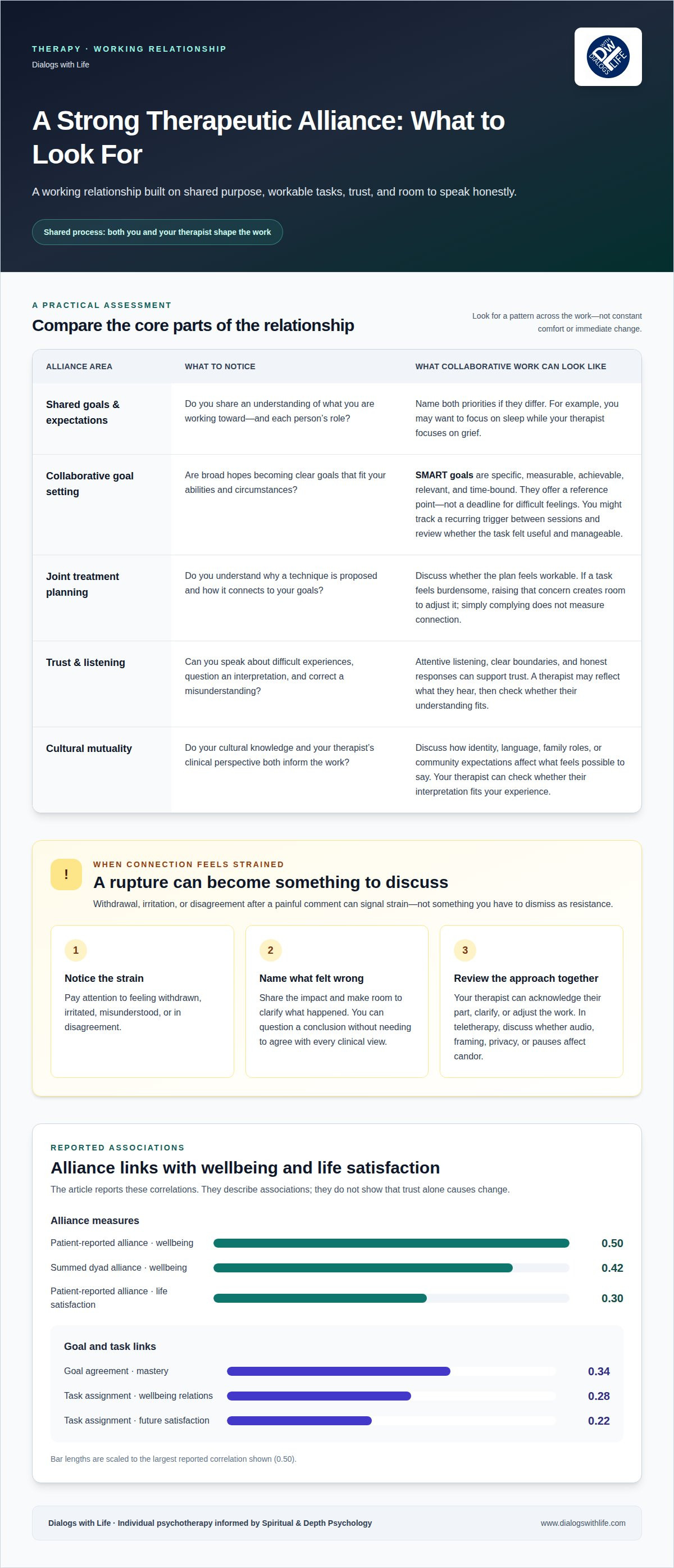
Alliance, psychological wellbeing, and life satisfaction
A collaborative therapeutic relationship may matter beyond symptom relief: it can support a sense of agency, connection, and meaning. The association between alliance and well-being does not prove that trust alone causes change. Mental health is shaped by therapy as well as circumstances outside the consulting room.
Imagine feeling increasingly able to name grief during sessions. That ability may help you make choices aligned with your values, rather than simply reducing distress. The strength of the alliance can affect whether difficult material is explored and whether treatment feels relevant enough to continue. A working relationship may therefore be one influence on engagement, not a guarantee of a particular outcome.
Life satisfaction means more than feeling better in a given moment. Someone navigating loss, for example, may still feel sorrow while developing a renewed sense of purpose or connection. Therapy can make room for both realities. Collaborative work supports this by connecting conversations to your priorities, relationships, and daily life.
The takeaway is not to judge therapy by constant comfort or immediate change. Instead, notice whether the work helps you understand yourself, act with greater intention, and speak honestly about what is not helping. If the relationship feels stalled, discussing it can clarify whether your goals or the therapeutic approach need attention.
Positive wellbeing links: patient-reported alliance 0.50, summed dyad alliance 0.42; life satisfaction: patient-reported alliance 0.30. Correlations: goal agreement-mastery 0.34; task assignment-future satisfaction 0.22, wellbeing relations 0.28.
Dialogs with Life
Dialogs with Life, Inc. offers individual psychotherapy informed by Spiritual & Depth Psychology, where you can explore trust, meaning, and connection as part of therapy. If grief, loss, or a major life transition is shaping your search for support, that context can inform the work too. A free introductory session gives you space to discuss the process and consider whether the fit feels right.
To explore working together, contact Dialogs with Life, Inc.
Make room for an honest next step
Building a strong therapeutic alliance isn’t a test you must pass before meaningful work can begin. It develops through attention to what feels possible, what remains difficult to say, and whether the work can adapt as your understanding changes. You don’t need perfect trust or certainty to begin. You can bring questions, hesitation, and hopes into the conversation. These responses are part of the relationship, not signs that you’re doing therapy incorrectly.
If you’re considering support, use the first conversation to speak plainly about what you’re carrying and what you need from therapy. You can take that step without having every answer already.
Thoughtful change can begin with one candid conversation.
Frequently Asked Questions
What is a therapeutic alliance in counseling?
A therapeutic alliance is the collaborative working relationship between a counselor and client. It includes their human connection, shared aims, and agreement about the work. It isn’t simply liking your therapist or feeling comfortable in every session. For example, you may feel uneasy discussing a subject and still trust your counselor to approach it respectfully.
What are the key components of a strong therapeutic alliance?
A strong alliance includes a reliable bond, shared goals, and agreement about therapeutic tasks, as described in Bordin’s working alliance model. These elements can vary independently: you might trust your therapist but feel uncertain about a particular exercise. Considering each part separately can show what feels solid and where a conversation could help.
What communication skills strengthen the therapeutic alliance?
Clear questions, careful summaries, and openness to correction make communication collaborative. Your therapist might say, “I hear that the decision felt forced; have I understood?” You can then clarify what they missed. This exchange makes room for your meaning instead of treating the therapist’s first interpretation as final.
How should therapists collaborate with clients on goals and treatment plans?
Your therapist should connect your priorities with a plan that has a clear purpose and can be revisited. If you want to feel less overwhelmed at work, you and your therapist can explore what that means in daily life before choosing an approach. Reviewing whether the plan still fits helps keep treatment responsive as your circumstances or priorities shift.
How can therapists repair a rupture in the therapeutic alliance?
Your therapist can repair a rupture by noticing strain, inviting your perspective, and responding without defensiveness. You might say, “I felt judged when you said that.” Your therapist can ask what felt judgmental, acknowledge the impact, and clarify or change their approach. Returning to the moment together can help make the source of disconnection clearer.


