

Many people who describe themselves as spiritual but not religious want to bring spiritual and existential questions into the room with their therapist, and to be met with real interest when they do.
A therapist trained in spiritual and depth psychology, sometimes with added studies in comparative religion, can welcome those conversations without minimizing or pushing aside any belief system.
Here is what to expect from therapy that doesn't depend on shared faith, how a therapist's experience and approach shape the work, and how spiritual and psychological perspectives can meet in individual therapy.
Key Takeaways
- Clarify whether you want therapy to engage with spirituality, remain secular, or leave that choice open.
- Consider a counselor’s psychological training and experience alongside their comfort discussing faith, meaning, and spiritual questions.
- Look for an approach that respects your beliefs without treating religious practice as a condition of therapy.
- Explore how spiritual and depth psychology may help you examine grief, loss, or major life changes.
Therapeutic dialogs without faith-based beliefs or religious practices
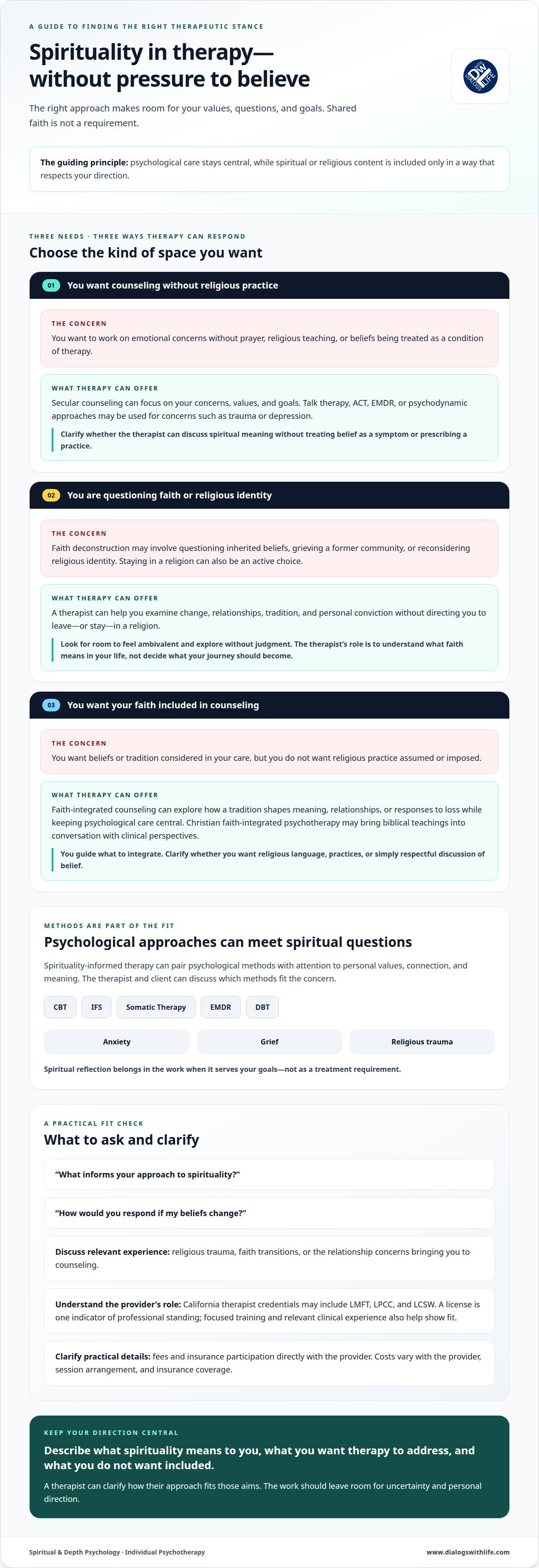
Counseling Without Religious Practices
Secular counseling doesn't rely on any particular religious belief or practice. Your therapist focuses on your concerns, values, and goals, with no religious teaching attached.
A clinician might use talk therapy, ACT, EMDR, or psychodynamic approaches for trauma or depression. One practical check: can the therapist talk about spiritual meaning without treating belief as a symptom? That matters when healing needs room for uncertainty.
Faith Deconstruction and Religious Commitment
Faith deconstruction can mean questioning inherited beliefs, grieving a former community, or rethinking your religious identity. Therapy can help you understand what faith or its absence means in your life, without nudging you to leave or join a religion. Faith and non-faith communities are shaped by relationships, tradition, and personal conviction, and both can be explored without bias or prejudice. Notice whether a counselor can hold space for mixed feelings without judging them.
Faith-Integrated Counseling Across Traditions
Faith-integrated counseling can include your religious beliefs when you want them involved. That might mean looking at how a tradition shapes meaning, relationships, or the way you handle loss. You decide what gets included, and psychological care stays front and center. Religious faith-integrated psychotherapy may bring those teachings into conversation with clinical perspectives, but religious practices shouldn't be assumed or imposed.
Counselor experience and psychological expertise
Experience counts when spiritual identity overlaps with mental health, relationships, or difficult life changes. In California, therapist credentials may include LMFT, LPCC, and LCSW. A license is one sign of professional standing, but focused training and relevant clinical experience tell you more about whether someone suits your concerns. So ask how they handle spiritual questions without pushing beliefs.
For non-religious marriage or premarital counseling, sessions can focus on communication, conflict, and shared decisions rather than doctrine. Clients who are religious may look for counseling that respects their faith while addressing emotional or relationship concerns. What matters most is how the therapist works with your beliefs.
A few good questions to ask: "What shapes how you approach spirituality?" and "What happens if my beliefs change?" It also helps to ask about experience with religious trauma, faith transitions, or whatever relationship concerns brought you in. Their answers show how they work and whether there's room for your values.
Licensed and unlicensed counselors differ in professional status, so check a provider's credentials and role before you start. Ask about fees and insurance up front, too. Costs vary with the provider, the session setup, and your coverage, so there's no single price. California requires providers to disclose their fees and fee policies up front.
Therapy for spiritual but not religious clients
Spirituality can shape who you are and what matters to you without any organized religion. Therapy can make room for spirituality while also helping with everyday concerns like anxiety.
Spirituality-Informed Therapy Approaches
Spirituality-informed therapy pairs practical psychological methods with attention to your values, connection, and sense of meaning. Examples include CBT, IFS, Somatic Therapy, EMDR, and DBT. You and your therapist can talk through which method suits what you're dealing with, whether that's anxiety, grief, or religious trauma.
Finding Welcoming California Therapists
When choosing a California therapist, look at their clinical approach, their experience with spiritual concerns, and how they treat different beliefs. Ask what they do when a client rejects organized religion, changes beliefs, or wants spiritual questions included without religious practices. Their answer should show whether they leave room for psycho-spiritual uncertainty and offer unconditional positive regard toward you and your process.
For spiritual but not religious clients, the therapist's stance matters as much as the method. Religious trauma can affect trust, community ties, and how you feel day to day, though the phrase itself isn't a formal DSM-5-TR diagnosis. In therapy you can simply describe what happened and how it has affected you, no label needed.
A simple first step: jot down what spirituality means to you, what you'd like therapy to help with, and what you'd rather leave out. A therapist can then tell you how their approach fits. A free introductory session is a low-pressure way to see if it feels right.
Dialogs with Life: Spiritual & Depth Psychology
Dialogs with Life, Inc. offers Spiritual & Depth Psychology for people who want therapy to take their inner life and sense of meaning seriously. Individual Psychotherapy gives you room to explore spiritual questions alongside everyday emotional concerns; shared religious belief isn't the basis of care.
This approach can be a good fit when grief, loss, or a big life change has shaken your understanding and sense of meaning. Grief & Loss Counseling can help you look at your own experience and explore what has changed and what still matters. A Free Introductory Session is a chance to talk through your concerns and see if it feels like a fit.
Contact Dialogs with Life, Inc. when you're ready for the next step.
Take the Next Step Toward Therapy That Fits
A therapist for spiritual but not religious people in California should engage with your inner life without steering your beliefs or asking you to set them aside. You don't need to have figured out your beliefs first. You're simply making room for what matters to you, including questions that may stay open.
Dialogs with Life, Inc. offers Individual Psychotherapy and Spiritual & Depth Psychology for people who want a thoughtful space to explore. A Free Introductory Session is a simple way to talk about what you hope to bring into therapy and see whether it feels like a good fit. You don't need a polished account of your beliefs. Just start with whatever feels most present.
Your spiritual life stays yours. Therapy is a place to look at it with care.
Frequently Asked Questions
Will my therapist share my faith?
No. A therapist doesn't need to share your faith to work respectfully with your spiritual life. They can help you look at how your beliefs affect your choices, relationships, or stress without holding those beliefs themselves. For example, you might talk through a spiritual experience and focus on what it means to you and how it affects you.
What questions should I ask a therapist about spirituality before booking?
Ask how the therapist handles clients whose beliefs differ from their own, and whether you can keep religious practices out of sessions. You might also ask how they approach spiritual experiences that feel frightening, or how they tell personal meaning apart from a mental health concern. Clear answers show you their boundaries and approach, and whether they can sit with uncertainty without pushing their beliefs.
What are warning signs of a therapist imposing religious beliefs or making unsupported claims?
A good therapist explains what an approach is for, respects your consent, and welcomes questions when an explanation doesn't fit your experience. Watch for pressure to adopt a faith, join religious practices, or read your distress through one doctrine when you've said you don't want that.
Be wary of big promises. Any claim that a spiritual practice cures depression or trauma can only be assessed through independent, unbiased, evidence-based clinical trials.


