

What if a creative block is not a failure of discipline, but a sign that something deeper needs attention? A California therapist for creative blocks can help you explore how burnout, perfectionism, imposter feelings, and self-doubt may become tangled with your work. Therapy does not manufacture inspiration; it can create space to understand what is getting in its way.
If creating has become a source of pressure or shame, that strain matters, even when its cause is unclear. This article looks at how therapy may address creative blocks, what psychological experiences can contribute, and when individual psychotherapy may offer a meaningful setting for exploration. It also considers how a depth-oriented approach can make room for the personal history and questions of meaning that creative work often carries.
Key Takeaways
- Therapy can explore how burnout and perfectionism affect both creative work and personal well-being.
- Imposter feelings and self-doubt may shape how you judge your work, even when the underlying causes are difficult to see.
- Grief, exhaustion, depression, traumatic memories, or a loss of meaning can contribute to creative blocks.
- Individual psychotherapy with a depth-oriented focus can help examine these roots and clarify what kind of support may fit.
Can therapy help with creative burnout and perfectionism?
Therapy can help artists explore creative blocks when they begin to affect well-being or strain their relationship with themselves. It can examine the pressures and experiences shaping the work, rather than simply pushing for more output.
Effects on Creative Work and Well-Being
A block may interrupt a writer’s draft, leave an actor unable to approach a role, or make a musician avoid rehearsal. Repeated rejection can feel like “creative mortification,” deepening self-doubt and diminishing self-worth. Perfectionism can turn every minute of work into a test, while commercial demands may pull artists away from what feels authentic. If the struggle affects daily life, relationships, or a person’s sense of self, those effects matter as much as unfinished work.
Therapy for Creative Professionals in California
Psychotherapy for artists, performers, writers, and musicians can explore how feelings, trauma, depression, exhaustion, and performance anxiety affect the creative process.
A therapist may examine the roots of a block and consider psychological and physiological approaches suited to the individual. Modern psychoanalytic work and Cognitive Behavioral Therapy are among the approaches used in this area. The goal is to understand what obstructs expression, not to prescribe one method for every creative life.
Insurance coverage depends on your plan’s behavioral-health benefits, provider status, and billing arrangements. Therapy costs vary with the clinician and care arrangement; an average alone may not reflect your circumstances. Ask about coverage, fees, and any sliding-scale options during a consultation.
Useful questions to ask during an introductory conversation include: “How do you work with creative blocks?” and “How might we explore perfectionism or rejection?” The answers can help you decide whether the approach suits your needs.
Imposter syndrome and creative self-doubt
A writer may finish a story, then dismiss it as luck rather than skill. An actor may take one difficult audition as proof they lack talent. These imposter feelings can turn career milestones into fresh sources of anxiety, while negative self-talk narrows what feels possible in creative work. The emotional strain may persist even when others value the work.
In therapy, you can examine when those judgments arise and what they mean. A therapist may explore whether criticism, rejection, or earlier experiences contribute to the belief that success is undeserved. Connecting stress with self-doubt can help distinguish a specific concern from a sweeping verdict about yourself. The goal is not to replace every doubt with praise, but to understand its influence.
Creative self-trust also involves play: making room to experiment without treating every attempt as a career-defining test. Therapy can help you identify conditions that make inspiration feel closer or more distant, including exhaustion and pressure to produce. Attending to rest, boundaries, and emotional needs can support resilience and help you recognize burnout before it becomes the only way to stop.
For someone drawn to questions of meaning as well as symptoms, spiritual and depth psychology can offer a framework for exploring how identity, values, and creative work remain connected. The aim is not to force flow, but to understand what interrupts it and what a more authentic relationship with creating might require.
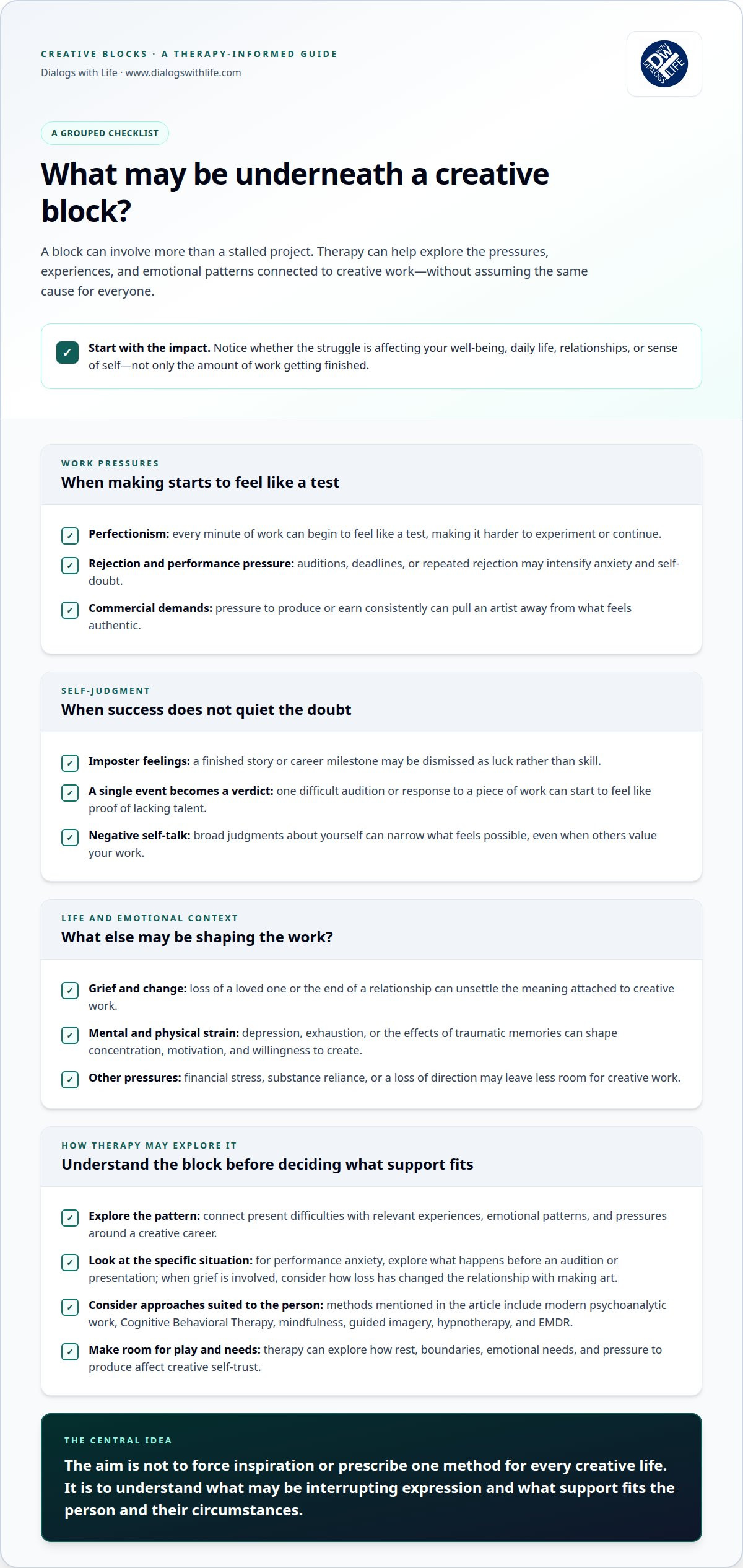
Creative blocks and their psychological roots
A creative block may signal more than a stalled project. Perfectionism, exhaustion, substance reliance, or a loss of direction can make expression feel difficult. Financial pressure can also leave less room for creative work, especially when income depends on producing consistently.
Relationships and life changes can matter, too. The loss of a loved one or the end of a relationship may unsettle the meaning attached to your work. Depression and the effects of traumatic memories can also shape concentration, motivation, and willingness to create. Rejection may intensify these struggles, particularly when one response to a piece of work starts to feel like a verdict on your whole identity.
Therapy begins by exploring what may be contributing to the block, rather than assuming the same cause for everyone. A therapist can help connect present difficulties with relevant experiences, emotional patterns, and the pressures surrounding a creative career. The aim is to find psychological and physiological approaches suited to you and your circumstances.
Methods used in creative-block treatment can include mindfulness, guided imagery, hypnotherapy, and EMDR. These approaches differ, so the key question is how a method relates to your needs. For performance anxiety, therapy may examine what happens before an audition or presentation. When grief is involved, it may explore how loss has changed your relationship with making art.
A useful starting point is to consider whether the block is affecting your mental health, daily life, or sense of meaning. Exploring those connections can shift the focus from forcing output to understanding what expression requires now.
Dialogs with Life Inc. California
Dialogs with Life, Inc. offers individual psychotherapy for people whose creative blocks connect with self-doubt, grief, or questions of meaning. Spiritual & Depth Psychology makes room to explore the personal history and inner conflicts shaping a creative life, rather than treating stalled work as a discipline problem.
A Free Introductory Session gives you a chance to discuss what has become difficult and consider whether the therapeutic process feels like a fit. Therapy may be worth considering when creative struggles affect your well-being, relationships, or connection to your work, not just your output.
Make room for a different relationship with your work
Creative life rarely follows a straight line. A pause can invite you to examine what your work has come to carry: expectation, identity, livelihood, or the fear of being seen. Working with a therapist for creative blocks can offer a thoughtful setting to explore those meanings and consider what you want your relationship with creating to become.
The next step does not have to commit you to a particular outcome. It can begin with an honest conversation about what feels difficult, what you hope to understand, and whether therapy feels like a suitable place to start. You deserve space to approach the question without reducing your creative life to productivity.
There may be another way forward, shaped by understanding rather than pressure to produce.
Frequently Asked Questions
Can trauma ruin creativity?
Trauma can affect concentration, emotional safety, or confidence in creative expression, but it does not determine a person’s creative future. For example, a performer may feel exposed onstage after a distressing experience. Therapy can help explore how past events relate to present reactions and what support feels appropriate, without treating creative work as a measure of recovery.
Do you offer therapy in person and online for creatives with irregular schedules?
Dialogs with Life, Inc. provides individual psychotherapy, and the demands of creative work can be part of the conversation. A writer managing shifting deadlines or a performer balancing rehearsals may want to consider how appointments fit alongside work. The introductory session offers a chance to discuss the therapeutic process and whether it feels like a fit.
How does a creative block impact my mental health?
A creative block can affect mental health when it starts shaping how you see yourself beyond your work. A musician who stops composing, for instance, may withdraw from collaborators or feel that a temporary pause defines their identity. Notice whether distress affects relationships, sleep, or everyday responsibilities, not only whether a project is moving forward.
How do I find a therapist for creative blocks in California?
A therapist for creative blocks should be someone you can talk to about the realities of your creative life, including deadlines, collaboration, and rejection. Consider whether their approach leaves room for your personal history and the meaning of your work. Dialogs with Life, Inc. offers a free introductory session to explore the process and fit.
What therapy approaches help with creative blocks, perfectionism, and burnout?
The approach depends on what is contributing to the difficulty. Creative-block treatment may draw on mindfulness, guided imagery, EMDR, or Cognitive Behavioral Therapy while Dialogs with Life, Inc. includes Spiritual & Depth Psychology. In an initial conversation, you can describe a specific challenge, such as avoiding a submission, and discuss the kind of exploration you’re seeking.


