

By Bernard Douglas, M.A., LMFT
There are moments in life when the familiar language of psychology seems insufficient.
We may be anxious, grieving, dissatisfied, or caught in a transition that we cannot quite explain. We may know the diagnostic terminology. We may even understand the behaviors and circumstances contributing to our distress. Yet something remains unanswered. Beneath the symptoms is often a quieter and more difficult question:
What is happening to my life, and what does it mean?
This is where depth psychology—and particularly the archetypal tradition associated with James Hillman—offers a different way of listening.
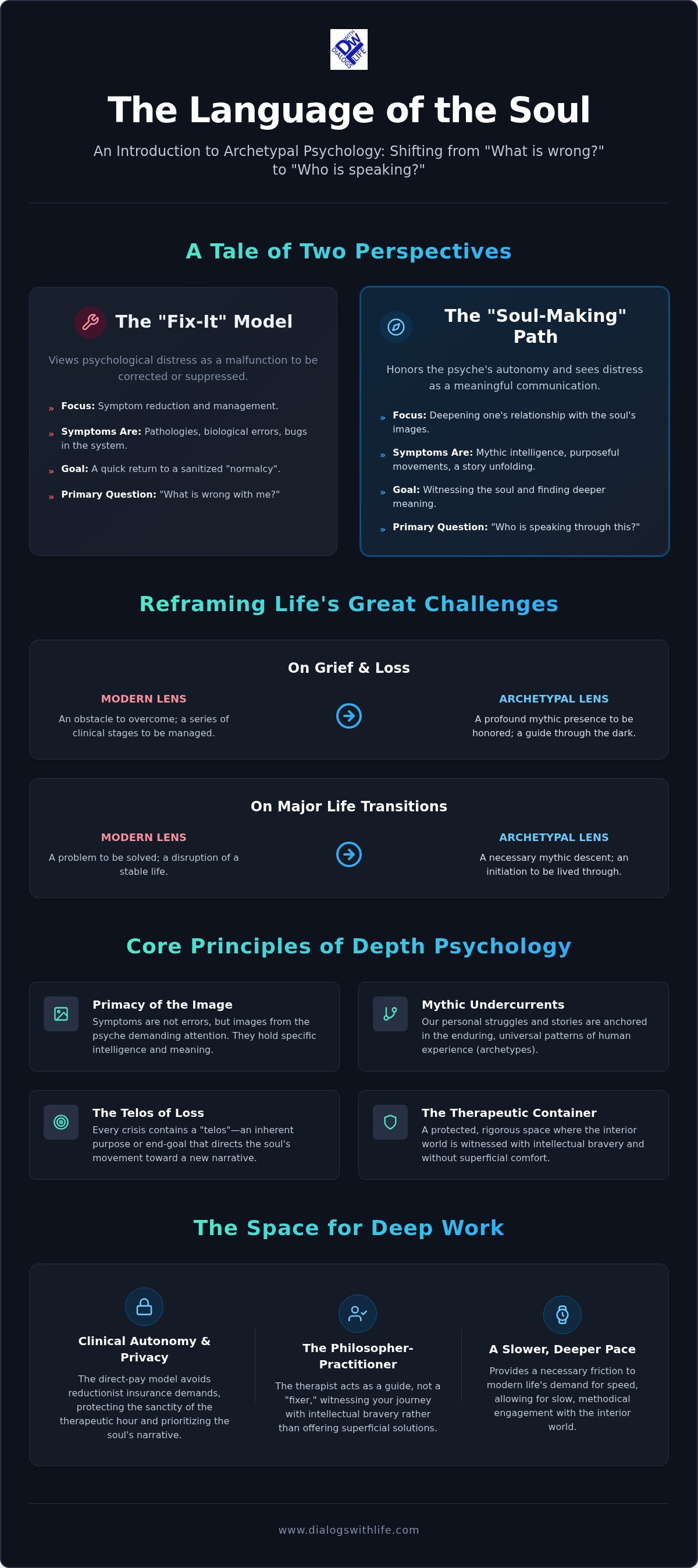
Rather than beginning with the assumption that psychological suffering is evidence that something has malfunctioned, archetypal psychology asks us to become curious about the images, conflicts, longings, and recurring themes that accompany our distress. The question shifts from simply How do I make this stop? toward What is trying to be known here?
This does not mean romanticizing suffering or dismissing the importance of symptom relief. Anxiety can be debilitating. Depression can profoundly interfere with work, relationships, sleep, motivation, and the ordinary pleasures of being alive. Grief can overwhelm us.
But human beings are more than collections of symptoms.
Sometimes psychological suffering also carries information about the life we are living—and perhaps about the life that can no longer be lived in quite the same way.
The Psyche Does Not Always Speak Literally
One of the central insights of depth psychology is that the psyche frequently communicates through images, dreams, fantasies, memories, emotional reactions, and repeating patterns.
We tend to approach these experiences literally.
“I hate my job.”
“My marriage feels empty.”
“I don't know who I am anymore.”
“I should be happier than I am.”
“I've accomplished what I wanted, so why do I feel dissatisfied?”
Our first impulse is often practical: change the job, repair the relationship, develop better habits, reduce the anxiety, become more productive.
Sometimes that is exactly what is needed.
But sometimes the literal problem is only the surface of something deeper.
A person who feels trapped professionally may indeed need another position. But the psychological question may concern something larger: ambition, identity, mortality, creativity, sacrifice, or the realization that an earlier definition of success no longer carries meaning.
The psyche may be asking for something that cannot be solved by rearranging circumstances alone.
This is one reason psychotherapy can become more than problem-solving. Therapy can provide a place in which we slow the story down enough to hear what lies beneath the obvious explanation.
Symptoms as Psychological Images
Archetypal psychology challenges the tendency to regard every uncomfortable psychological state primarily as something to eliminate.
Imagine, for example, someone experiencing persistent anxiety.
There are legitimate clinical reasons to understand the anxiety itself: its severity, frequency, triggers, physical manifestations, history, and effect on functioning. These questions matter.
But another set of questions may also matter:
What does the anxiety imagine is about to happen?
What situations repeatedly awaken it?
What does the person fear losing?
What kind of life has become impossible to sustain?
What remains unsaid?
Anxiety then becomes more than an item on a symptom inventory. It becomes part of the person's psychological narrative.
The same may be true of depression, anger, loneliness, recurring relationship conflicts, or an inexplicable sense of emptiness.
This perspective asks us to resist the temptation to reduce complicated human experiences too quickly. A symptom may require treatment while simultaneously deserving interpretation.
Those two positions do not have to contradict one another.
Grief and the Descent
Grief makes this distinction particularly clear.
Our culture often treats grief as though it were an unfortunate interruption in otherwise productive living. There is subtle pressure to recover, resume functioning, achieve closure, and eventually “move on.”
The psyche does not necessarily cooperate.
Loss changes the landscape of identity.
When a spouse dies, a marriage ends, a career disappears, children leave home, health changes, or a long-held dream becomes impossible, we do not merely lose something external. We may lose the person we understood ourselves to be in relation to it.
Archetypal traditions often understand these experiences through the metaphor of descent.
Myths across cultures repeatedly describe journeys downward: into darkness, wilderness, exile, uncertainty, or the underworld. The person who eventually returns is not identical to the person who departed.
This is psychologically important.
There are periods of life in which the task may not be immediate restoration. The task may be tolerating uncertainty long enough for another understanding of oneself to emerge.
Grief asks something different from efficiency.
It asks for time.
The Stranger We Become
Major transitions frequently produce an unsettling experience: we become strangers to ourselves.
A person retires after decades in a profession and suddenly discovers how much identity had been organized around work.
Someone leaves a long marriage and realizes that the pronoun “we” has quietly governed much of adult life.
A parent whose children have become independent may encounter both freedom and an unexpected emptiness.
Someone who has achieved professional success may discover that accomplishment has not answered questions of meaning.
These experiences are easily mistaken for personal failure.
But from an archetypal perspective, the stranger can be understood differently. The unfamiliar self may represent not pathology but transition.
The old narrative has lost authority, while the new one has not yet been written.
Psychotherapy cannot—and should not—write that story for someone. What it can provide is a disciplined relationship in which uncertainty does not have to be prematurely resolved.
The Danger of a Life Lived Only on the Surface
Modern life rewards speed.
We measure steps, sleep, productivity, income, followers, efficiency, performance, and increasingly our own emotional states. Much of this information can be useful.
But measurement has limitations.
There is no metric for whether a life feels meaningful.
There is no dashboard that tells us whether we have betrayed something essential in ourselves.
There is no algorithm capable of determining whether grief has been sufficiently honored, whether a marriage still possesses emotional truth, or whether a long-suppressed creative life deserves attention.
The interior life operates according to a different rhythm.
Depth psychotherapy therefore asks for something increasingly unusual: sustained attention.
Not every silence needs to be filled.
Not every contradiction needs immediate resolution.
Not every uncomfortable feeling requires immediate correction.
Sometimes the most important therapeutic question is simply:
What happens if we stay with this a little longer?
Therapy as Conversation Rather Than Correction
I have long been interested in psychotherapy as a genuine dialogue.
The therapist brings training, clinical judgment, experience, and responsibility to the room. But the therapist is not the final authority on another person's interior life.
Something must remain unknown.
That uncertainty is not a weakness of therapy. It is part of what makes authentic psychological inquiry possible.
A useful therapist listens not only for symptoms but for metaphors, contradictions, repetitions, omissions, dreams, humor, anger, and the unexpected sentence that seems to change the atmosphere of the room.
The therapeutic relationship becomes a place where a person can hear themselves differently.
This is particularly important when working with questions of meaning, grief, identity, aging, relationships, creativity, and major life transitions. These concerns rarely submit to simple prescriptions.
They require curiosity.
They also require courage, because genuine self-knowledge does not always confirm the story we would prefer to tell about ourselves.
The Purpose Hidden Within a Crisis
The ancient concept of telos refers to an aim, direction, or inherent movement toward an end.
Applied psychologically, it raises an intriguing question:
What if this crisis is moving somewhere?
That question should be approached carefully. Not every tragedy happens “for a reason,” and imposing meaning upon another person's suffering can be both simplistic and cruel.
Meaning is not the same as explanation.
Rather, the question is whether something new can emerge from our encounter with what has happened.
A loss may reveal relationships we neglected.
Anxiety may expose a life organized around impossible expectations.
Depression may confront us with exhaustion after years of performing an identity that no longer feels authentic.
A relationship crisis may reveal needs that have remained unspoken for decades.
The purpose is not necessarily contained in the suffering itself. It may develop through the way we respond to it.
The original material describes this as finding purpose within the void—the possibility that psychological emptiness can become fertile ground for a different narrative.
Learning to Listen Differently
Archetypal psychology ultimately asks us to reconsider our relationship with our interior lives.
Instead of asking only:
How do I get rid of this feeling?
we might also ask:
What is this feeling connected to?
Instead of:
Why can't I get back to who I was?
perhaps:
Who am I becoming now that the old identity no longer fits?
Instead of:
How quickly should I be over this loss?
perhaps:
What has this loss changed about my understanding of love, time, and myself?
These questions do not replace clinical assessment or responsible treatment. They deepen them.
There are times when psychotherapy appropriately focuses on stabilization, symptom reduction, coping skills, safety, and restoring functioning. There are other times when treatment must make room for the more elusive questions of identity and meaning.
Often, good psychotherapy must be capable of doing both.
A Life Is More Than a Problem to Solve
Perhaps one of the difficulties of contemporary psychological life is that we have become extraordinarily skilled at identifying problems while becoming less comfortable living with mystery.
Yet every meaningful life eventually encounters experiences that cannot be optimized away: love, aging, disappointment, mortality, grief, uncertainty, longing, and change.
Psychology at its best should help us function more effectively.
But it can also help us become more attentive to the life we are actually living.
The goal is not endless introspection. Nor is it to transform every ordinary difficulty into mythology. It is to recognize that beneath some of our symptoms and conflicts lies a human being attempting to construct meaning from experience.
That process deserves patience.
It deserves intellectual seriousness.
And sometimes it requires sitting beside questions whose answers are not yet available.
The psyche may not always be asking to be fixed.
Sometimes it is asking to be heard.
And perhaps one of the most important things psychotherapy can offer is a place quiet enough for us to listen.
Bernard Douglas, M.A., LMFT, is a California psychotherapist whose work emphasizes depth-oriented psychotherapy, relationships, life transitions, grief, identity, and the search for meaning.


