

In a culture that equates human value with professional output, losing a career isn't just a logistical hurdle; it's an existential bereavement, a kind of death certificate for that facet of one's identity. Oftentimes one can feel a profound sense of shame or a hollow void where your purpose used to sit. Seeking therapy for job loss grief provides a necessary, rigorous space to mourn this professional self without the shallow pressure to simply bounce back. It's an honest acknowledgment that a significant expression of your identity has died.
It's understandable to feel adrift when the structures that defined you suddenly vanish. This article explores how depth psychology addresses the internal disruption of career loss, moving beyond surface-level coaching. We'll examine the psychological weight of the professional void and offer a path toward re-integrating your self into a life no longer dictated/measured by productivity.
Key Takeaways
- Recognize professional loss as a form of disenfranchised grief that demands legitimate mourning. You'll learn to acknowledge the disruption of your daily rhythm and sense of transcendent purpose.
- Explore how depth psychology views aspects of career loss as a profound ego-death. This perspective allows you to engage with the resulting void as a necessary site for internal reclamation.
- Understand why specialized therapy for job loss grief is essential for moving beyond surface-level solutions. It provides a rigorous container for re-orienting your identity outside of your economic output.
- Discover the benefits of a direct-pay therapeutic model in California. This approach ensures clinical autonomy and deep privacy as you navigate this sensitive existential transition.
The Existential Weight of Professional Loss
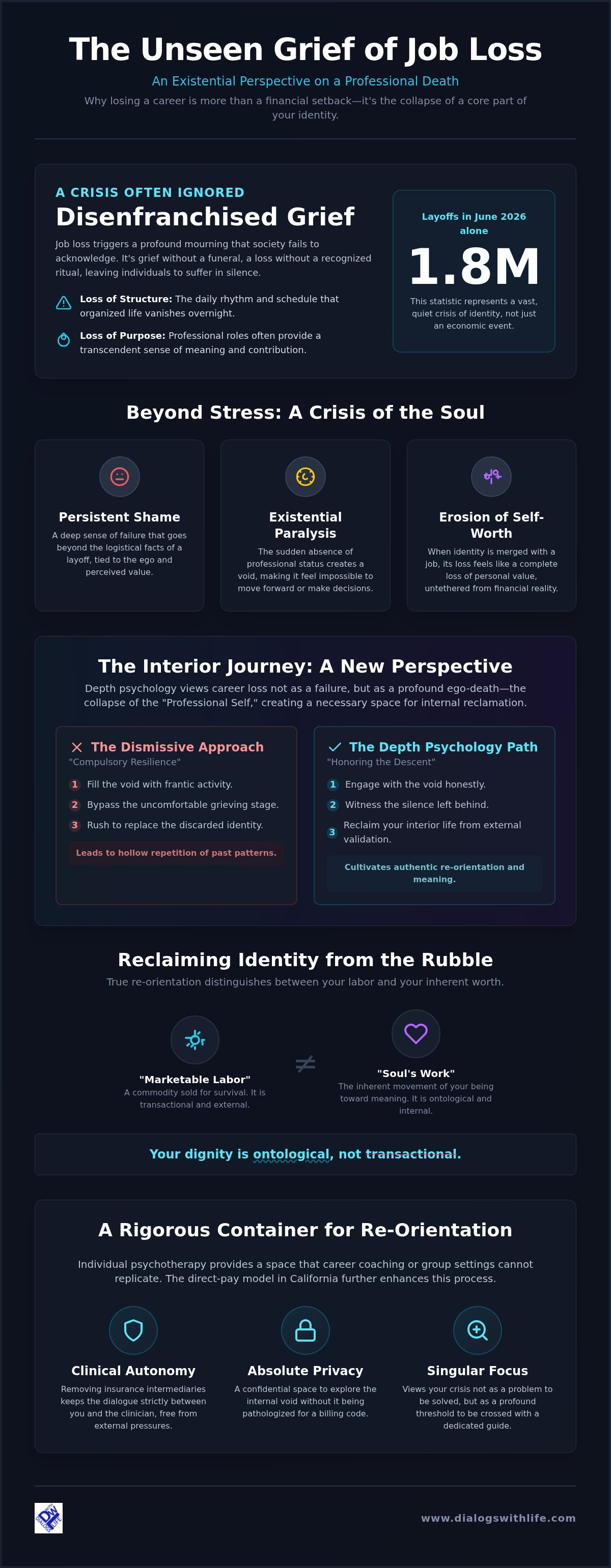
Society frequently reduces job loss to a pecuniary setback, a "stressor" to be mitigated with a revised resume and a veneer of optimism. With **1.8 million layoffs in June 2026 **alone, the scale of this quiet crisis is immense, yet it remains largely misunderstood. When a career structure collapses, the individual enters a state of disenfranchised grief, a profound mourning that remains unacknowledged because no physical body has been buried. Professional roles provide more than a salary; they offer a deliberate time structure and a sense of transcendent purpose. When these vanish overnight, the resulting vacuum isn't just quiet. It's deafening.
The cultural insistence on "compulsory resilience" is psychologically dismissive. It pressures the griever to bypass the liminal space, that uncomfortable threshold between a discarded identity and an unformed future. Entering therapy for job loss grief allows for an honest confrontation with this threshold rather than a frantic, hollow flight from it.
Beyond Stress: When a Career Loss Becomes a Crisis of Soul
In a culture which emphasizes high-achievement, the professional role often merges with the ego-ideal, the internalized image of who we must be to possess value. Engaging in therapy for job loss grief is the difference between repairing a broken tool and witnessing a soul in transition. Depth psychotherapy prioritizes the internal upheaval over external mechanics, identifying symptoms of complicated grief such as:
- Persistent shame that transcends the logistical facts of the layoff.
- Existential paralysis when faced with the sudden absence of professional status.
- Erosion of self-worth that feels entirely untethered from financial reality.
The Interior Journey: A Depth Psychology Perspective on Career Grief
In the wake of a layoff, the psyche undergoes a profound ego-death. The "Professional Self" isn't merely a role we play; it's a psychic architecture we've constructed to house our identity and shield us from existential dread. When this structure collapses, we're left standing in a raw, psychological void. While conventional advice urges us to fill this emptiness with frantic activity, depth psychology facilitates an honest engagement with the void itself. It asks us to witness the silence that remains when the titles and accolades are stripped away.
This process often involves shadow work, a rigorous interrogation of why a specific role held such sovereign power over our self-worth. Was the job a genuine expression of the self, or was it a mask worn to appease a deep-seated fear of insignificance? Engaging in therapy for job loss grief through individual psychotherapy offers a container for these difficult questions, providing a path to reclaim the interior life from the wreckage of external validation. If you're ready to explore these depths, you might consider a free introductory session to see how this work resonates.
Reclaiming Identity from the Rubble of Productivity
True re-orientation requires a distinction between our "marketable labor" and our "soul's work." The former is a commodity sold for survival; the latter is the inherent movement of our being toward meaning. Honoring the "descent," that period of stillness and grief, is vital before attempting a new ascent. Rushing into a job search without this reflection often leads to a hollow repetition of past patterns. By choosing contemplative reflection, we find that meaning persists even in the absence of a professional title. We learn that our dignity is ontological, not transactional.
Finding a Space for Re-Orientation: Individual Therapy in California
Processing the dissolution of a career requires a container that is both private and profound. Individual psychotherapy provides this, offering a singular focus that group settings or career coaching cannot replicate. In California, the direct-pay model distinguishes itself by prioritizing clinical autonomy and absolute privacy. By removing insurance intermediaries, the dialogue remains strictly between the individual and the clinician, ensuring that the exploration of one's internal "void" is never pathologized for a billing code. This independence is crucial for those navigating therapy for job loss grief, as it respects the gravity of the transition without external interference.
Finding the right therapeutic fit is an act of intellectual bravery. It requires a guide who is comfortable with silence and complexity; a philosopher-practitioner who views your crisis not as a problem to be solved, but as a threshold to be crossed. This relationship serves as a witness to your internal restructuring, providing the steady presence needed to face the uncertainty of a professional ego-death.
The Process of Engaging with a Depth Psychologist
Engagement begins with a shift in perspective. You must first identify that your struggle requires deep inquiry rather than just tactical career advice. Once you recognize the need for soul-level work, the next step is scheduling a free introductory session. This meeting isn't a diagnostic intake, but a space to test the resonance between clinician and client. Finally, the work requires committing to a somber, honest exploration of the internal world. There are no quick fixes here; there is only the steady, methodical process of reclaiming meaning from the rubble of a lost career.
Moving Toward a Life Defined by Being, Not Doing
The sudden absence of a career is an invitation to confront the architecture of your identity. You've learned that your grief is a valid response to the death of a professional self; the void left behind is a site for deep, psychological reclamation. By engaging in therapy for job loss grief, you move past the superficial pressure of "bouncing back" to find a dignity that doesn't depend on economic output.
Our California practice specializes in spiritual and depth psychology, utilizing a direct-pay model to ensure your journey remains private and clinically rigorous. This methodical process allows for a somber, honest inquiry into who you are becoming in this liminal space.
Schedule a free introductory session to explore your path through professional loss. You don't have to navigate this transition alone. There is a profound strength in choosing to witness your own evolution with clarity and intellectual bravery.
Frequently Asked Questions
Is it normal to feel like I am grieving a death after losing my job?
Yes, it's a legitimate psychological response often categorized as disenfranchised grief. Because our culture ties identity so closely to productivity, losing a career feels like a form of ego-death. You aren't just losing a paycheck; you're losing the daily structure and the social mirror that reflected your value back to you. Mourning this loss is a necessary part of psychic survival.
How long does job loss grief typically last before I should seek therapy?
There's no standardized timeline for existential mourning, but seeking therapy for job loss grief is advisable preemptively before the "void" begins to feel like a permanent paralysis. If you find yourself experiencing persistent shame or an inability to envision a future outside of your former role, a professional witness can help. Early intervention allows you to process this descent before it hardens into long-term despair.
How does depth psychology differ from standard career counseling for job loss?
While career counseling focuses on tactical mechanics like resume optimization, depth psychology interrogates the internal world. It explores the symbolic meaning of your work and the unconscious attachments you held to your professional title. This approach treats the loss as a profound life transition rather than a logistical problem, aiming for a fundamental re-orientation of the self beyond marketable labor.
Why should I consider a direct-pay therapist in California while I am unemployed?
Choosing a **direct-pay model **in California ensures that your therapeutic journey remains confidential and clinically autonomous. Insurance providers often require a diagnosis of a disorder to justify coverage, which can pathologize a natural, albeit painful, life transition. Direct-pay allows you and your therapist to focus on the depth of your internal experience without the constraints of external administrative oversight or mandatory diagnostic labels.


