

What if the persistent sense of meaninglessness in modern life isn't a pathology to be cured, but a threshold to be crossed? Many individuals find that conventional therapy often fails to hold the weight of their most profound experiences, sometimes dismissing spiritual emergencies as mere clinical anxiety. It's alienating to feel that your soul's deepest inquiries are being reduced to a list of symptoms. This article explores transpersonal psychology as a rigorous framework that honors both the psyche and the spirit. You'll discover a psychological path that transcends the individual ego to address the existential dimensions of your human experience. We will examine how this discipline integrates spiritual insights into daily life, offering a way to move through life transitions that feel far larger than a standard diagnosis. By moving beyond the limitations of the self, we find a more sincere engagement with the world.
Key Takeaways
- Explore the evolution of the "Fourth Force" in psychology and how it moves beyond the individual ego to honor the transcendental dimensions of human existence.
- Examine the clinical grounding of transpersonal psychology and its sophisticated intersection with traditional depth psychology frameworks for a more holistic approach to healing.
- Reframe major life transitions and bereavement as profound thresholds for soul inquiry rather than clinical pathologies to be suppressed or avoided.
- Identify a framework for integrating spiritual insights into a grounded, authentic daily life that respects the weight of both the psyche and the soul.
Defining the Transpersonal: Beyond the Boundaries of the Individual Ego
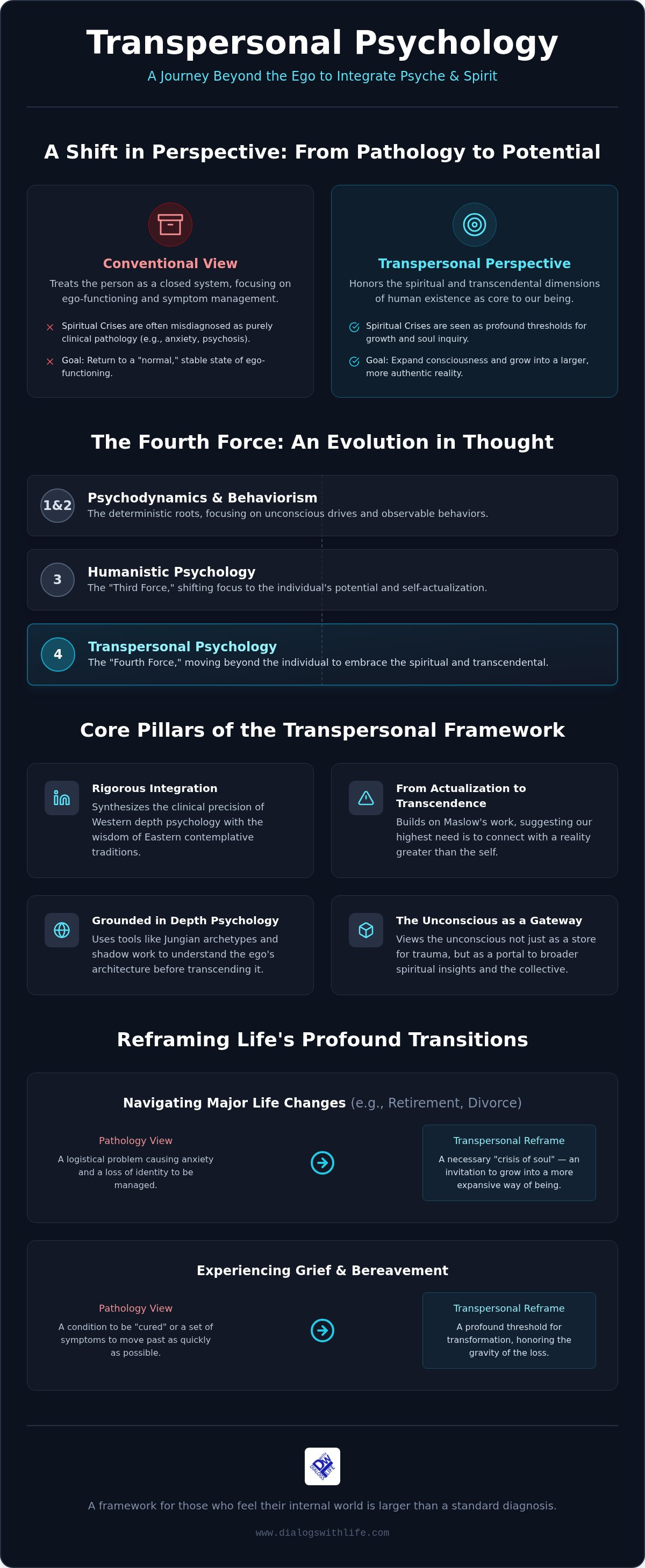
Modern clinical frameworks often stop at the edge of the ego, treating the person as a closed system of drives and cognitive reactions. Transpersonal psychology emerges as a rigorous inquiry into what lies beyond these perceived boundaries. It examines the spiritual and transcendental dimensions of human existence as core facts rather than peripheral anomalies. Often called the "Fourth Force," this discipline represents a significant evolution. It moved through the deterministic roots of psychodynamics and behaviorism, past the individualistic focus of humanism, to finally address the soul's inherent capacity for expansion.
Traditional models frequently define mental health as a stable, "normal" state of ego-functioning. In contrast, the transpersonal perspective seeks to understand expanded states that reach toward the infinite. This distinction is crucial for those who feel their internal world is larger than a standard diagnosis. Without this lens, profound spiritual crises are often misdiagnosed as purely clinical pathology. A "dark night of the soul" or a sudden psychic awakening shouldn't be flattened into a simple depressive episode or a psychotic break; they are often thresholds of growth.
The Core Themes of the Transpersonal Perspective
This framework demands a synthesis of Western clinical rigor and Eastern contemplative traditions. It isn't a rejection of the scientific method, but a widening of its scope to include the subjective weight of the spirit. Abraham Maslow, in his later work, recognized that "self-actualization" was an incomplete peak. He argued for "self-transcendence," suggesting that our highest human need involves connecting to a reality greater than the individual self. In a clinical context, non-ordinary states of consciousness describe shifts in awareness where the typical sense of time, space, and personal identity dissolves into a broader field of being.
The Rigorous Integration of Spirit and Psyche
A common critique suggests that transpersonal psychology lacks empirical weight, drifting instead into the nebulous waters of "New Age" thought. This dismissal ignores the clinical precision required to hold space for the soul's expansion. True transpersonal work isn't an escape from reality; it's a confrontation with it. It requires an intellectual bravery that refuses the anesthetic of superficial comfort. We don't look away from the existential weight of being. Instead, we move through it with eyes open.
In this framework, the unconscious acts as more than a repository for repressed trauma. It's a gateway to broader spiritual insights. By engaging with the depths of the mind, we find that the personal and the universal are inextricably linked. This isn't a passive process. It's a methodical exploration of the internal world that respects the gravity of your experience.
Depth Psychology and the Transpersonal Path
The bridge between the individual and the infinite often begins with depth psychology. Jungian archetypes and the collective unconscious provide a structured map for experiences that otherwise feel chaotic or ungrounded. Before one can transcend the ego, one must first understand its architecture. This includes the vital, often painful process of shadow work. Integrating the disowned parts of the self is a prerequisite for genuine spiritual expansion.
This integration is a rigorous path to self-knowledge, demanding both honesty and endurance. It's about witnessing the difficult aspects of the human condition without flinching. For those seeking a container for this deep work, a free introductory session can clarify if this contemplative approach aligns with your current internal journey.
Transpersonal Psychology in Practice: Navigating Life’s Profound Transitions
Life transitions often strip away the familiar structures of the ego, leaving a person feeling unmoored and hollow. Shifts like retirement or divorce aren't just logistical changes; they represent a fundamental loss of identity. While traditional models might focus on symptom management for the resulting anxiety, transpersonal psychology views these moments as a necessary "crisis of soul." It provides a container where the dismantling of the old self is seen as a prerequisite for a more expansive way of being. This isn't a process of returning to "normal," but an invitation to grow into a larger reality.
In the context of bereavement, this framework is particularly vital. Grief isn't a pathology to be cured, but a profound threshold. Grief and loss counseling through a transpersonal psychology lens honors the gravity of the absence while witnessing the transformation it demands. The therapeutic relationship in California becomes a "dialogue with life" itself, where the practitioner acts as a witness to the patient's internal shifts. We don't offer superficial comfort. We offer a space for serious inquiry into what remains when the external roles we've inhabited fall away.
Applying the Transpersonal to Grief and Transition
Honoring the soul's interior requires a willingness to stay with existential anxiety rather than rushing to fix it. This approach changes how we encounter the void left by loss. For those seeking a depth psychology therapist in California, the work involves integrating these shocks into a coherent, soulful narrative. It's a rigorous path that demands both vulnerability and intellectual bravery. To explore if this contemplative approach matches your current needs, we provide a free introductory session. This allows a sincere assessment of whether our practice can support the weight of your internal world during this time of transition.
Embracing the Threshold of Expansion
Transpersonal psychology offers more than just relief from clinical symptoms; it provides a map for the soul's movement through the unknown. By shifting focus from the narrow constraints of the ego to the expansive field of the spirit, we begin to see our crises as essential dialogues with life. This rigorous path honors the gravity of your experience, ensuring that your most profound transitions are met with sincerity rather than reductionism. It's a commitment to seeing the human condition in its full, complex light.
Choosing to engage with the depths of your psyche is an act of intellectual bravery. In our California-based individual psychotherapy practice, we stand as witnesses to this difficult work, helping you integrate spiritual insights into a grounded, meaningful existence. You don't have to navigate these shadows alone.
Frequently Asked Questions
Is transpersonal psychology considered a legitimate clinical field?
Yes, it's a recognized academic and clinical discipline. It's taught at accredited institutions such as Sofia University and Naropa University, where rigorous research meets contemplative practice. Rather than dismissing spiritual experiences, this field uses phenomenological and qualitative methodologies to study consciousness and human potential with clinical precision. It treats transpersonal psychology as a space for serious inquiry into the spirit.
How does transpersonal therapy differ from traditional talk therapy?
Traditional talk therapy generally aims for ego-integration and symptom management within a materialistic framework. This therapy, however, acknowledges that the human experience includes dimensions that go beyond the personal ego. It addresses peak experiences and existential crises as opportunities for growth. The goal is to facilitate self-transcendence, moving from a narrow focus on individual problems to a broader engagement with existence.
Can transpersonal psychology help with grief and bereavement?
This framework is uniquely suited for bereavement because it doesn't view grief as a problem to be solved. Instead, it sees loss as a profound threshold of the soul. By honoring the interiority of the grieving process, transpersonal psychology helps individuals navigate the existential weight of death. It provides a container for the transformation that occurs when the external world's structures are irrevocably altered.
Do I need to be religious or spiritual to benefit from transpersonal psychology?
You don't need a religious background to find value in this approach. Transpersonal work is rooted in the universal human quest for meaning and the experience of being more than one's daily roles. It appeals to those facing meaninglessness or navigating life transitions that feel larger than clinical anxiety. The focus remains on your subjective experience of depth rather than external dogma.


