

Retirement is often imagined as a destination arrived at: more freedom, fewer demands, and finally the time to live differently.
Yet for many people, retirement feels less like arriving somewhere and more like leaving something behind, even arriving at the precipice of eternity, the undeniable last chapter.
For many people work provided far more than employment, it provided meaning and purpose. Over the years, it may have become woven into identity, relationship, competence, belonging, and the ordinary rhythms by which a life is organized. When that structure disappears, even voluntarily, the resulting freedom may not feel like freedom at all but instead may present as a profound loss.
There may be simultaneously relief and grief; the pleasure of having fewer obligations alongside an unsettling question: Who am I when I am no longer doing what I have done for so long? Who am
At Dialogs with Life, Inc., we look at life transitions such as retirement not as obstacles to be surmounted, but as life passages—periods in which one has had to let go of an established way of living and is seeking to reorient and achieve clarity about how to engage with the next part of one's life journey.
During the course of our life times we go through several jobs, live in many places we call home and experience the coming and going of people in we relate to; through each of these 'going throughs' we consciously or unconsciously develop secure attachments (even ones that are uncertain). They provide us a sense of security. When time itself compels change through age related events like retirement. illness, injury we find our attachments to be less secure. For many this sponsors conscious or unconscious existential-mortal anxiety.
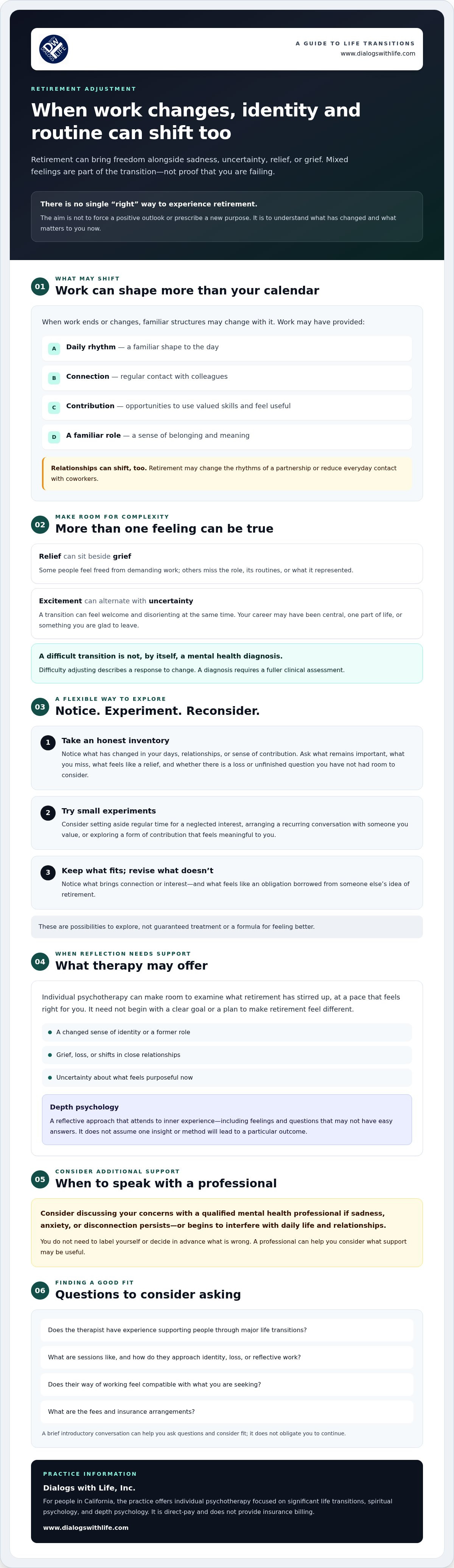
Psychotherapy can provide a secure container in which to collect oneself, reorient and reclaim a sense of security in one's own life and a renewed understanding of oneself.
Rather than immediately replacing the structure of work with another schedule, another set of accomplishments, or a prescribed idea of what retirement ought to look like, therapy can make room for deeper questions: What has in fact been lost? What remains? What parts of oneself were unavailable during your working life which can now be embraced?
From a depth-oriented perspective, these questions do not require immediate answers but rather need to be lived. Sometimes, the practice is to become simply attentive/available to one's inner life—to feelings, memories, longings, disappointments, relationships, and questions of meaning that may become more evident now the past preoccupations of work grow still.
Traditionally people characterize retirement solely as the conclusion of a career, but what if it is instead the genesis of finally 'becoming' who we have been preparing to be through all the iterations of being throughout our lives—one whose meaning cannot be determined in advance.
The task is not to reinvent oneself, but to let go of attachment to all prior identities of *self *and become oneself, the one complete authentic self which has been evolving throughout the entirety of one's life's journey.
It may be time to become curious about the living that remains, available to its teachings and to give oneself permission to live out the final questions..


