

Spiritual Psychotherapy: A Dialog With the Deeper Questions of Life
There are periods in life when the usual language of mental health seems inadequate.
Grief, aging, loss, changes in identity, the ending of relationships, questions of mortality, or simply the persistent feeling that something essential is missing may not fit comfortably into the language of symptoms and diagnoses. At such times, suffering may be asking something of us that cannot be answered simply by making it disappear.
This is where the shift to spiritual psychotherapy can offer a different kind of encounter.
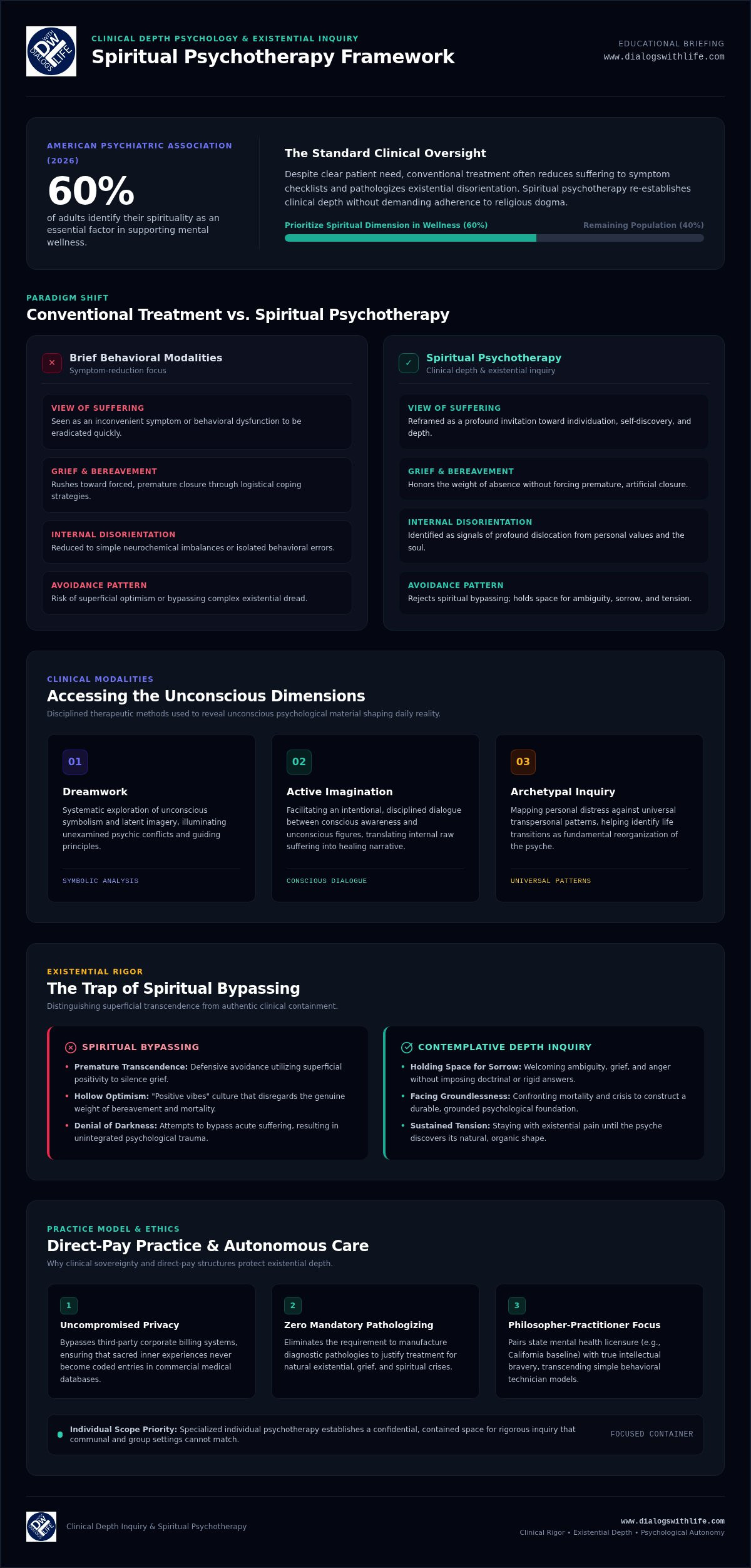
Spiritual psychotherapy is not generally religious psychotherapy (though it can hold space for an individual's belief practices). It does not require a deistic orientation, adherence to a spiritual tradition, or acceptance of a particular philosophy. Rather, it recognizes that human beings inevitably confront questions of meaning within a frame that is uniquely inscribed by their own life experiences: Who am I? What has shaped me? What matters now? How do I live with what cannot be changed?
These are psychological questions, but they are also deeply human ones.
Beyond Symptom Reduction
Much contemporary psychotherapy understandably focuses on reducing symptoms. Anxiety interferes with life, so we seek to lessen anxiety. Depression diminishes engagement, so treatment attempts to restore functioning. These approaches can be useful and, at times, necessary.
But there is another possibility.
What if distress is not always simply an intruder to be eliminated? What if some forms of anxiety, grief, loneliness, or disorientation contain critical information about how we are living, and real choices available to us?
Depth-oriented psychotherapy approaches suffering with curiosity rather than immediately declaring war upon it.
Instead of asking only, How do we make this feeling stop? we might also ask:
What is this experience telling us or conversely not telling us?
This shift is subtle but important. It changes psychotherapy from a process concerned exclusively with correction/fixing into a dialog with one’s own life.
Dreams, memories, recurring patterns, relationships, imagination, values, and even contradictions can become material for exploration. The objective is not to impose meaning upon experience but to become more attentive to meanings that may already be emerging.
Grief and the Refusal to Rush
Grief provides perhaps the clearest example.
Often clinicians and healthcare institutions speak about grief as though it were a journey with a destination. There is an implicit expectation that eventually we will achieve “closure” and resume ordinary life.
But profound loss rarely behaves so conveniently, nor should it and the notion of 'resuming ordinary life' is also presumptuous and I would argue disassociated from reality as we actually experience it.
When someone or something central to our existence disappears, we do not merely lose an external presence. We may lose part of the structure through which we understood ourselves.
The question then becomes less How do I get over this? and more Who am I now that this has happened?
Spiritual psychotherapy makes room for that question without insisting upon an immediate answer.
There is value in learning to remain with uncertainty. Sorrow does not always need to be transformed quickly into gratitude, wisdom, or personal growth. Sometimes grief needs first to be recognized as grief.
Within the compilation "Letters to a Young Poet", Rainer Maria Rilke encourages,
"I would like to beg you, as well as I can, to have patience with everything unresolved in your heart and to try to love the questions themselves as if they were locked rooms or books written in a very foreign language. Don’t search for the answers, which could not be given to you now, because you would not be able to live them. And the point is, to live everything. Live the questions now. Perhaps then, someday far in the future, you will gradually, without even noticing it, live your way into the answer. "
Not living the question is also where spiritual bypassing can become problematic. At times we can be at risk of employing Spiritual ideas to romanticize our experiences, and contextualize them in such a manner to, in effect, gaslight ourselves into moving around suffering rather than through it. Optimism, transcendence, forgiveness, or statements that “everything happens for a reason” may become ways of negating, even subtly discrediting experiences that are difficult to tolerate.
Depth work asks something different: that we remain present and in relationship with what we are actually experiencing.
The Therapist as Companion Rather Than Authority
The spiritual psychotherapist is not an oracle and nor an authority on the meaning of another person's life.
The therapist’s task is that of an attentive companion: someone capable of remaining present while difficult questions are explored without presuming answers that prematurely seem to resolve them.
This requires a particular kind of therapeutic relationship.
The therapist must be able to tolerate ambiguity, contradiction, silence, sorrow, anger, and uncertainty. The work is not about supplying philosophical answers that act as a refuge from discomfort but rather it is about securing a therapeutic environment in which a person can dialog with his or her own questions more honestly.
A useful therapist should therefore be able to hold space with their client, without presuming to know where their dialog will lead.
There is value in such uncertainty: sometimes it is precisely in this space where the work of psychotherapy begins.
A Dialog With Life
At Dialogs with Life, psychotherapy is approached as an active conversation between the individual and their being alive.
Our histories, families, loves, disappointments, bodies, cultures, losses, and hopes, none of these alone or in sum determine who we are to become; through the psychotherapeutic dialog we are invited to examine our inheritance.
The invitation is to develop a more conscious, deliberate, and intentional dialog with one's life—and perhaps a greater capacity to live within the complexity of being human.
Spiritual psychotherapy, understood this way, does not promise transcendence from ordinary life, but a deeper encounter with it.
There may be no final answer to the questions of meaning, grief, identity, love, mortality, or belonging, but there can be greater fluency in relationship to those questions.
The willingness to remain in dialog with life—without demanding an immediate conclusion—is itself part of the work.


