

What if an ancient philosophy could help us face modern anxiety, grief, and uncertainty more clearly? Stoicism and psychotherapy share a central concern: how to live meaningfully when much of life remains beyond our control.
Rather than eliminating suffering, Stoicism offers a disciplined way to distinguish what we can influence from what we cannot. Combined with depth psychotherapy, it provides a framework for resilience, self-examination, and meaningful engagement with life's difficulties.
Key Takeaways
- Distinguish what is within your control from what is not.
- Use Stoic principles as more than cognitive techniques—they can support deeper psychological inquiry.
- Recognize grief and emotional reactions as natural rather than failures of self-control.
- Cultivate attention, reflection, and psychological agency amid uncertainty.
Stoicism and Psychotherapy: Ancient Roots of Modern Healing
Epictetus described the philosopher's lecture room as a hospital for the soul. This tradition of cura animarum, or care of the soul, understood philosophy as a practical discipline for living.
Today, Stoicism and psychotherapy can serve a similar purpose. Both examine how our judgments shape our experience and how we might respond more deliberately to circumstances we cannot control.
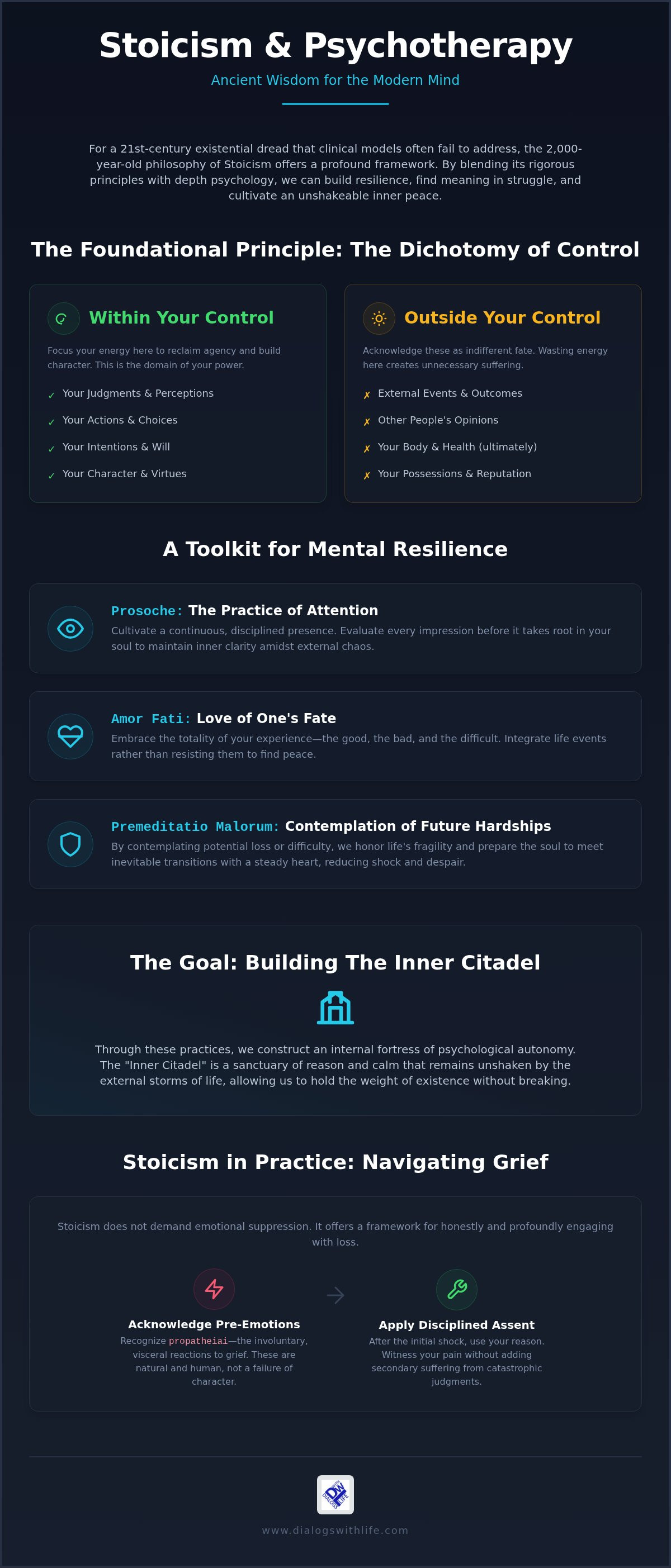
The Dichotomy of Control
Central to Stoic philosophy is the distinction between prohairesis—our capacity for choice—and events outside our control.
Much unnecessary suffering arises from trying to control outcomes, other people, or circumstances that are not ours to determine. Acceptance does not mean passivity. It means directing our energy toward what remains ours: judgment, choice, conduct, and character.
We may not control a loss, career disruption, relationship change, or uncertain future. We can determine how we meet it.
Beyond Cognition: Stoicism and Depth Psychology
Stoicism is sometimes reduced to a technique for changing thoughts. Its original practice was broader.
Prosoche, or continuous attention, involves observing impressions before automatically accepting them as truth. This practice complements individual psychotherapy, where attention moves beyond symptoms toward the deeper patterns shaping psychological life.
Marcus Aurelius's metaphor of the "Inner Citadel" captures this psychological autonomy: an interior position from which we can encounter external turmoil without being entirely governed by it.
Amor Fati and the Shadow
Amor Fati—the love of one's fate—does not require pretending that painful experiences are desirable. It asks whether we can incorporate what has happened into the larger reality of our lives.
Within Stoicism and psychotherapy, this can mean examining difficult experiences and unwanted aspects of ourselves rather than simply trying to eliminate them.
Stoic self-examination and depth psychology converge here: both ask us to encounter ourselves with greater clarity and less reflexive judgment. A philosopher-practitioner approach can provide a setting for this deeper inquiry.
Grief and Life Transitions
Stoicism is often mistaken for emotional detachment. The Stoics themselves recognized propatheiai—involuntary emotional reactions that occur before conscious judgment.
Grief is therefore not a failure of Stoic discipline. Mourning acknowledges both attachment and mortality.
The practice of Premeditatio Malorum, or contemplating possible loss, was intended not to invite tragedy but to remind us of life's impermanence. Awareness of mortality can deepen our appreciation of relationships precisely because they cannot be guaranteed.
Integrating Philosophy and Psychotherapy
Major losses and identity transitions often raise questions that cannot be reduced to symptom management: Who am I now? What remains within my control? How do I live with what cannot be changed?
The Dialogs with Life, Inc. approach uses individual psychotherapy to explore these questions through depth psychology and philosophical inquiry.
For people in California seeking this kind of work, an introductory conversation can help determine whether the approach is a good therapeutic fit.
Reclaiming Agency
Stoicism and psychotherapy meet at a simple but demanding question: How do we live well within circumstances we cannot fully control?
The dichotomy of control clarifies where our agency begins and ends. Depth psychology helps us examine the less conscious forces influencing how we exercise that agency.
Neither requires escaping grief or uncertainty. The task is to encounter them with greater awareness, integrity, and psychological freedom.
Frequently Asked Questions
Is Stoicism in psychotherapy about suppressing feelings?
No. Stoicism recognizes that immediate emotional reactions are natural. The practice focuses on examining the judgments and actions that follow those reactions rather than denying emotion itself.
How does Stoicism differ from Cognitive Behavioral Therapy (CBT)?
Stoicism influenced some ideas associated with modern cognitive therapies, but it is a broader philosophy of life. In a depth-oriented approach, Stoic ideas can become part of a wider inquiry into meaning, character, mortality, identity, and psychological life.
Can Stoic principles help with grief or sudden loss?
Stoic principles can provide a framework for distinguishing between what cannot be changed and what remains within one's agency. They do not eliminate grief; they offer a way to remain psychologically grounded while mourning.
What can depth psychology offer during life transitions?
Depth psychology examines not only immediate symptoms but also questions of identity, meaning, unconscious patterns, and psychological development. During major transitions, this can create space to understand what the change means within the larger course of a person's life.


