

I recast the piece around a more relational philosophy: grief as a human response that deserves companionship rather than correction; therapy as dialogue rather than expert-driven treatment; and Jungian ideas as invitations to exploration, not doctrines imposed upon the mourner.
Jung & Grief: Living in Dialog With Loss
What if the ache that follows a loss is not simply a symptom to eliminate, but an experience asking to be heard?
Grief can unsettle our identity, our relationships, and the assumptions that once made life feel coherent. Although counseling may help relieve the anxiety, depression, or disorientation accompanying a loss, grief itself is not necessarily evidence that something has gone wrong within us. It is often the natural response of a person whose world has been profoundly changed.
Jungian therapy approaches grief with curiosity rather than a timetable. It does not ask only, “How can this pain be reduced?” It also asks, “What is this loss asking of you now?” Through honest conversation, dreams, memories, images, and reflection, therapy can provide a place to encounter grief without reducing it to a diagnosis or forcing it toward a predetermined conclusion.
The aim is not to turn tragedy into something positive. Nor is it to “get over” the person or life that has been lost. It is to discover how the loss may be carried—and how life might gradually be lived in relationship with what can no longer be restored.
Key Takeaways
- Grief is not a predictable sequence or a problem that can be solved according to a fixed schedule.
- Jungian therapy attends to dreams, images, memories, contradictions, and the symbolic dimensions of loss.
- The therapist does not assign meaning to grief but joins the client in discovering what the experience means within that person’s life.
- Healing does not require forgetting or “moving on.” It may mean developing a new relationship with memory, absence, and continuing life.
- A direct-pay practice can allow the therapeutic process to follow the needs and natural pace of the individual rather than the timetable of an insurer.
The Jungian Perspective: Grief as a Transformation of the Inner World
When someone important dies—or when a relationship, identity, home, ability, or hoped-for future is lost—we lose more than an external presence. We may also lose a familiar way of knowing ourselves.
The person who existed before the loss cannot always return unchanged. Roles shift. Relationships are reorganized. Assumptions about fairness, safety, faith, and the future may no longer hold. Even ordinary routines can feel strangely unfamiliar.
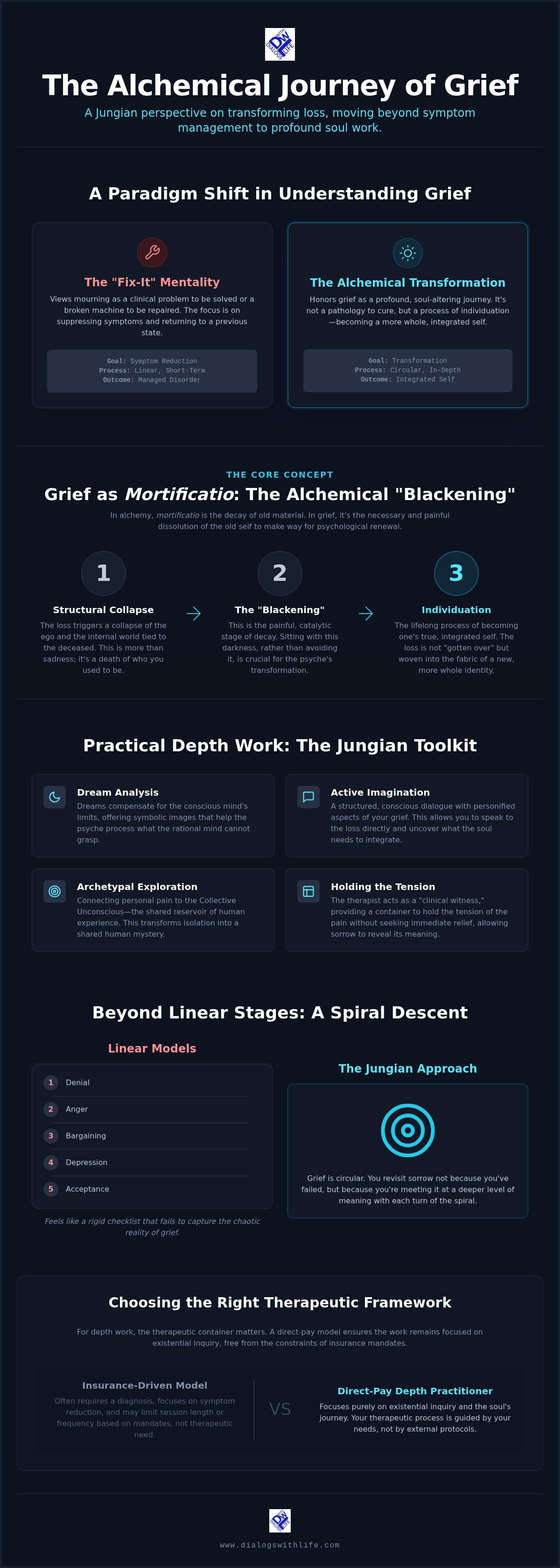
From a Jungian perspective, this disruption is not automatically pathological. It may represent a deep movement within the psyche: the painful dissolution of an identity that can no longer contain the reality of what has happened.
Alchemy used the word mortificatio to describe a stage of darkening, decomposition, and the breaking down of an old form. As a metaphor for grief, it can help us understand why mourning sometimes feels like a descent into darkness. Something has ended, yet what comes next cannot be known or hurried into existence.
This metaphor should not be used to romanticize suffering or suggest that every loss produces personal growth. Some losses remain tragic. Some questions remain unanswered. Transformation, when it occurs, does not justify what happened. It simply describes the human capacity to continue becoming, even in the presence of what cannot be repaired.
Beyond the Stages: Grief Does Not Move in a Straight Line
Popular descriptions of grief are often presented as stages. These models can offer language for certain experiences, but they can become burdensome when treated as instructions. A grieving person may begin to wonder whether they are mourning correctly, progressing quickly enough, or failing because sorrow has returned.
Actual grief is rarely linear. It may recede and then reappear through an anniversary, a familiar song, a new relationship, a family gathering, or an ordinary moment when the absence becomes newly real. Its return does not necessarily mean that healing has failed.
Grief may be more faithfully understood as a continuing dialogue. As life changes, the meaning of the loss may change with it. We do not encounter the same grief at thirty, fifty, and seventy. Each stage of life may bring us into a different relationship with what—and whom—we have lost.
Depth therapy makes room for this movement. It does not require grief to follow a map. It listens for the particular shape that mourning takes in an individual life.
Personal Loss and the Larger Human Story
Grief is deeply personal, but it is also among the oldest human experiences. Stories of exile, descent, death, separation, remembrance, and return appear across cultures because human beings have always needed ways to approach what reason alone cannot resolve.
During bereavement, these larger patterns may appear in dreams, religious images, myths, memories, or unexpected associations. A person might dream of an abandoned house, a dark forest, an ocean crossing, or a conversation with someone who has died. Such images need not have one universal interpretation. Their meaning emerges through careful attention to the dreamer’s own history and associations.
Jung referred to recurring patterns in human imagination as archetypal. Archetypal language can sometimes connect private suffering with the broader human story, helping a person feel less isolated. Yet the personal experience remains primary. The therapist’s role is not to impose a myth upon the mourner, but to wonder alongside them about the images through which their inner life is speaking.
How Jungian Therapy Approaches Bereavement
Jungian therapy begins with relationship. The therapist offers a steady presence in which grief can be spoken without being hurried, corrected, or made more acceptable to others.
This does not mean that the therapist remains distant or merely observes. Therapy is a genuine encounter between two people. Together, therapist and client attend to what has been lost, what has been disrupted, what remains unsaid, and what may slowly be coming into view.
At times, the work may focus on immediate realities: sleeping, functioning, maintaining relationships, or enduring waves of emotion. At other times, it may explore questions that do not have simple answers:
- Who am I now?
- What remains of my relationship with the person who died?
- What happens to love when its familiar form is gone?
- How has this loss changed my understanding of life?
- What do I owe the person I was before this happened?
- How do I continue without betraying what mattered?
These are not problems for a therapist to solve on the client’s behalf. They are questions to be lived with until an answer—or a different way of holding the question—begins to emerge.
Dreams, Images, and the Language of Grief
Grief is not experienced only through thought. It may appear in the body, in dreams, in sudden memories, in repeated images, or in feelings for which ordinary language seems inadequate.
Dreams can offer another way of approaching the experience. A dream about someone who has died may be comforting, disturbing, confusing, or all three at once. Rather than assigning it a fixed symbolic meaning, Jungian therapy explores the dreamer’s emotional response and personal associations.
Active imagination may also be used when appropriate. This practice involves giving sustained attention to an image, feeling, memory, or inner figure and allowing a dialogue to develop. It is not an attempt to escape reality or pretend that a loss has not occurred. It is a way of listening to dimensions of experience that may not yet be available through rational explanation alone.
Dream work is not required. A person who rarely remembers dreams can still engage deeply through memories, relationships, creative expression, bodily experience, spiritual questions, or the emotions arising in the therapeutic relationship.
Grief and the Question of Identity
A significant loss often changes more than our circumstances. It may alter the answer to the question, “Who am I?”
A spouse becomes a widow or widower. A parent loses a child. A person leaves a long-held career, receives a life-changing diagnosis, loses a home, or recognizes that a hoped-for future will not occur. Even when no public name exists for the loss, the internal change may be profound.
The pressure to “return to normal” can feel alienating because the old normal may no longer exist. Therapy can provide a place to acknowledge this without prematurely constructing a new identity.
The question is not simply how to rebuild the old self from the wreckage. It may be how to live truthfully as the person who now exists—someone shaped by love, absence, memory, contradiction, and ongoing possibility.
Finding a Jungian Therapist for Grief in California
Finding the right therapist is not simply a matter of locating someone with the correct terminology on a website. Training and experience matter, but so does the quality of the encounter.
A useful introductory conversation may help you consider:
- Do I feel listened to rather than interpreted too quickly?
- Can this therapist tolerate uncertainty and strong emotion?
- Is there room for my spiritual beliefs, doubts, or lack of belief?
- Does the therapist regard grief as an individual experience rather than a standardized process?
- Can practical concerns and deeper existential questions both be addressed?
- Does this relationship feel sufficiently trustworthy for honest work?
No therapeutic relationship is immediately free of discomfort. Depth therapy may involve difficult feelings and challenging questions. Still, there should be a growing sense that your experience is being met with respect rather than fitted into someone else’s theory.
The Value of a Direct-Pay Therapeutic Relationship
Dialogs with Life operates as a direct-pay practice. This structure allows the work to be guided primarily by the needs of the client and the therapeutic relationship.
Insurance-based care can be valuable and necessary for many people. At the same time, insurers commonly require a diagnosis, documentation of medical necessity, and treatment organized around defined symptoms and goals. A direct-pay arrangement can create greater freedom to explore grief as a relational, spiritual, and existential experience—not only as a collection of symptoms.
This does not make the work less clinically grounded. It means that diagnosis does not have to become the whole story of the person seeking help. The pace and direction of therapy can be considered collaboratively, with attention to both emotional suffering and the larger questions the loss has brought into view.
Beginning With an Introductory Conversation
The free introductory session is an opportunity for us to meet and consider whether working together feels appropriate.
You do not need to arrive with a polished explanation of your grief. You may bring uncertainty, anger, numbness, dreams, memories, spiritual questions, or simply the knowledge that life no longer feels as it once did.
The purpose of this first conversation is not to diagnose you or persuade you to begin therapy. It is to experience how we speak together, ask questions about the work, and consider whether this relationship might offer a useful place for your grief.
Living With Loss
Grief is not a task to complete. It is a changing relationship with what has been lost.
Over time, sorrow may become less consuming, but this does not mean the lost person or former life becomes unimportant. The continuing bond may take another form. Memory may become less like an interruption and more like a presence woven into ongoing life.
Jungian therapy does not promise that every loss will reveal a hidden purpose. It offers something quieter: a sustained dialogue in which suffering does not have to be disguised, explained away, or endured alone.
Within that dialogue, grief may gradually become more bearable—not because it has been defeated, but because there is more room around it. A life altered by loss may still hold relationship, imagination, meaning, and unexpected possibility.
Schedule a Free Introductory Session
You do not have to know where grief is leading before beginning to speak about it.
If you are a California resident and would like to explore whether depth-oriented therapy may be right for you, I invite you to schedule a free introductory conversation.
A dialogue with life can begin wherever you are.
Frequently Asked Questions
How is Jungian therapy different from standard grief counseling?
The difference is often one of emphasis rather than opposition. Many forms of grief counseling provide compassionate and valuable support. Jungian therapy adds particular attention to dreams, images, identity, relationship, spirituality, and the unconscious dimensions of experience.
It is concerned not only with reducing distress, but with understanding how the loss is affecting the whole person and the way that person encounters life.
Must I remember my dreams to benefit from Jungian therapy?
No. Dreams can be meaningful, but they are only one doorway into depth work. Therapy may also attend to memories, emotions, recurring relationship patterns, bodily experience, creative expression, spiritual questions, and what develops between client and therapist.
The work begins with your lived experience, not with a requirement to produce particular material.
Why does Dialogs with Life operate as a direct-pay practice?
The direct-pay model gives us greater freedom to shape therapy around your particular needs rather than an insurer’s diagnostic and administrative requirements. It allows grief to be approached as a deeply human, relational, and existential experience while still attending carefully to clinical concerns.
It also makes the financial arrangement clear and direct between client and therapist. Questions about fees, documentation, and possible out-of-network reimbursement can be discussed during the introductory conversation.
Can Jungian therapy help when grief remains intense for a long time?
There is no universal timetable for mourning. Long-lasting grief does not by itself mean that a person has failed or refused to heal.
When grief continues to cause severe distress or substantially interferes with daily life, careful clinical attention is important. Jungian therapy can address that suffering while also exploring the relationship, identity, and meaning bound up with the loss. When additional forms of care would be helpful, those possibilities can be considered collaboratively.
The purpose is not to take the lost person away from you. It is to help you find a way to remain connected to what mattered while continuing to participate in your own life.


