

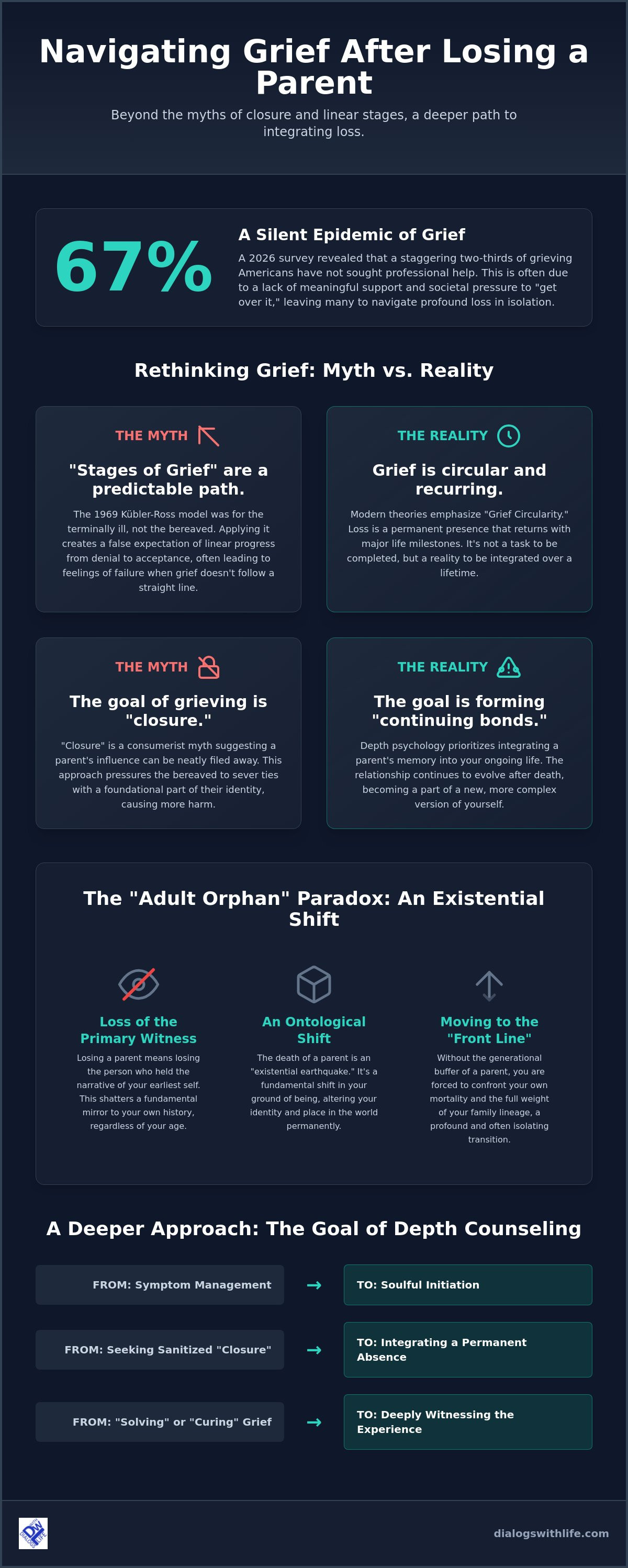
Society often frames the death of a parent as a predictable milestone of adulthood, yet for those left behind, it feels like the sudden, quiet collapse of the world's primary architecture. You might find yourself grappling with the heavy identity of an "adult orphan," a term that captures the isolation you feel when the people who knew your beginning are gone. If you've sought grief counseling for loss of parent, you may have been met with superficial platitudes or pressure to "get over it," despite the fact that a 2026 survey revealed 67% of grieving Americans haven't sought professional help, often due to a lack of meaningful support.
It's exhausting to perform recovery for a world that's uncomfortable with your silence. We'll explore why your grief isn't a temporary sickness to be cured, but a permanent expansion of your soul that requires a more rigorous, depth-oriented approach. By deconstructing common myths and looking through the lens of depth psychology, we'll provide a framework for integrating this loss into a larger, more complex version of yourself. You'll learn how to find a practitioner who respects the weight of your experience and understands that some things aren't meant to be "solved," but rather deeply witnessed.
Key Takeaways
- Understand why the 1969 "stages of grief" model is often misapplied to bereavement and how the concept of grief circularity honors your actual experience.
- Examine the specific existential weight of the "adult orphan" and why the loss of a parental witness remains significant regardless of your age.
- Discover how depth-oriented grief counseling for loss of parent facilitates the integration of a permanent absence rather than seeking a sanitized, final closure.
- Learn to view the loss of a parent as a soulful initiation, moving from mere symptom management toward a deeper engagement with the archetypal self.
The Myth of Linear Progress: Why "Stages of Grief" Fail the Bereaved
The 1969 Kübler-Ross model was never intended to be a roadmap for the bereaved. It was designed to describe the psychological process of the terminally ill facing their own mortality, not the complex aftermath of losing a parent. When you seek grief counseling for loss of parent, you may feel a sense of failure because your experience doesn't move in a straight line from denial to acceptance. Instead, we must recognize Grief Circularity. This is the reality that loss isn't a task to be completed but a presence that returns with every major life milestone. Modern grief theories emphasize this non-linear nature, moving away from rigid, stage-based expectations.
Complicated grief is best understood as a natural, profound response to a complex or unresolved relationship rather than a clinical pathology to be medicated away. The cultural pressure to reach a "final stage" often creates a secondary layer of shame for those still in the depths of mourning. You aren't grieving wrong; you're simply existing in a world that lacks the vocabulary for your depth.
The Problem with "Closure"
The concept of "closure" is a modern, consumerist myth. It suggests that a person is a project that can be finished, or that a parent's influence can be neatly filed away. Depth psychology prioritizes "continuing bonds" over closure. This approach acknowledges that your relationship with your parent continues to evolve even after their death. You're integrating their memory into your ongoing life, not cutting them out of it.
Grief as an Ontological Shift
The death of a parent represents a fundamental shift in your "ground of being." It is an existential earthquake that moves you to the "front line" of your family lineage. Without the generational buffer of a parent, you're forced to confront your own mortality and the weight of your heritage. This shift requires specialized grief counseling for loss of parent to navigate the profound transformation of your identity and your place in the world.
The "Adult Orphan" Paradox: Confronting the Myth of Total Recovery
Becoming an "adult orphan" carries a weight that society rarely acknowledges. Regardless of your age, the death of a parent signifies the loss of the primary witness to your childhood. They were the ones who held the narrative of your earliest self. When they vanish, that mirror is shattered. When navigating grief counseling for loss of parent, one must address this ontological void. There is a persistent, damaging myth that older adults should be better prepared for this transition. However, chronological maturity doesn't insulate the soul from the profound disorientation of losing a foundation. While models like The Four Phases of Grief offer more nuance than rigid stages, they still struggle to capture the existential reality of the internalized parent. Through dreams and the unconscious, the relationship continues, demanding a form of Individual Psychotherapy: A Rigorous Path to Self-Knowledge and Healing that focuses on reclamation rather than just recovery.
When the Relationship was Fraught
Grief isn't reserved for the "good" parent. In fact, those with fraught or complicated histories often experience a more agonizing mourning process. The absence of the person makes it impossible to resolve conflict in the physical world, leaving a residue of unsaid words. Specialized grief counseling for loss of parent allows for these dialogues to continue in the therapeutic space. We use depth therapy to engage with the archetypal father or mother within, seeking the resolution that life failed to provide. This process transforms a haunting into a meaningful presence that no longer requires the physical person to be present.
The Silence of Society
Our culture treats grief as a logistical inconvenience. The standard "three days of bereavement leave" is a hollow gesture that pathologizes long-term sorrow. While states like California and Oregon have begun mandating leave as of 2026, there is still no federal law providing this basic protection. This systemic silence forces the bereaved to perform a "normalcy" that feels like a lie. Individual psychotherapy offers the rigorous, unhurried space that the modern world denies you. It's a place where your sorrow is not a symptom to be managed, but a truth to be honored. If you're seeking a clinician who can sit with the weight of this transition, a free introductory session can help determine if our intellectual and emotional registers align.
Beyond Symptom Management: Moving Toward Meaning, Not Closure
While many clinical models focus on reducing anxiety or depression, depth psychology views the loss of a parent as a soulful initiation. It isn't a set of symptoms to be excised. Instead, it's an invitation to engage with the archetypal Mother or Father that resides within your own psyche. This perspective transforms the void into a landscape for exploration. By utilizing a direct-pay model in California, we maintain the clinical autonomy necessary to pursue this depth, avoiding the insurance-driven pressure for "quick fixes" that rarely honor the gravity of grieving the death of a parent. Effective grief counseling for loss of parent isn't a lecture; it's a dialogue between the grieving soul and an attentive, expert witness.
This approach moves away from the sanitized goals of modern mental health. We don't seek to return you to a "pre-loss" state, as that person no longer exists. We aim for integration. True healing occurs when you can carry the absence without being crushed by it, allowing the loss to become a permanent, meaningful expansion of your internal world. It's a slow, methodical process that respects the weight of your history.
Engaging with the Absence
We move beyond passive mourning by actively engaging with the memory. Techniques like active imagination or structured journaling allow you to translate the somber weight of your sorrow into a source of inner strength. This isn't about finding a way to stop missing them. It's about learning to inhabit the silence they left behind. Through this work, the "internalized parent" becomes a guide rather than a ghost, providing a sense of continuity that closure could never offer.
Seeking a Philosopher-Practitioner
When searching for grief counseling for loss of parent, look for a clinician who acts as a philosopher-practitioner. You need someone who can withstand your silence and hold space for the existential dread that often follows parental loss. Intellectual bravery is just as important as clinical expertise in this work. This is why we offer a free introductory session. It's a vital opportunity to test the therapeutic fit and ensure your guide is capable of sitting with the profound complexities of your internal world.
Integrating the Absence into a New Ground of Being
The existential shift following a parent's death doesn't culminate in a tidy sense of closure. It's a permanent expansion of the soul that requires you to integrate a profound absence into your ongoing identity. By rejecting the myth of linear progress and acknowledging the unique weight of the adult orphan, you move toward a more honest engagement with your internal world. This work isn't about returning to a pre-loss state. It's about discovering who you are now that the primary architecture of your life has changed. Integrating this loss is a methodical process of meaning-making rather than a simple act of moving on.
When seeking grief counseling for loss of parent, it's essential to find a guide who respects the gravity of your experience. If you're seeking a space for rigorous, contemplative engagement with your loss, schedule a free introductory session with Dialogs with Life. Our California-based direct-pay practice prioritizes clinical depth and autonomy, specializing in individual psychotherapy rooted in spiritual and depth psychology. This approach ensures your mourning is treated not as a pathology to be cured, but as a meaningful initiation into a deeper layer of the human experience. You don't have to carry the heavy silence of this transition alone.
Frequently Asked Questions
Is it normal to still be grieving the loss of my parent years later?
It's entirely normal to experience grief years after a parent's death because loss is an ongoing dialogue rather than a task to be completed. The concept of grief circularity suggests you'll revisit the absence at every significant life milestone. This isn't a sign of pathological "stuckness" but a testament to the depth of the original attachment. Your grief is a permanent expansion of your soul, not a sickness that eventually clears.
How is depth psychology different from standard grief counseling?
Depth psychology differs from standard models by prioritizing meaning-making over simple symptom reduction. While many forms of grief counseling for loss of parent focus on coping skills to manage anxiety, depth work engages with the unconscious and the archetypal images of the Mother or Father within. It seeks to integrate the loss into the soul's architecture rather than attempting to return the individual to a sanitized, pre-loss state.
What if I had a difficult or abusive relationship with the parent who died?
Grieving a difficult or abusive parent is often more complex because the death solidifies the relationship's unresolved nature. You aren't just mourning the person who was, but also the parent they failed to be. Depth therapy provides a rigorous space to address these unsaid dialogues. It allows you to resolve the internal conflict even when the physical person is no longer present to participate in the reconciliation.
Why does the death of a parent feel like a loss of my own identity?
The death of a parent feels like a loss of identity because they served as the primary witnesses to your existence from its inception. When they die, the mirror that held the narrative of your childhood is shattered, forcing a fundamental ontological shift. You're moved to the front line of your lineage. This requires a profound re-evaluation of who you are without their gaze to define your history.


