

What if the paralyzing dread that keeps you awake at 3:00 AM isn't a pathology to be cured, but a profound summons to be answered? For many, the sudden realization of our own finitude feels like a weight that modern life is ill-equipped to carry. You might feel isolated in these concerns, finding that standard clinical fixes often ignore the soul's deeper requirements. Seeking therapy for mortality anxiety is not an admission of weakness; it's an act of intellectual bravery. It's a choice to stop flinching at the inevitable and instead engage with the gravity of existence.
You likely believe that the weight of your own end should be met with more than just coping skills. We agree that a meaningful life requires a rigorous engagement with its limits. This article explores how depth psychology transforms the fear of the end into a catalyst for an authentic life. We will examine the process of integrating mortality into your personal narrative, moving toward a state where intrusive dread is replaced by a steady, grounded presence. By looking directly at the finality of our days, we find the clarity needed to live them with intention.
Key Takeaways
- Distinguish between clinical thanatophobia and the ontological dread that serves as a fundamental, unavoidable limit-condition of our human experience.
- Discover how therapy for mortality anxiety utilizes our inherent finitude as a rigorous catalyst for clarifying personal values and cultivating an authentic life.
- Contrast sanitized, symptom-focused interventions with the contemplative depth of spiritual psychology, which honors the soul's need for meaning over mere stabilization.
- Understand how a direct-pay model in California ensures your therapeutic space remains focused on existential depth rather than administrative diagnostic requirements.
What is Mortality Anxiety? Beyond Clinical Thanatophobia
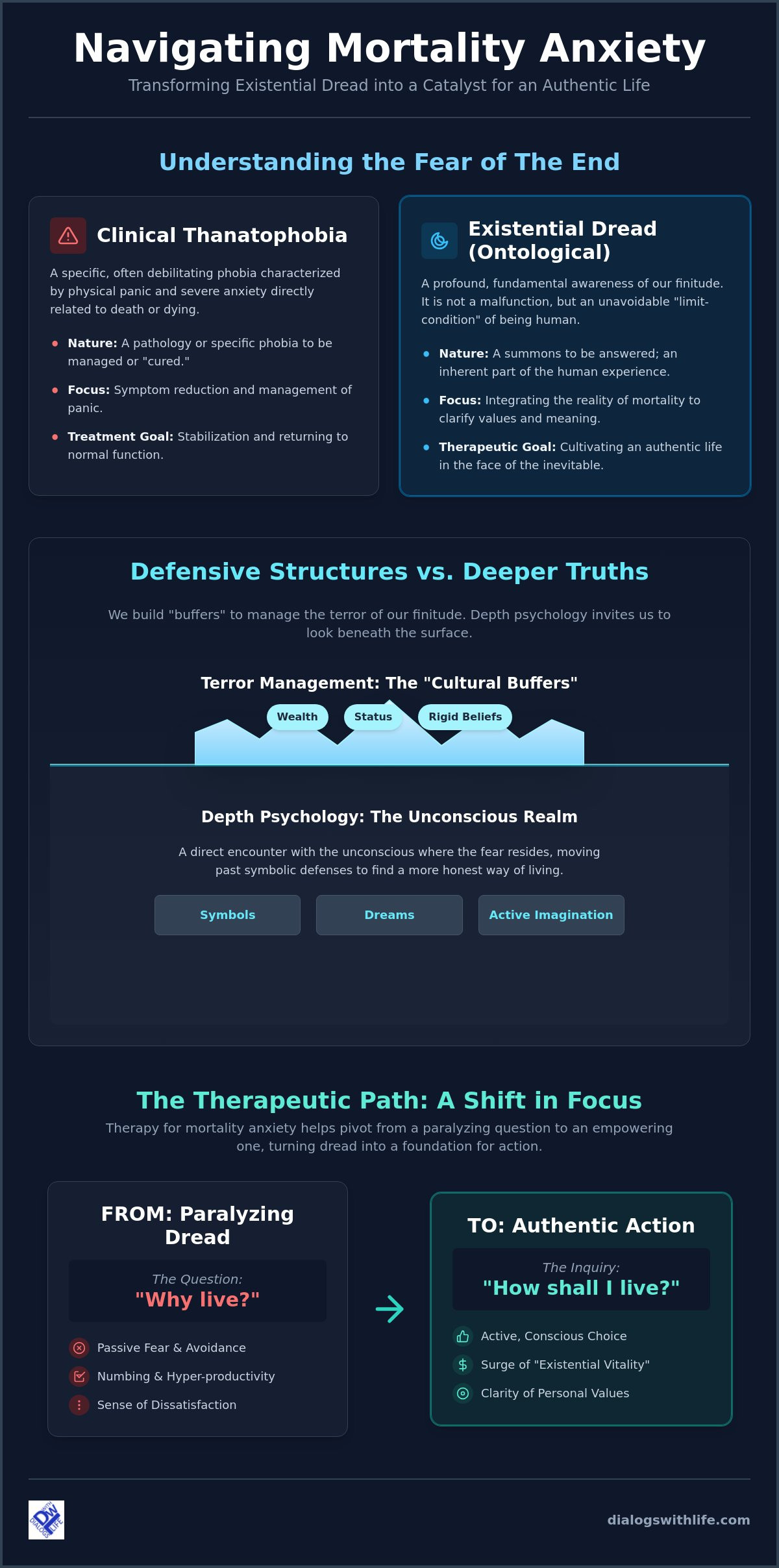
To understand the weight of our own end, we must first look beyond the narrow confines of clinical diagnosis. While medical literature often categorizes the fear of death as "thanatophobia," a specific phobia characterized by physical panic, existential thought offers a broader lens. What is Mortality Anxiety? It is the ontological confrontation with the limit-condition of human existence, a fundamental awareness that our time is finite. This isn't a malfunction of the mind; it's the "dread" Kierkegaard described or the "ultimate concern" identified by Irvin Yalom. Mortality anxiety is a natural response to the awareness of finitude that demands psychological integration.
This anxiety often emerges with piercing clarity during major life transitions or periods of profound loss. When the structures of our daily lives shift, the underlying reality of our impermanence becomes impossible to ignore. It's a heavy realization that requires more than just clinical "fixes." It requires a space where the gravity of being human is respected and explored with intellectual bravery.
The Symptoms of an Existential Encounter
This encounter often arrives unbidden, manifesting as intrusive thoughts during the quiet hours of the night or a sudden, frantic search for legacy in midlife. You might experience sleep disturbances or a persistent sense of dissatisfaction that "success" cannot soothe. Many attempt to outrun this shadow through hyper-productivity or numbing behaviors. These avoidance strategies only serve to exacerbate the underlying dread. Seeking therapy for mortality anxiety recognizes these symptoms as signals that the soul is ready for a deeper conversation with reality.
Terror Management and the Unconscious
Social psychology describes our defensive structures through Terror Management Theory. We often build cultural "buffers" like wealth, status, or rigid belief systems to achieve a sense of symbolic immortality. These structures protect us from the raw reality of our eventual dissolution. Depth psychology, however, looks beneath these fragile buffers. It invites a direct encounter with the unconscious, where the fear resides. By moving past these symbolic defenses, we find a more honest and grounded way of inhabiting our lives.
The Therapeutic Path: Integrating the Fear of Death
Standard clinical models often treat death anxiety as a cognitive distortion to be corrected. While challenging irrational thoughts has its place, The Therapeutic Path toward integration requires a more rigorous, contemplative engagement. Depth and spiritual psychology do not seek to "fix" the fact of mortality. Instead, they invite us to use finitude as a teacher. When we stop trying to eliminate the dread, we can use the reality of our end to clarify our most essential values. This work demands a therapist who can witness profound fears without offering superficial comfort or hollow reassurances. Engaging in individual psychotherapy provides the necessary container for this difficult, yet vital, exploration. It is a process of shared bravery that makes therapy for mortality anxiety a transformative rather than defensive act.
Depth Psychology and the Search for Meaning
Depth psychology moves beyond the surface of daily stress to explore the interior world. Through the use of symbols, dreams, and active imagination, we can begin to process the "unthinkable" end of the self. These archetypal tools allow us to find a sense of purpose that transcends physical existence. By engaging with the unconscious, we transform a raw, terrifying void into a meaningful landscape. This isn't about escaping reality, but about finding a language for it that respects the soul's complexity.
From Paralyzing Dread to Authentic Action
When we stop fleeing from our mortality, we often discover a surge of "existential vitality." This is the energy that arises from radical honesty. Therapy for mortality anxiety helps you pivot from the paralyzing question of "Why live?" to the urgent, authentic inquiry of "How shall I live given the time I have?" This shift turns dread into a foundation for action. It is a movement from passive fear to active, conscious choice. If you feel ready to explore these depths, pursuing a deeper understanding of your own internal world is the first step in this dialogue.
Seeking Therapy for Mortality Anxiety in California
Living in California often means navigating a culture that prizes eternal youth and relentless productivity. In this high-velocity environment, the sudden awareness of our own finitude can feel like a personal failure or an unwelcome intrusion. Seeking therapy for mortality anxiety in such a context requires a therapist who can withstand the weight of existential inquiry without flinching. It's about finding a soul-centered space where the gravity of your concerns is met with intellectual bravery rather than sanitized advice. We must move beyond the superficial to address the profound questions that modern life often ignores.
Dialogs with Life, Inc. operates on a direct-pay model to ensure that clinical autonomy remains the priority. This choice allows us to focus on the contemplative depth of your experience rather than the administrative constraints of diagnostic coding required by insurance providers. By stepping outside the insurance-driven framework, we create a sanctuary for genuine inquiry where depth takes precedence over a label. Because this work is so vulnerable and weighty, we provide a free introductory session. This session serves as a vital space to assess the "fit," ensuring the therapeutic alliance is grounded in mutual trust and philosophical alignment before we begin the rigorous path of integration.
Why a Depth Psychology Approach is Different
Our focus on spiritual and depth psychology addresses what is often a crisis of soul rather than a mere clinical disorder. While many modern approaches offer a ten-step fix for anxiety, we honor the inherent complexity of the human experience. Integrating the Fear of Death requires moving beyond surface-level stabilization to explore the archetypal roots of dread. This approach doesn't seek to eliminate the awareness of mortality; it transforms that awareness into a source of vitality and meaning.
Taking the First Step Toward Integration
Your anxiety is a summons to deeper self-knowledge. It's a signal that your internal world is ready for a more honest engagement with reality. Instead of viewing this dread as a burden to be discarded, we invite you to see it as a catalyst for authentic action. Scheduling an introductory session is the first step in moving from isolation to a shared exploration of what it means to live well. This dialogue marks the beginning of a process that turns finitude into the foundation of a more purposeful life.
Inhabiting a Life of Meaning and Finitude
The encounter with our own mortality is not an obstacle to be bypassed; it's the very ground upon which an authentic life is built. We've explored how moving beyond clinical labels allows us to see existential dread as a summons to deeper self-knowledge. By integrating the reality of the end into our daily narrative, we transform paralyzing fear into a rigorous catalyst for presence. Engaging in therapy for mortality anxiety offers the space to confront these heavy truths with a guide who values intellectual bravery over superficial comfort. It's a choice to live with eyes wide open.
Our work at Dialogs with Life, Inc. focuses on Spiritual and Depth Psychology. We provide dedicated support for those navigating profound life transitions and existential questions. We believe that the logistical and the philosophical are inextricably linked. This is why we offer a free introductory session to ensure a genuine clinical fit for this vulnerable work. You don't have to carry the weight of existence in isolation. Begin a deeper dialogue with your life; schedule a free introductory session today.
Choosing to look directly at the finality of your days is the first step toward living them with intention. It's a journey from the shadow of dread into the light of conscious, meaningful action. You're invited to step into a life that honors the full weight of your humanity.
Frequently Asked Questions
What is the difference between thanatophobia and normal mortality anxiety?
Thanatophobia is a clinical phobia characterized by acute physical panic and the avoidance of death related stimuli, whereas mortality anxiety is a universal ontological condition. The former often involves a physiological fear of the dying process itself. The latter is a deeper, philosophical awareness of the limit condition of existence. Distinguishing between a pathological phobia and a natural existential encounter is a vital first step in therapy for mortality anxiety.
Can therapy actually help with a fear that is based on a real fact like death?
Therapy helps by shifting the focus from the impossible task of avoiding death to the necessary task of inhabiting life fully. While the fact of finitude is unchangeable, your psychological relationship with that fact is dynamic. Through a rigorous therapeutic alliance, you can move past paralyzing dread toward a state of integration. The goal is to use the reality of the end as a catalyst for clarifying your most essential values.
How long does existential therapy for death anxiety typically take?
The timeline for this work depends on the depth of the existential crisis and the individual's willingness to engage with their interior world. Because depth psychology avoids "ten step fixes," the process is often methodical and unhurried. Some people find relief through several months of focused inquiry. Others choose to remain in therapy for mortality anxiety for a longer duration to navigate the complex intersection of soul, legacy, and identity.
Why is depth psychology particularly effective for mortality concerns?
Depth psychology is effective because it treats mortality as a profound summons to meaning rather than a symptom to be suppressed. It utilizes symbolic exploration, active imagination, and an engagement with the unconscious to process what the rational mind often finds unthinkable. By honoring the soul's complexity, this approach provides a more robust framework for addressing the raw encounter with finitude than purely cognitive models can offer.


