

Grief is not a clinical pathology to be cured, but a sacred threshold that demands an honest witness. You've likely felt the sting of well-meaning advice that asks you to move on or look on the bright side, only to find that such superficiality fails to honor the gravity of your loss. When the world feels thin and the absence of a loved one feels like a heavy, physical weight, clinical checklists often feel like an insult to the depth of your experience. Finding specialized counseling for bereavement shouldn't mean settling for a therapist who treats your sorrow as a problem to be solved through simple coping strategies.
We believe that your journey through loss deserves more than just symptom management. It should be a deliberate invitation to engage with the existential and philosophical questions that loss inevitably unearths. You deserve a space where your dread and your questions about finality are met with intellectual bravery rather than a rush toward closure. This exploration examines a contemplative, depth-oriented approach to loss that respects the silence of the after. We'll look at how to find a practitioner who can sit with you in the complexity of absence and help you develop a more profound understanding of your internal world post-loss.
Key Takeaways
- Reframe your grief from a clinical disorder to an existential threshold that requires deep witnessing rather than a quick cure.
- Discover how depth-oriented counseling for bereavement honors the unconscious mind and the permanence of absence instead of pushing for a return to normalcy.
- Distinguish between superficial behavioral strategies and an existential approach that makes space for philosophical inquiry and somber reflection.
- Gain clarity on when loss becomes complicated and requires a rigorous therapeutic space to explore the internal world post-loss.
- Learn about a methodical, intentional path forward that prioritizes your autonomy and respects the slow rhythm of profound transition.
Beyond Symptom Management: A Depth Perspective on Counseling for Bereavement
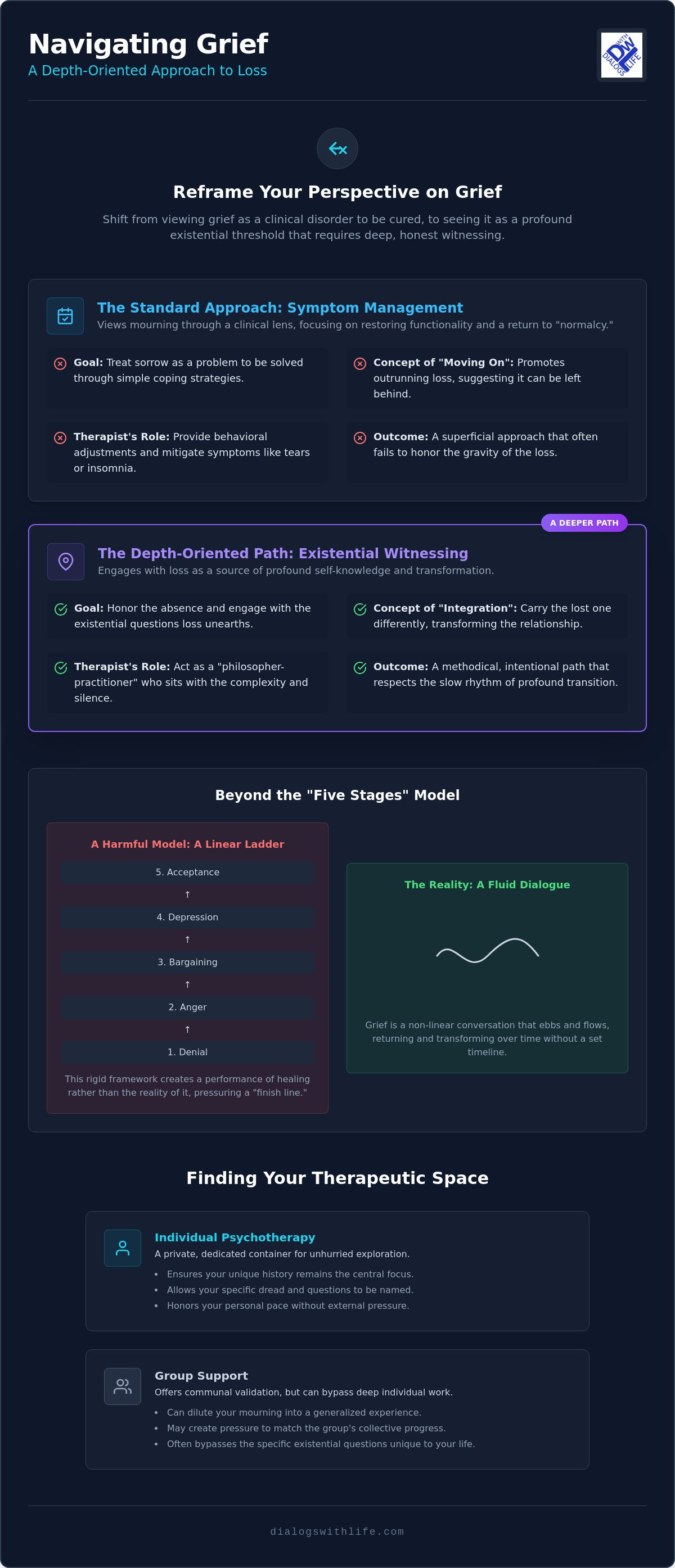
Most clinical frameworks view mourning through the lens of pathology, cataloging tears and insomnia as symptoms to be mitigated. True counseling for bereavement, however, rejects this sanitized perspective. It views the experience as a profound existential threshold. Instead of seeking a return to a pre-loss state, a depth-oriented approach focuses on witnessing the unconscious movements of the soul. This isn't a passive observation. It's a rigorous engagement with the shadow that loss casts over one's internal world. We don't look for a way out of the sorrow, but a way through it that honors the magnitude of what has been lost.
The role of the therapist in this context is that of a philosopher-practitioner. Unlike standard models of Grief counseling that prioritize behavioral adjustments, this work invites the somber weight of absence into the room. We don't treat the weight as a burden to be discarded. We treat it as a source of profound self-knowledge. By sitting with the gravity of what's missing, we begin to understand the true shape of what remains. It's a methodical process that requires intellectual bravery from both the clinician and the individual.
"Moving on" is a concept born of a culture that fears stillness. It's a reductive goal that ignores the permanence of significant absence. Absence isn't an empty space; it's a persistent, quiet presence that reshapes our identity. To move on is to suggest that the loss can be outrun, whereas depth psychology suggests the loss must be integrated. We don't leave the dead behind. We carry them differently, allowing the relationship to transform from one of physical presence to one of internal dialogue.
The Limitations of the Standard "Five Stages" Model
The popular expectation of moving through Denial, Anger, Bargaining, Depression, and Acceptance often does more harm than good. It creates a performance of healing rather than the reality of it. When we feel pressured to reach "Acceptance," we may stifle the contemplative work necessary for genuine transformation. Grief isn't a ladder to be climbed. It's a non-linear dialogue with the life that was lost. It ebbs and flows, returning in moments of quiet reflection or sudden memory, demanding a rhythm that defies clinical timelines. By viewing grief as a fluid conversation, we respect the gravity of the transition without the artificial need for a finish line.
Evaluating Bereavement Support: Choosing the Right Path for Complicated Loss
Choosing the right support requires discerning between clinical symptom management and a deeper psychological inquiry. While behavioral interventions focus on restoring daily functionality, existential and spiritual psychotherapy prioritize the underlying meaning of the loss. Counseling for bereavement is most effective when the therapist can sit with the silence. It's about finding a practitioner who doesn't flinch at the complexity of your interior world. When grief becomes "complicated," often marked by a sense of being stuck in a recursive loop of despair, it signals that the loss has touched something fundamental in your psyche.
Through individual psychotherapy, you create a dedicated container for this unhurried exploration. This private space allows for the unraveling of personal narratives that often feel too heavy for more public settings. It's a methodical process that honors your specific pace rather than adhering to an external timeline.
Individual Psychotherapy vs. Group Support for Mourning
Group settings offer communal validation, yet they often bypass the specific existential questions unique to your life. The death of a loved one isn't just a social event; it's a crisis of soul. Individual work ensures that your specific history and your unique relationship with the deceased remain the central focus. It prevents your mourning from being diluted into a generalized experience. You need a space where your specific dread can be named without the pressure to match the group's collective progress.
The Role of Spiritual and Existential Inquiry
Loss forces a direct encounter with the human condition. Depth psychology engages with these unseen elements, addressing the intersection of mortality and meaning. You might find clarity by reviewing Harvard's grief resources, which highlight the various ways people seek support during transition. However, for those seeking a rigorous, philosophical engagement with their pain, a professional guide is essential. If you feel ready to begin this work, you might consider a free introductory session to see if our approach aligns with your personal search for understanding.
Navigating the Path Forward: The Dialogs with Life, Inc. Approach in California
Our California-based practice, Dialogs with Life, Inc., prioritizes the autonomy and interiority of the client above all else. In a culture that often demands efficiency and rapid recovery, we offer specialized counseling for bereavement that respects the slow, intentional pace of your unique journey. We don't view your sorrow as a logistical hurdle to be cleared. Instead, we focus on the contemplative integration of loss into the person you're becoming. This isn't about returning to an old version of yourself; it's about the profound evolution of your internal world in the wake of absence.
Transitioning from sharp, acute pain to a state of integration requires a rigorous therapeutic container. While the Substance Abuse and Mental Health Services Administration (SAMHSA) provides foundational insights on Coping with Bereavement and Grief, our work is a deeper, individual inquiry into the shifts in your worldview. Our grief and loss counseling services are designed for those who seek to understand the deeper currents of their emotional life rather than simply managing outward symptoms. We invite you to explore this transition with intellectual bravery and a commitment to your own psychological depth.
Why Private Pay Enhances Clinical Depth in California
The decision to operate as a private-pay practice at Dialogs with Life, Inc. is a deliberate choice to protect the depth of our work. Insurance-mandated treatment often requires sanitized, time-limited plans that prioritize diagnostic codes over the human soul. In California's fast-paced mental health landscape, direct-pay allows us to bypass these external constraints. It grants us the clinical autonomy to pursue long-term depth work that isn't cut short by an arbitrary number of authorized sessions. We believe your mourning shouldn't be dictated by a third-party's bottom line, allowing our focus to remain entirely on your internal transformation.
Rigorous counseling for bereavement requires a unique resonance between therapist and client. If you're looking for a space that respects the somber weight of your journey, we invite you to a free introductory session. This is an opportunity to explore whether our philosophical and clinical approach aligns with your needs, ensuring that your path forward is met with profound empathy and intellectual rigor.
Honoring the Interiority of Your Transition
Grief isn't a pathology to be cured; it's a profound existential threshold that requires an honest witness. We've examined how depth-oriented counseling for bereavement moves beyond the limitations of standard clinical models to engage with the unconscious movements of the soul. By prioritizing a slow, methodical pace and philosophical inquiry, you can transform a period of acute dread into a rigorous search for meaning. This work isn't about finding a quick exit from sorrow, but about the contemplative integration of absence into a life that remains. It's a process of learning to carry what's missing without losing the essence of who you are becoming.
Our California-based practice offers a specialized focus on Spiritual and Depth Psychology, providing a container for individual psychotherapy that respects the somber weight of complicated transitions. We remain committed to a style of engagement that is both intellectually rigorous and deeply empathetic. If you're ready to explore your internal world with a guide who values complexity over closure, we invite you to schedule a free introductory session to explore a deeper path through loss. You don't have to navigate the silence alone. There is a way to hold the gravity of your loss while finding a steady, meaningful path forward.
Frequently Asked Questions
Is counseling for bereavement necessary if my grief feels "normal"?
Counseling for bereavement isn't reserved strictly for those in a state of clinical crisis; it's a resource for anyone who wishes to engage deeply with the gravity of their loss. Even when mourning follows a typical trajectory, it involves a profound reorganization of your identity and internal world. Choosing to work with a therapist allows you to witness these shifts with intention. It's a way to honor the transition rather than simply enduring it as a set of symptoms to be managed.
How does depth psychology differ from standard grief counseling?
Standard approaches often prioritize behavioral tools and symptom reduction to help you return to daily functionality as quickly as possible. Depth psychology, however, is a more contemplative inquiry that explores the unconscious movements of the soul and the permanence of absence. It treats your sorrow as an existential threshold rather than a problem to be solved. This method respects the slow, non-linear rhythm of mourning and seeks a more profound integration of the loss into your psyche.
What should I expect during a free introductory session for bereavement?
The introductory session is a dedicated space to explore therapeutic resonance and determine if our philosophical approach aligns with your needs. It's not a diagnostic intake or a formal interrogation of your history. Instead, we'll discuss the specific shape of your loss and the questions you're carrying. It's an opportunity for you to see if our methodical, unhurried pace feels like a safe container for your internal world.
Why does Dialogs with Life, Inc. operate as a private-pay practice in California?
We maintain a private-pay structure at Dialogs with Life, Inc. to protect the clinical autonomy and intellectual rigor of our work. Insurance-mandated treatment often requires sanitized, time-limited plans that prioritize diagnostic codes over the complexity of the human experience. By operating independently, we ensure that the pace and depth of your therapy are dictated solely by your needs. This allows us to focus on long-term depth work without the interference of third-party constraints.


