

Persistent Grief: A Depth-Psychology Approach to Loss and Meaning
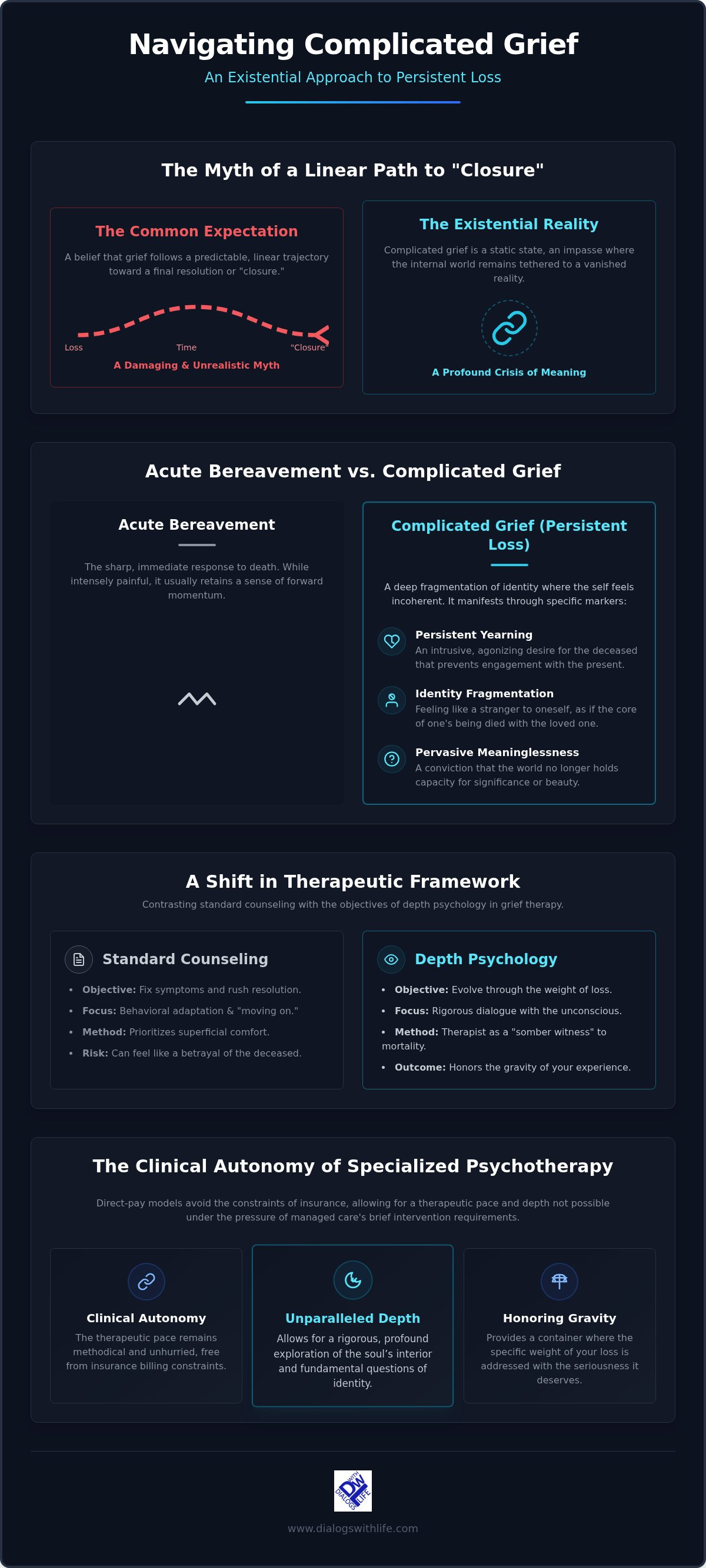
The expectation that grief follows a predictable trajectory toward “closure” remains one of the more persistent assumptions surrounding bereavement. Loss, however, does not conform to a timetable. For some, grief gradually changes; for others, its emotional and psychological weight remains substantial.
Clinical frameworks may describe this as Prolonged Grief Disorder or persistent grief. Such terminology can be useful in identifying symptoms and determining appropriate treatment, but diagnosis alone may not adequately describe what has occurred within the individual. The person may not simply be experiencing persistent sadness. Loss can challenge, even alter identity, meaning, relationships, and one’s understanding of existence itself.
It is similar to an experience of preparing to leave for somewhere and suddenly feeling certain that you have forgotten something important. You stop, search your memory, retrace your steps, and mentally review what you have done, yet cannot determine what has been left behind. The feeling persists precisely because what is missing matters.
From the perspective of depth psychology, persistent grief may therefore be understood not merely as a disorder requiring symptom reduction, but as a profound challenge for the individual to psychologically integrate the loss into identity, meaning, relationships, and their own understanding of existence itself—most profoundly, their understanding of their own existence and place in the world.
When Grief Becomes an Existential Challenge
Grief is commonly described as a process, implying movement from one psychological condition toward another. Yet grief often does not progress in an orderly manner.
A significant loss can disrupt the structure through which a person previously understood life. The individual does not only miss the deceased; they also grief the loss of who they were within that relationship.
When we loose significant longterm, sometimes lifelong beloved companions we consequently confront a difficult question:
Who am I now that this relationship no longer exists in the form I knew?
This question reaches beyond mere sadness.
Relationships contribute to identity. We understand ourselves partly through and in relation to the people with whom we share our lives. When an important relationship ends, part of the psychological structure surrounding that identity may also be disrupted; death imposes an absolute and irreversible change.
Persistent grief can therefore include several interconnected experiences:
- Persistent yearning: an intense remembering of the deceased that makes engagement with present life difficult.
- Identity disruption: uncertainty about oneself following the loss of an important relationship.
- Diminished meaning: difficulty experiencing purpose, significance, pleasure, or connection in the present because of their absence.
- Difficulty integrating finality: intellectually recognizing the fact of death while emotionally remaining strongly attached toward the world that existed before it.
These experiences must be approached consciously, deliberately and intentionally with insight and compassion. They may represent a substantial psychological challenge requiring thoughtful exploration. (Judgments about resilience or character are impotent and unreasonable.)
Beyond the Expectation to “Move On”
Modern culture frequently encourages grieving people to return to normal functioning as quickly as possible. Friends, family members, workplaces, and even some therapeutic environments may unintentionally communicate that grief should gradually disappear.
For the bereaved person, this expectation can feel (oftentimes does feel) alienating.
There may be no former “normal” to which one can simply return because the loss itself has changed the structure of life.
Depth-oriented psychotherapy begins with a different premise: the objective is not necessarily to restore the person to who they were before the death.
The work is instead concerned with discovering who the person is becoming because of the loss that has occurred.
Healing does not require forgetting the deceased, minimizing the importance of the relationship, or abandoning grief. It involves developing a psychological relationship to the loss that permits both remembrance and a reformed participation in life.
The deceased remains significant, but the relationship gradually acquires a different internal form as the bereaved learn to live in the presence of their beloved's absence.
The Role of Depth Psychology in Grief Therapy
Depth psychology approaches psychological experience through careful attention to the unconscious, symbolism, identity, memory, relationship, and meaning.
Within this framework, therapy for persistent or difficult grief does not focus exclusively on eliminating symptoms. It creates an environment in which the individual can examine what the loss represents psychologically and existentially.
Questions may emerge that ordinary conversation rarely permits:
What did this person represent in my life?
What part of myself existed primarily through this relationship?
What remains unresolved?
What does mortality now mean to me?
What am I afraid will disappear if my grief changes?
How can I continue living without experiencing that continuation as a betrayal?
These questions are not answered through bold reassurances alone. They require sustained dialog.
The therapeutic relationship provides a place in which grief can be examined without demanding that it become more comfortable than it actually is. The therapist functions as a professional witness—someone prepared to remain present with difficult emotional material while helping the individual investigate its psychological meaning.
This does not mean romanticizing suffering or avoiding practical change. Rather, it recognizes that meaningful psychological change oftentimes requires understanding the depth and impact of an experience before attempting to alter it.
Engaging the Interior World
Persistent grief often contains more than longing for another person. It may contain unresolved aspects of the self.
Memories, dreams, guilt, anger, regret, idealization, unfinished conversations, and questions about mortality can become psychologically significant following a death. Depth psychotherapy allows these experiences to become material for inquiry rather than experiences that must immediately be suppressed.
Contemplative reflection can help the individual examine what the loss has revealed.
Yearning may express attachment, but it may also reveal something about identity. Anger may concern the death itself, unresolved aspects of the relationship, or the unavoidable limitations of human existence. Guilt may involve actual unfinished matters, but it may also represent an attempt to create a sense of control over something that could not have been controlled.
The purpose of this inquiry is not to impose an interpretation. It is to develop greater awareness and psychological agency.
Through sustained therapeutic dialog, the individual may gradually differentiate the pain of losing the person from the additional psychological meanings that have accumulated around the loss.
Integration Rather Than Erasure
The word “closure” can suggest that grief eventually reaches a definitive conclusion. Human attachment is rarely so simple.
A more useful objective may be integration.
Integration means allowing the reality of the loss to become part of one’s continuing identity without permitting the loss to define the entirety of that identity.
The person who died does not become irrelevant. The relationship changes from an external relationship to an internal psychological reorientation expressed through memory, values, influence, meaning, and personal history.
This transformation can be difficult because moving toward life may initially feel disloyal. A grieving person may consciously or unconsciously believe:
If I become interested in life again, perhaps the relationship mattered less than I thought.
Depth therapy challenges this assumption.
Continued living does not invalidate loss. Developing new relationships does not erase previous ones. Experiencing pleasure does not diminish love for the deceased.
The psychological task is not choosing between grief and life. It is discovering how both exist within life itself.
Individual Psychotherapy and Clinical Depth
This kind of therapeutic work requires time, attention, and a strong therapeutic relationship.
Standardized approaches can be valuable, particularly when immediate symptom relief or stabilization is necessary. Yet a therapeutic environment in which existential questions can be examined more extensively is also important for those inclined towards it.
Individual psychotherapy can provide that environment.
The pace is determined not simply by symptom reduction but by the individual’s capacity and willingness to investigate the psychological dimensions of loss. Therapy becomes a structured form of inquiry in which grief, identity, mortality, relationship, and meaning can be considered without imposing an artificial deadline.
For individuals seeking this kind of work, the initial therapeutic meeting is especially important.
A therapist should not merely possess technical knowledge. The individual must determine whether the therapist can listen carefully, tolerate difficult emotional material, engage thoughtfully, and respect the significance of the loss.
Clinical fit matters because grief is intensely personal.
A New Relationship With Loss
Profound loss cannot be reversed.
Psychotherapy cannot restore the person who died, eliminate mortality, or guarantee freedom from sorrow. It can provide an environment, a kind of container in which the bereaved person can develop a different relationship to what has happened.
Over time, grief may become less exclusively an experience of absence and increasingly part of a larger understanding of one’s life in the present.
The objective is not forgetting or “moving on.” It is continuing with one's life through integrating the loss and remaining emotionally and intellectually connected to what has always mattered.
Persistent grief evidences a significant psychological and existential challenge, to an individual whose identity remains strongly organized around a reality that no longer exists externally. Depth-oriented psychotherapy offers an opportunity to examine that challenge through sustained reflection, professional witnessing, and meaningful dialog.
Loss changes us.
The therapeutic question is therefore not simply, How do I stop grieving?
A more meaningful question may be:
How do I allow this loss to become part of who I am without allowing it to become all that I am? How do I allow this loss become a life wisdom and not just a long suffering wound?
Those questions offer something substantial: the possibility that mourning can gradually become integrated into the continuity of life—where in which the deceased remains meaningful, the loss remains acknowledged, and the living remain capable of growth, relationship, and renewed continuing engagement with existence.


