

There are times in life when the familiar ways we have understood ourselves simply stop working.
Sometimes we know why. A marriage ends. We retire. Someone dies. Our work changes. Children grow up and leave. Our health changes. We move somewhere new.
And sometimes nothing dramatic happens at all. We simply begin to notice that the life we have been living no longer feels quite like our own.
That can be an unsettling experience.
We may find ourselves thinking, I should be happy. Or, I have nothing to complain about. And yet something feels different. The old motivations don't carry quite the same energy. Things that once seemed important may suddenly seem strangely empty.
I think we often make the mistake of assuming that this kind of disorientation means something has gone wrong.
Perhaps it doesn't.
Perhaps there are moments in life when being somewhat lost is actually an appropriate response to what is happening inside us.
When the Old Identity No Longer Fits & Can No Longer Fit
Most of us build an identity gradually.
We become a life partner, husband or wife, a parent, a professional, a caretaker, a successful person, a responsible person, the person others depend upon.
Over time these roles become so familiar that we stop noticing how much of our identity is contained within them and infused by them.
Then something changes. The role disappears, or perhaps we simply outgrow it. And suddenly there is an uncomfortable question, a restlessness underneath everything else:
Who am I if I am no longer that person?
This is one reason even positive transitions can sponsor an unsettling discomfort, and grief.
Retirement may bring freedom and also a surprising sense of loss. A long-awaited success may arrive accompanied by the peculiar realization that achieving it did not answer the questions we thought it would.
Something has ended; whatever comes next has not yet taken shape. We are standing between the times of our lives.
I am reminded as to what Rainer Maria Rilke says in "Letters to a Young Poet" reflecting on answers and questions:
"I would like to beg you, as well as I can , to have patience with everything unresolved in your heart and to try to love the questions themselves as if they were locked rooms or books written in a very foreign language. Don’t search for the answers, which could not be given to you now, because you would not be able to live them. And the point is, to live everything. Live the questions now. Perhaps then, someday far in the future, you will gradually, without even noticing it, live your way into the answer."
Letters to A Young Poet, P. 35
The Temptation to Fix the Feeling
Our culture is very good at offering solutions.
Exercise more. Travel. Find a hobby. Set some goals. Stay busy. Think positively.
There is nothing inherently wrong with any of these things. Sometimes they help enormously.
But occasionally our distress is asking something different of us.
It may not be asking, How can I feel better?
It may be asking, What is happening to me?
Those are very different questions.
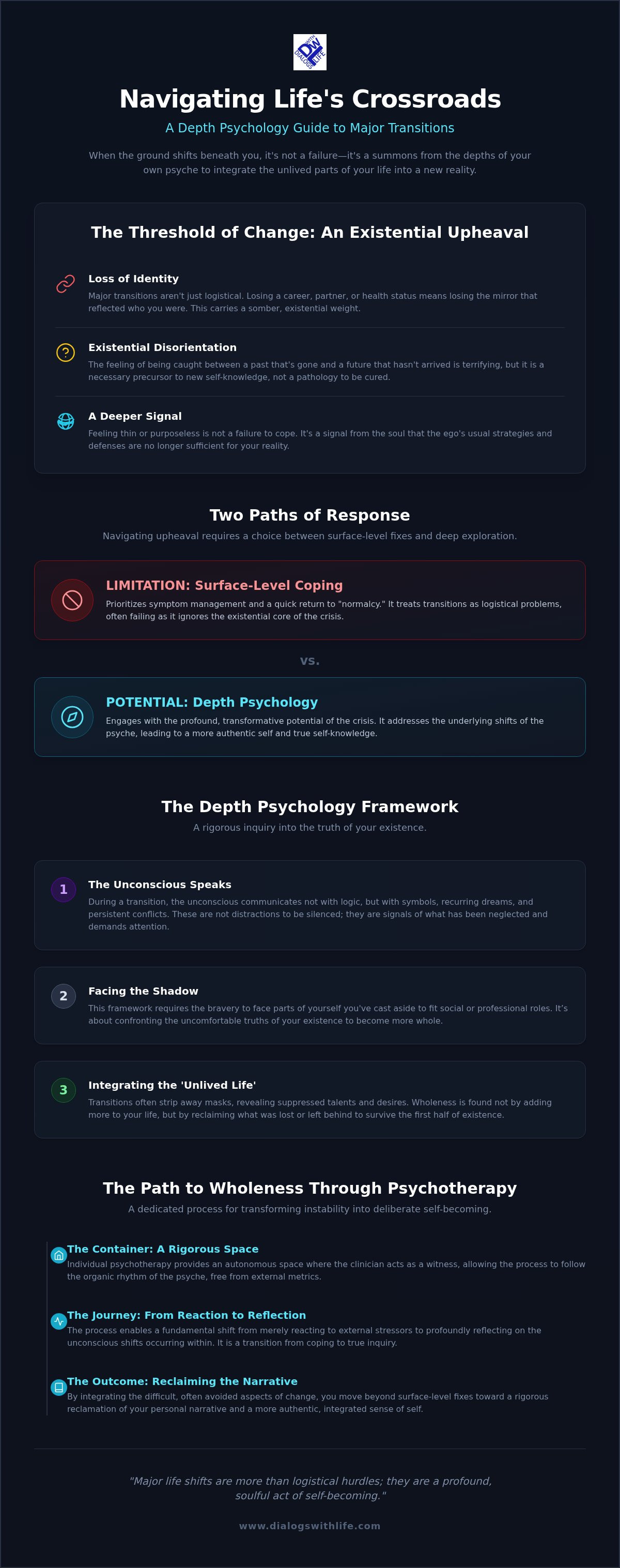
Depth psychology begins with the assumption that our conscious explanations do not always tell the whole story. Beneath the life we deliberately construct there are other unrealized desires, fears, memories, possibilities, and parts of ourselves that have never been brought to conscious life.
Periods of transition have a way of bringing these things closer to the surface.
Dreams may become more vivid. Old memories return unexpectedly. We may find ourselves thinking about choices made and opportunities not taken.
We may begin musing about the person whom we might have become had we made different choices.
The Unlived Life
This notion has always intrigued me.
Every life we choose inevitably leaves other lives unlived. To become one person means that we have not become every other person we might have been.
We choose a profession and leave another possibility behind. We marry one person rather than another. We raise children or don't. We remain somewhere or leave. We make compromises because life requires compromises.
Most of the time we move forward without thinking too much about these alternate possibilities.
But later in life they sometimes return. Not necessarily because we made the wrong choices. Rather, because parts of ourselves that had to remain quiet earlier may now be asking for attention. This is especially noticeable whenever we encounter any of our life's innumerable crossroads.
Earlier adulthood often requires us to establish ourselves in the external world. We build careers, families, homes, reputations and responsibilities.
Later, another question can emerge:
Now that I have become the person I needed to become, who else do I need to become?
Sitting With the Question
Psychotherapy does not generally provide immediate answers, at best it creates a place where important questions can reside, and do not have to be answered too quickly.
One can speak without having to make sense, and contradictions can remain contradictions.
Grief does not have to immediately become gratitude. Uncertainty does not have to become a plan. Anger does not have to be explained away. We can simply become curious about what these experiences might be saying.
This is one of the things I value about depth-oriented psychotherapy. It gives us permission to listen before we decide what something means. The therapist is not there to provide one a new identity. The work is more subtle than that.
We pay attention together.
To what keeps returning.
To what has been avoided.
To the stories we have told ourselves for years, and oftentimes to the quiet realization that some (maybe more or even all) of those stories is no longer true.
Between What Was and What Comes Next
There is a territory between endings and beginnings that can be psychologically difficult to tolerate.
The old life has loosened its hold.
The new one has not yet arrived.
We naturally want to get through this territory as quickly as possible.
But transitions are not givent to the dictates of timelines, they cannot be hurried. Sometimes it seems we are forcibly stalled, as if healing from a complex surgery. waiting for each suture to dissolve, for every wound to become a scar.
When we resist the urge to immediately reconstruct our lives, we sometimes clearly hear things that were previously drowned out by responsibility, ambition, habit, or simple necessity.
What do I actually want now?
What have I been carrying that I no longer need?
What have I neglected?
What am I afraid would happen if I changed?
And perhaps the most difficult question:
What do I already know about my life that I have been reluctant to admit?
These are not questions that lend themselves to quick answers.
They are questions we live out.
A Different Way of Thinking About Change
The purpose of a major life transition may not simply be to reclaim a semblance of stability.
It may be an invitation to become less certain about who we are so that we can simply be.
That uncertainty can be unsettling, even feel frightening, because we have enjoyed how orienting and stabilizing identity has felt. We liked knowing where we stood and what was coming next.
But there are periods when the psyche seems to insist that an old definition of ourselves no longer works and is no longer useful.
Something wants to change and we begin engaging by becoming willing to listening deeply within our discomfort.
To dreams.
To regrets.
To the possibilities we dismissed years ago.
To the parts of ourselves that have been dormant now obsolete or waiting patiently while we attended to everything else.
Not every challenging transition is the harbinger of some hidden gift. Loss is still loss. Grief is still grief. Yet sometimes, alongside the loss and grief, another movement is taking place.
We may be receiving and invitation to the life not yet imagined, slowly emerging.
And perhaps our invitation is not to encourage, empower it into existence.
Perhaps the greatest challenge of this invitation is for us simply to become quiet enough to notice it.


