

What if emotional suffering is not simply something to alleviate, but something that asks to be understood?
People often seek individual psychotherapy when familiar ways of understanding themselves no longer seem sufficient. A relationship ends. A career changes. Grief alters the landscape of everyday life. Anxiety or depression becomes difficult to carry alone. Or perhaps nothing dramatic has occurred, yet there remains a persistent sense that something within one's life is asking for attention.
At Dialogs with Life, Inc., individual psychotherapy begins with respect for the complexity of that experience.
Psychotherapy can help reduce distress and improve functioning. But therapy may also offer something more: an opportunity to become attentive to one's interior life—to relationships, history, choices, conflicts, longings, and the continuing search for meaning.
A depth-oriented approach does not presume that every difficulty has a simple explanation or immediate solution. Instead, therapist and client enter into a thoughtful dialog about the life being lived, the patterns that have shaped it, and the life that may still be seeking expression.
Individual Psychotherapy as a Place for Reflection
Individual psychotherapy provides a confidential professional relationship in which experiences difficult to examine elsewhere can be approached with greater attention and care.
Symptoms matter. Anxiety, depression, grief, loneliness, relational conflict, and emotional distress can significantly affect a person's capacity to work, love, create, rest, and participate meaningfully in life.
Yet symptoms occur within the context of a life.
A depth-oriented perspective therefore asks not only, “How might this distress be relieved?” but also, “What might this experience be asking us to understand?”
Relief and understanding are not competing goals. They can develop together.
Psychotherapy may involve exploring recurring patterns, formative relationships, emotional conflicts, dreams, values, fears, defenses, aspirations, and aspects of experience that have remained outside conscious awareness.
The therapist's purpose is not to impose an interpretation. It is to participate in a relationship in which understanding can gradually emerge through sustained attention, curiosity, and dialog.
Greater awareness does not give us control over everything that happens. It can, however, provide greater freedom in determining how we respond.
Depth Psychology and the Interior Life
Depth psychology begins with a simple but consequential recognition: we do not always fully understand what moves us.
Patterns can repeat themselves long before we recognize them. We may enter similar relationships, confront familiar conflicts, avoid particular emotions, or organize our lives around assumptions formed many years earlier.
Psychotherapy offers an opportunity to become curious about these patterns rather than merely judging or repeating them.
This kind of self-knowledge can require courage. We encounter contradictions within ourselves: strength alongside vulnerability, love alongside resentment, certainty alongside doubt, independence alongside the desire to be known.
Psychological maturity does not necessarily require eliminating these contradictions. It may involve becoming increasingly capable of recognizing them and living more consciously in their presence.
At Dialogs with Life, psychotherapy is understood as a collaborative inquiry. The therapist brings clinical training, experience, attentiveness, and perspective. The client brings something no less essential: intimate knowledge of a life no one else has lived.
The therapeutic relationship becomes a place where understanding can emerge through conversation, reflection, silence, curiosity, and careful attention.
Life Transitions and Existential Questions
Transitions frequently bring people into psychotherapy.
Retirement, divorce, bereavement, aging, career changes, illness, changing family relationships, and questions of identity can unsettle assumptions that once provided stability.
Sometimes the practical problem is apparent while the deeper question remains difficult to name:
Who am I when a role that defined me is gone?
What remains after someone I love is no longer here?
What do I want from the years ahead?
Why do accomplishments that once mattered no longer seem sufficient?
What does it mean to live authentically at this point in my life?
These are psychological questions. They are also questions of existence.
Psychotherapy does not necessarily provide predetermined answers. It can create conditions in which important questions may be examined without demanding premature resolution.
There is value in remaining with an important question long enough for something genuine to emerge.
Grief Is More Than a Problem to Solve
Grief deserves particular care.
Loss can profoundly affect emotion, identity, relationships, memory, and one's sense of the future. Although grief may coexist with clinical conditions requiring assessment and treatment, grief itself is inseparable from our capacity for attachment.
We grieve because someone or something mattered.
The aim of psychotherapy is therefore not necessarily to make grief disappear. Therapy may help a person discover a way of carrying loss that permits both remembrance and continued living.
Integration does not mean forgetting, nor does healing require severing one's relationship with what has mattered.
Sometimes the question gradually changes from “How do I get over this?” to something more human:
“How do I live now, knowing what I have loved and what I have lost?”
The Search for Meaning
Modern life places considerable emphasis on efficiency, productivity, optimization, and measurable outcomes. These have their place. Human experience, however, does not always unfold according to an efficient timetable.
Some questions require patience:
What do I value now?
What relationships deserve my attention?
What am I responsible for changing?
What must I learn to accept?
What kind of life feels genuinely my own?
Depth-oriented psychotherapy makes room for these questions.
The purpose is not endless introspection. Self-understanding becomes meaningful when it changes how we actually live—how we choose, relate, establish boundaries, accept responsibility, respond to uncertainty, and participate in the lives of others.
Insight eventually asks something of us.
Autonomy and the Therapeutic Relationship
A central value at Dialogs with Life, Inc. is respect for personal autonomy.
Therapy is collaborative rather than prescriptive. The therapist's task is not to author another person's life or determine what a meaningful life should look like.
Psychotherapy can instead help clients examine the forces influencing their choices so those choices may become increasingly conscious and intentional.
A therapist cannot remove uncertainty from life, eliminate every painful emotion, or determine another person's path. What psychotherapy can offer is a sustained professional relationship in which difficult experiences can be encountered with seriousness, compassion, curiosity, honesty, and appropriate clinical care.
The client remains the author of their life. The therapist participates in the dialog.
A Thoughtful Relationship With Diagnosis
Depth-oriented psychotherapy need not reject diagnosis or contemporary clinical knowledge.
Diagnostic concepts can provide useful language for understanding distress, guiding treatment, communicating among healthcare professionals, and recognizing circumstances in which additional care may be necessary.
But a diagnosis cannot encompass the entirety of a human being.
A person is always more than a collection of symptoms.
At Dialogs with Life, clinical understanding is held alongside an appreciation for biography, relationships, culture, values, imagination, meaning, and the individual's particular experience of being alive.
The question is not whether symptoms and diagnoses matter. They can. The deeper question is how we understand them within the context of an entire life.
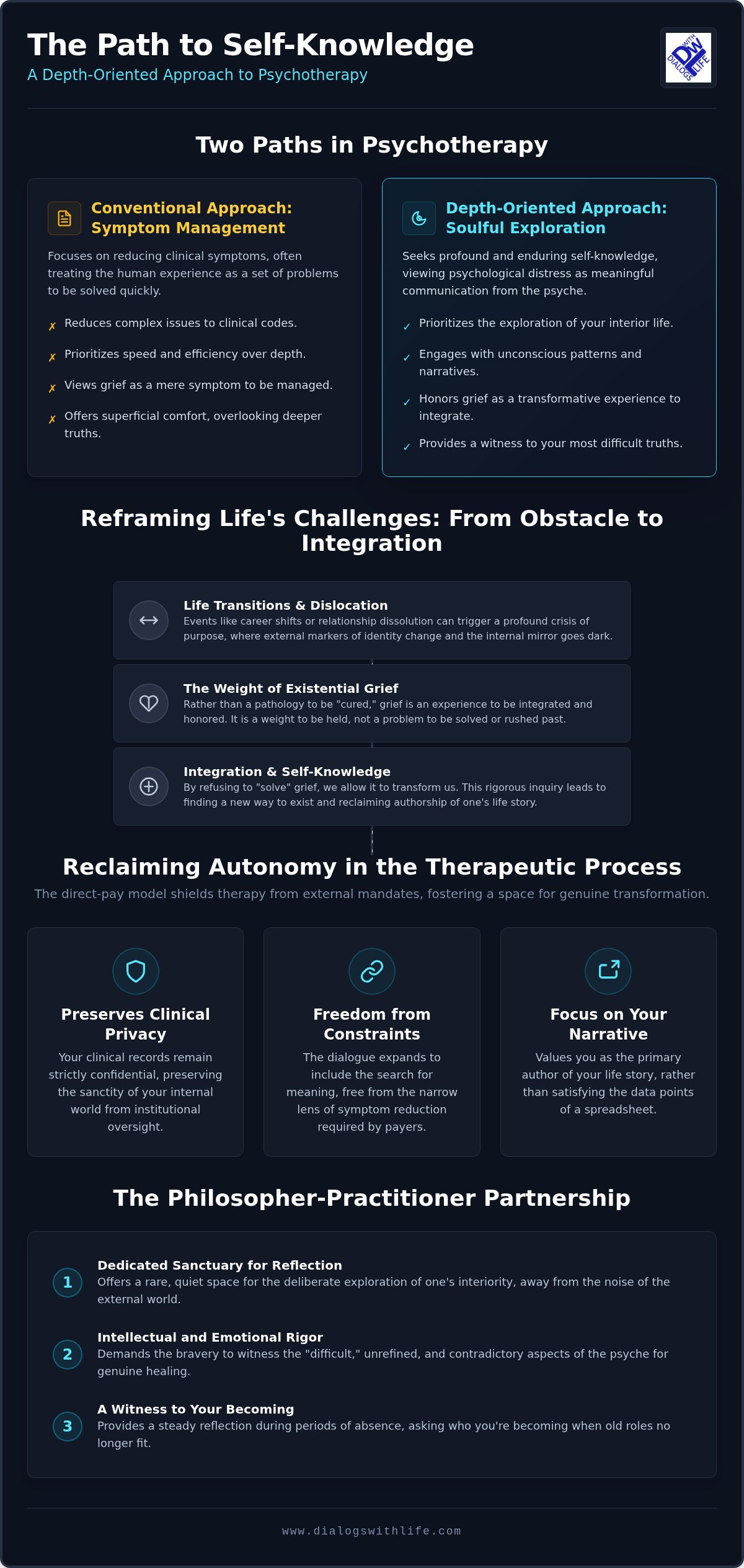
Direct-Pay Psychotherapy: Ownership, Time, and Access
Dialogs with Life, Inc. operates as a direct-pay psychotherapy practice in California. This choice reflects more than a method of payment. It reflects a central value of the practice: the goals and ambitions of psychotherapy belong, first and foremost, to the client.
When psychotherapy is reimbursed through insurance, treatment may need to satisfy requirements involving medical necessity, diagnosis, documentation, authorization, and reimbursement. These requirements serve purposes within an insurance system, but they do not necessarily encompass everything a person may legitimately wish to explore in psychotherapy.
A client's ambitions for therapy may extend beyond symptom reduction.
Someone may wish to understand a repeating relationship pattern, come to terms with an important loss, reconsider the direction of a life or career, explore questions of identity and meaning, or examine psychological patterns developed over many years.
Such work does not always conform to a predetermined timetable.
Direct-pay psychotherapy allows therapeutic goals to remain primarily a matter between client and therapist. Together, they can consider what deserves attention, how the work is progressing, whether therapy remains useful, and when the work has accomplished what the client came to do.
The pace of psychotherapy can therefore respond to the individual rather than being organized primarily around an insurer's authorization cycle, reimbursement criteria, or prescribed timeframe.
This does not mean therapy continues indefinitely or without purpose. Goals, progress, usefulness, and the continuing value of treatment deserve ongoing consideration.
The distinction is who participates in making those decisions.
At Dialogs with Life, the client retains meaningful ownership of the therapeutic undertaking. The therapist brings professional judgment, ethical responsibility, clinical knowledge, and appropriate challenge. But the client's life does not become the property of a treatment plan.
The work remains accountable to the person who came seeking it.
Making Depth Psychotherapy More Accessible
Direct-pay psychotherapy also presents an important question of accessibility.
Independence from third-party reimbursement has limited value if the resulting psychotherapy becomes accessible only to those with substantial financial resources.
For this reason, direct-pay practices such as Dialogs with Life may employ fee adjustments when circumstances and availability permit, helping make depth-oriented psychotherapy accessible to a broader range of people.
Financial circumstances can be discussed openly rather than assumed to determine, without conversation, whether someone can participate in this kind of therapeutic work.
A fee adjustment does not alter the seriousness of the psychotherapy, the therapist's commitment, or the client's place within the therapeutic relationship. It does not create a lesser form of care.
Rather, fee flexibility attempts to hold two important values simultaneously: the independence that direct-pay psychotherapy can provide and a genuine commitment to accessibility.
There are practical limits. A private practice must remain sustainable, and adjusted-fee availability cannot always be guaranteed. Where flexibility is possible, however, it can help create a therapeutic model that is both professionally sustainable and responsive to the economic realities of those seeking care.
For someone drawn to depth psychotherapy but uncertain whether direct-pay treatment is financially possible, the first step may simply be to ask.
Direct pay does not eliminate professional documentation requirements, ethical responsibilities, legal obligations, or established limits of confidentiality. These remain essential aspects of responsible clinical practice.
What direct pay can provide is greater freedom for client and therapist to determine the aims, pace, and duration of psychotherapy according to the client's needs and the clinical usefulness of the work.
For Dialogs with Life, this is ultimately a question of autonomy, time, and access.
The client owns the goals. The work is given the time it requires. And, when circumstances permit, fee flexibility can help make depth psychotherapy available to those for whom the standard fee might otherwise place it beyond reach.
Finding the Right Therapist
Psychotherapy depends upon more than theoretical orientation or professional credentials. The quality of the therapeutic relationship matters.
An introductory conversation provides an opportunity for client and therapist to consider whether working together appears appropriate.
Do I feel listened to?
Can I imagine speaking honestly here?
Does this therapist tolerate complexity rather than rush toward an answer?
Can this person challenge me while respecting my autonomy?
Can I imagine a meaningful therapeutic dialog developing between us?
A good therapeutic relationship does not require complete agreement. Thoughtful disagreement can itself become meaningful material for therapy.
What matters is whether sufficient trust, respect, safety, curiosity, and openness can develop for meaningful work to occur.
A Dialog With Life
The name Dialogs with Life reflects a particular understanding of psychotherapy.
Therapy is not simply a conversation about what is wrong.
It is a dialog with relationships, grief, memory, uncertainty, choices already made, and possibilities not yet explored. It is a dialog with the person we have been and the person we are becoming.
There are periods when familiar answers cease to satisfy us. These moments can be disorienting, but they can also invite a different quality of attention.
Not every difficulty contains a hidden lesson. Not every loss needs to become something positive. Not every wound disappears. And not every important question receives a final answer.
Sometimes the work consists of learning how to remain present to what is true while discovering greater freedom in how we live in relationship to it.
That is the dialog.
Frequently Asked Questions
Why does Dialogs with Life offer direct-pay psychotherapy?
Direct pay helps preserve the client's ownership of the therapeutic process. Client and therapist have greater latitude to establish goals according to what the client wishes to understand, address, or change, and to determine the pace and duration of therapy through the ongoing therapeutic relationship rather than primarily through an insurer's authorization process.
Are fee adjustments available?
When circumstances and availability permit, fee adjustments may be considered for people seeking this depth-oriented model of care. Adjusted fees cannot be guaranteed, but prospective clients are welcome to raise financial concerns during an introductory consultation.
Does direct pay mean therapy has no goals or timeframe?
No. Client and therapist can identify goals, evaluate progress, reconsider priorities, and discuss when the work has reached an appropriate conclusion. The difference is that therapeutic goals do not have to be reduced solely to what a third-party payer will reimburse, nor does the therapeutic process necessarily conclude because an externally prescribed timeframe has elapsed.
Beginning the Dialog
There are moments when we recognize that continuing to live in precisely the same way is no longer enough.
We may not yet know what needs to change. We may not even know precisely what question we are trying to answer.
Knowing that something deserves our attention can be enough to begin.
Dialogs with Life, Inc. offers individual psychotherapy in California for adults interested in approaching emotional difficulty, life transitions, grief, relationships, and questions of meaning with depth, curiosity, and respect for the complexity of human experience.
The purpose is not to tell you who you should become.
It is to create a therapeutic dialog in which you can more fully encounter the life that is already yours—and consider, with greater awareness, how you wish to live it.
Schedule a free introductory consultation with Dialogs with Life, Inc. and begin the dialog.


