

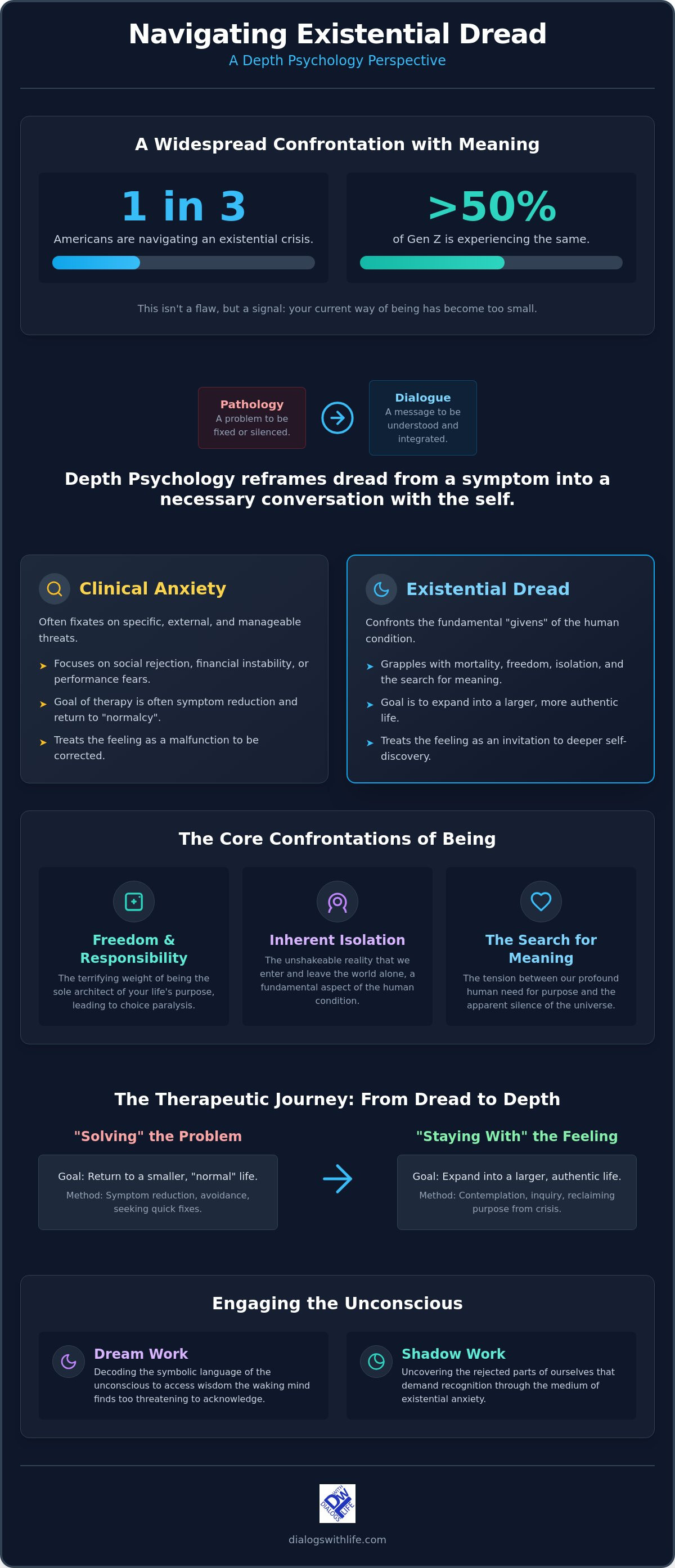
Recent 2026 data indicates that nearly one in three Americans is currently navigating an existential crisis. For Gen Z, that number climbs to over half the population. If you're among those feeling a persistent, heavy disconnect from the mundane rhythms of daily life, you've likely realized that standard advice to "stay positive" feels like a hollow insult. Utilizing depth psychology for existential dread offers a different path. It's not about silencing the anxiety; it's about listening to what it's trying to say.
You know that sinking feeling. It's the quiet realization that mortality and choice carry a weight that traditional, symptom-focused therapy often fails to address. You're likely tired of superficial comfort. You're looking for a witness to your complexity. This article explores how we can transform this paralyzing symptom into a profound catalyst for self-discovery and spiritual growth. We'll examine a rigorous framework for understanding your dread and outline a path toward reintegrating meaning into a life that currently feels fractured and thin.
Key Takeaways
- Reframe your experience as a confrontation with the "givens" of existence, distinguishing natural existential anxiety from clinical pathology.
- Explore how depth psychology for existential dread facilitates a transition from paralyzing symptoms to a rigorous, meaning-centered dialogue with life.
- Understand the contemplative shift required to move beyond superficial symptom management toward a deeper engagement with the internal world.
- Learn why the direct-pay model in California supports the clinical autonomy needed for the long-term, exploratory work that existential inquiry demands.
Defining Existential Dread Through the Lens of Depth Psychology
To experience existential dread is to stand before the vast, unblinking silence of the void. It isn't a pathology to be excised, but a confrontation with the fundamental givens of our lives. While clinical anxiety often fixates on specific, manageable threats like social rejection or financial instability, the application of depth psychology for existential dread focuses on the broader weight of being. It's a weight that comes from a rigorous engagement with reality, a sign of intellectual and emotional honesty that many choose to avoid. Depth psychology suggests that this dread is not merely a symptom of a broken mind, but a signal. It indicates that your current ego-structure has become too small to contain the expanding growth of your soul.
From a Jungian perspective, this paralyzing feeling is often the unconscious attempting to break through stale, calcified life patterns. It's a violent invitation to a deeper dialogue. When we use depth psychology for existential dread, we stop trying to "fix" the feeling and start asking what it requires of us. This shift moves the crisis from a medical problem to a philosophical necessity. It's an internal revolution where the old self must die to make room for a more authentic version of being.
The Existential Givens: Freedom, Isolation, and Meaning
The weight of absolute freedom is often heavier than the burden of restriction. Without a pre-ordained script, we face a choice paralysis that can feel like a slow descent into panic. This paralysis isn't a failure of will, but a recognition of the terrifying responsibility that comes with being the sole architect of one's own purpose. We're also faced with the inherent isolation of the human condition; we enter and leave this world essentially alone. Depth work doesn't promise to remove this isolation but seeks to bridge the gap through shared witness and internal integration. Existential dread is the tension between our search for meaning and the apparent silence of the universe.
The Therapeutic Journey: Moving from Dread to Depth
The standard clinical response to anxiety is often reductive, aiming to restore the patient to a previous state of "normalcy." However, when we engage in depth psychology for existential dread, the goal isn't to return to a smaller life, but to expand into a larger one. This requires a fundamental shift from trying to "solve" the dread to a contemplative practice of "staying with" it. By refusing to look away, we allow the dread to reveal its underlying structure. This meaning-centered psychotherapy doesn't offer easy answers; it provides a container where you can reclaim a sense of purpose from the wreckage of a crisis. What is Depth Psychology? It is a commitment to exploring the layers of the psyche that remain hidden beneath the surface of daily awareness.
Engaging in individual psychotherapy provides the necessary sanctuary for these heavy inquiries. In this dedicated space, the "crisis of soul" isn't treated as a malfunction, but as a spiritual psychotherapy process. It's a transformative narrative where the breakdown of the ego becomes the breakthrough of the self. If you feel ready to honor this internal call, you might consider a free introductory session to see if this rigorous path aligns with your needs.
Engaging the Unconscious: Dreams and Shadow Work
Depth psychology utilizes dream work to decode the symbolic language of the unconscious. Often, the "wisdom" hidden within dread is found in images that the waking mind finds too threatening to acknowledge. Shadow Work further illuminates why certain life transitions feel so catastrophic. It uncovers the parts of ourselves we've rejected, which now demand recognition through the medium of existential anxiety.
Existential-Integrative Therapy for Life Transitions
In California’s high-pressure culture, major changes like divorce, retirement, or loss aren't just logistical hurdles. They act as existential triggers that expose the fragility of our identities. Navigating these threshold moments requires a philosopher-practitioner guide who understands that these aren't just problems to be managed, but mysteries to be lived through. This integrative approach ensures that the logistical and the existential remain inextricably linked.
Entering the Dialogue: Finding a Depth Psychologist in California
The pursuit of meaning isn't a task that fits neatly into the constraints of insurance-mandated short-term care. Managed care often prioritizes rapid symptom reduction over the slow, methodical inquiry required for soul work. Engaging with depth psychology for existential dread requires a framework that respects the patient's autonomy and the clinician's expertise. By opting for a direct-pay model, both practitioner and client bypass the reductive "medical necessity" labels that often sanitize the therapeutic process. This clinical rigor ensures that the work remains focused on the internal world rather than administrative compliance. Choosing depth psychotherapy is a commitment to a process that values intellectual depth over superficial comfort.
When seeking a guide for depth psychology for existential dread, look for a philosopher-practitioner who possesses more than just technical training. You need someone with the presence and intellectual bravery to sit with your darkness without rushing to provide easy answers. This is a person who understands that dread is a rigorous call to growth. It's often helpful to utilize a free introductory session to test the resonance between yourself and the practitioner. The therapeutic relationship is the primary vessel for transformation, and a shared commitment to sincerity is vital for success.
The Logistics of Soul Work
Private-pay therapy in California allows for a depth of engagement that isn't possible under the scrutiny of third-party payers. While finding a licensed practitioner ensures they've met the state's rigorous standards, including 3,000 hours of supervised professional experience, the direct-pay model focuses on the clinical autonomy needed for existential work. This model protects your privacy and allows the therapy to unfold at its own pace. It's vital to find a therapist who respects the somber weight of your experience and doesn't shy away from the intersection of your personal struggle and the broader human condition.
Conclusion: The Dialogue Begins
Dread is not a terminal state. It is the threshold of a deeper involvement with your own existence. Viewing an existential crisis as a sacred transition allows you to move from paralysis to participation. Your dread is not the end of the road, but the beginning of a more honest Dialog with Life. By stepping into this inquiry, you transform a crisis of meaning into a catalyst for spiritual growth, ensuring that your internal and external worlds are finally, inextricably linked.
Commencing the Dialogue with Life
Dread isn't a sign of failure. It's a rigorous invitation to expand the boundaries of your internal world. By utilizing depth psychology for existential dread, you move beyond the surface-level management of symptoms. You enter a space where your anxiety is treated as a profound catalyst for spiritual growth. We've seen how facing the "givens" of existence and engaging with the unconscious can transform a paralyzing crisis into a narrative of self-discovery.
Dialogs with Life, Inc. operates as a direct-pay practice to ensure your privacy and the clinical depth required for this somber work. With a specialized focus on spiritual and depth psychology, I provide a witness to those navigating complex life transitions and grief. This path doesn't offer easy comfort, but it does offer honest integration. If you're ready to honor the weight of your experience, you can begin your journey with a free introductory session at Dialogs with Life. Your crisis of meaning isn't the end. It's the threshold of a more intentional existence.
Frequently Asked Questions
Is existential dread the same as clinical depression?
Existential dread is distinct from clinical depression, though the two experiences often share a somber landscape. Depression typically presents as a pervasive loss of interest or biological lethargy. In contrast, dread is a rigorous, conscious confrontation with the fundamental conditions of being. It's a crisis of meaning rather than a purely chemical or mood-based disorder. Depth psychology treats this dread as an invitation to dialogue with the soul rather than a malfunction to be medicated.
How long does depth psychotherapy take to resolve existential dread?
The timeline for depth psychology for existential dread is methodical and varies based on the complexity of your internal world. This isn't a manualized treatment designed for rapid symptom suppression. Instead, it's a slow, intentional process of uncovering the wisdom within the anxiety. While some feel a sense of relief upon being "seen" in their complexity within several weeks, the work of reintegrating meaning often unfolds over many months of consistent, deep inquiry.
Why should I choose a private-pay therapist for existential issues?
Choosing a private-pay therapist ensures your clinical work remains free from the reductive constraints of insurance companies. Managed care often demands rapid results and superficial labels that don't respect the weight of existential inquiry. A direct-pay model prioritizes your privacy and allows for the clinical depth necessary to explore complex life transitions. This autonomy ensures that the pace of your therapy is dictated by your soul's needs rather than administrative quotas.
Can depth psychology help with death anxiety or fear of mortality?
Depth psychology is specifically designed to address death anxiety by integrating mortality into the broader narrative of your life. Rather than offering superficial distractions, this approach helps you confront the reality of finitude as a catalyst for authentic living. By exploring the symbolic and unconscious layers of your fear, we move toward a place where mortality isn't just a threat. It becomes a rigorous teacher that clarifies what truly matters in your daily existence.


