

What if the persistent sense of aimlessness you carry isn't a clinical deficit to be corrected, but a profound call to engage in a deeper dialogwith your existence? For many, the modern insistence on "positive thinking" feels like a hollow response to a very real, heavy silence. You don't need a sanitized version of happiness; you need a space that respects the gravity of your internal world. When seeking therapy for loss of purpose, it's easy to feel misunderstood by approaches that prioritize quick fixes over the rigorous work of self-reflection. This emptiness isn't something to be feared or medicated away without inquiry.
We believe that existential anxiety is often the starting point for a more authentic life. This article offers a rigorous exploration of how depth and meaning-centered therapy can transform a sense of emptiness into a vital conversation with reality. We'll provide a framework for understanding the internal void and introduce tools for meaningful reflection. By examining the intersection of the personal and the global, we will show how a therapeutic relationship can honor your intellectual complexity and help you navigate the finality of life with quiet strength.
Key Takeaways
- Recognize the "existential vacuum" not as a clinical pathology, but as a significant state of internal transition that demands a deeper engagement with life.
- Explore how meaning-centered psychotherapy draws from existential philosophy to facilitate a profound dialog between your daily experience and your inner world.
- Discover how specialized therapy for loss of purpose provides a rigorous framework for transforming aimlessness into a deliberate and reflective path.
- Identify the importance of a therapeutic alliance that honors your intellectual complexity and respects the weight of your existential concerns.
- Learn how to utilize a Free Introductory Session to evaluate the sincerity and depth of a potential therapeutic partnership.
The Existential Vacuum: Understanding the Weight of Lost Purpose
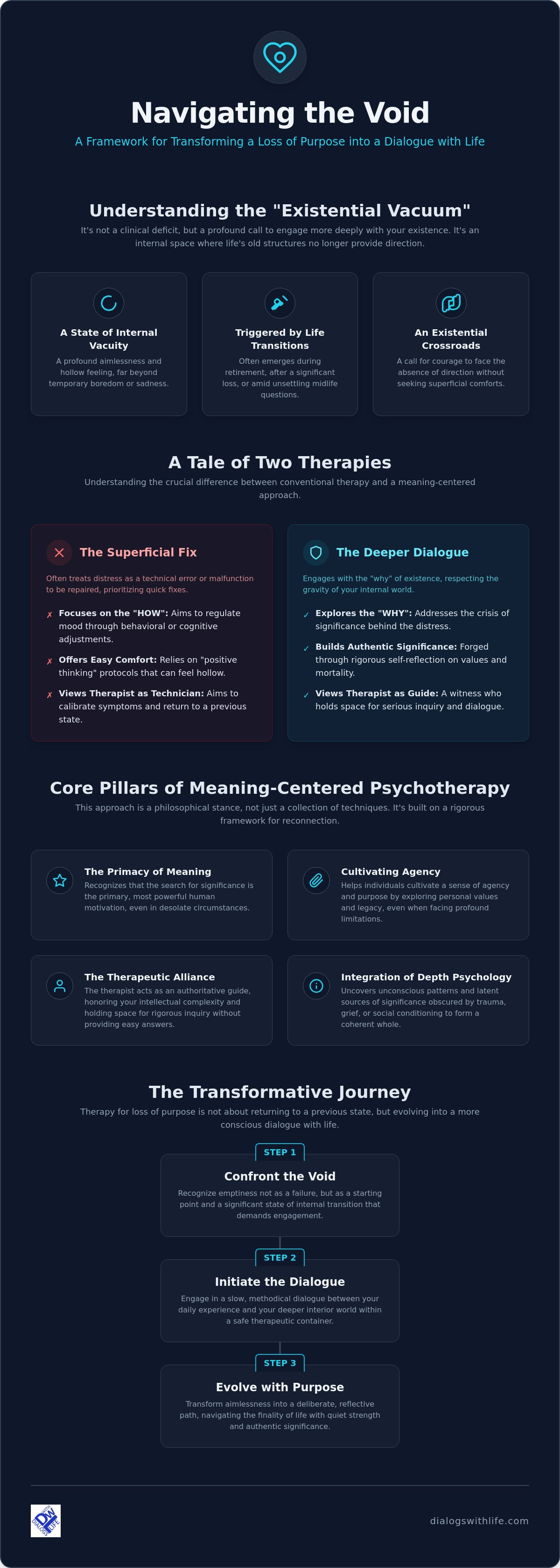
The term "existential vacuum" describes a state of internal vacuity; it's a hollow space where the structures of daily life no longer provide a sense of direction. It isn't just a temporary boredom. It's a profound aimlessness that often emerges when the roles we've inhabited for decades suddenly dissolve. Modern life transitions, like the silence of retirement, the heavy stillness after a significant loss, or the unsettling questions of midlife, frequently trigger these crises. These moments strip away the superficial layers of identity, leaving us to confront the stark reality of our own existence without the usual distractions of utility or social expectation.
Loss of purpose is an existential crossroads rather than a mere clinical symptom. Facing this crossroads requires immense courage, as you must sit with the somber weight of your own absence of direction without rushing to fill the void with superficial comforts. In this space, William Breitbart's Meaning-Centered Psychotherapy offers a vital anchor. This approach, rooted in the work of Viktor Frankl, suggests that even in the most desolate circumstances, the search for meaning remains our primary drive. Seeking therapy for loss of purpose isn't about returning to a previous state of being; it's about evolving into a more conscious, intentional dialog with life itself.
Distinguishing Existential Distress from Clinical Depression
Traditional clinical models often view distress as a malfunction to be repaired. They focus on the "how" of mood regulation, aiming to lift the fog of depression through behavioral shifts or cognitive adjustments. Meaning-centered psychotherapy, however, addresses the "why" of existence. It moves beyond the fixing mentality that characterizes much of the industry, opting instead for the witnessing nature of depth psychology. While depression might involve a loss of energy or interest, existential distress is a crisis of significance. It's a sophisticated internal conflict that demands a therapist who can stand as a witness to the complexity of your internal world rather than a technician trying to calibrate your symptoms.
Meaning-Centered Psychotherapy: A Rigorous Framework for Reconnection
Meaning-centered psychotherapy isn't a collection of techniques; it's a philosophical stance. It recognizes that the search for significance is the primary human motivation. When you seek therapy for loss of purpose, you're engaging in a process that respects the ontological weight of your struggle. This isn't about "fixing" a mood. It's about a slow, methodical dialog between your conscious self and your deeper interior world. Individual psychotherapy provides the necessary container for this work, allowing for a level of depth that more generalized or brief interventions often overlook.
The therapist functions as an authoritative guide through the soul's more difficult terrains. They aren't there to provide easy answers or sanitized comfort, but to hold the space for serious inquiry. Current research on meaning-centered psychotherapy highlights how this framework helps individuals cultivate a sense of agency even when facing profound limitations. By centering the therapeutic relationship on the exploration of values and legacy, it transforms the clinical encounter into a shared witness of the human condition.
The Integration of Depth Psychology and the Unconscious
Meaning often hides in the shadows of the psyche. By uncovering unconscious patterns, we can reveal latent sources of significance that have been obscured by trauma, grief, or social conditioning. This process is central to Individual Psychotherapy: A Rigorous Path to Self-Knowledge and Healing, where the goal is to integrate these disparate parts of the self into a coherent whole. It's a journey into the interiority of the self that requires both bravery and professional clinical expertise.
Moving Beyond Superficial Comfort toward Authentic Significance
Quick fixes and "positive thinking" protocols fail because they treat existential crises as technical errors. A sustainable sense of self isn't built on comfort; it's forged through rigorous self-reflection. This requires looking honestly at your history, your values, and your mortality. If you're ready to move beyond superficiality, you might find that engaging in spiritual and depth psychology offers the gravity and sincerity your experience deserves. This path doesn't promise an easy life, but it does promise a more meaningful one.
Navigating the Transition: Initiating the Therapeutic Dialog
Starting the search for therapy for loss of purpose marks a significant shift from passive endurance to active inquiry. It requires finding a clinician who doesn't merely tolerate existential questions but respects their central weight in the human experience. This choice is an intellectual and spiritual alignment. You're seeking a witness who possesses the clinical expertise to navigate the darker, more complex corners of the psyche without resorting to simplistic platitudes or superficial encouragement.
The first encounter often takes the form of a Free Introductory Session. Rather than a standard clinical intake, view this as a space for mutual inquiry. It's an opportunity to gauge the intellectual fit and determine if the therapist's presence offers the necessary gravity for your specific struggle. This dialog is the foundation of a therapeutic alliance that honors your complexity and establishes a sense of safety for the difficult work ahead.
Reclaiming your autonomy through therapy is a socially conscious act. In a culture that often values utility and productivity over depth, choosing to prioritize your internal world is a quiet rebellion. This practice operates as a private-pay model in California; a logistical choice that intentionally prioritizes clinical depth over the bureaucratic constraints of insurance mandates. By stepping outside these systems, we ensure the focus remains entirely on the rigorous work of your individual transformation rather than meeting external administrative requirements.
What to Expect in a Meaning-Centered Session
Sessions are characterized by an unhurried pace and an intentional flow. This methodical rhythm mirrors the process of deep reflection, allowing ideas to breathe and settle. The logistical and the existential are inextricably linked here. The structure of the hour provides the stability needed to explore the heaviest aspects of your existence. You can expect a conversation that is both grounded in psychological theory and fluid enough to follow the subtle, often ignored movements of your internal world.
Reclaiming the Narrative of Your Existence
The transition from a state of internal vacuity to one of intentional presence isn't a return to the past; it's an evolution. We've explored how the "existential vacuum" serves as a profound invitation to engage with the soul's deeper terrains, moving beyond the superficiality of symptom management. By adopting a philosopher-practitioner approach to individual psychotherapy, you allow for a level of inquiry that respects your intellectual complexity and honors the weight of your internal world. This process requires a therapeutic space that prioritizes clinical autonomy and depth, free from the constraints of institutional oversight.
Choosing specialized therapy for loss of purpose is a commitment to witnessing the truth of your experience without the distraction of "positive thinking" platitudes. Our direct-pay model ensures that the focus remains entirely on your spiritual and depth psychology needs. You don't have to navigate this silence alone. Schedule a free introductory session to begin your dialog with life. Your journey toward an authentic significance is a courageous act of reclaiming your own autonomy. It starts with a single, sincere conversation.
Frequently Asked Questions
Is a loss of purpose always a sign of clinical depression?
A loss of purpose is not always a sign of clinical depression; rather, it often represents an existential crossroads or a crisis of significance. While depression involves physiological and mood-based symptoms, an "existential vacuum" is a state of internal aimlessness that can occur even in the absence of clinical pathology. It's a sophisticated response to life transitions that demands philosophical inquiry rather than just symptom management.
How does meaning-centered psychotherapy differ from Cognitive Behavioral Therapy (CBT)?
Meaning-centered psychotherapy differs from Cognitive Behavioral Therapy by prioritizing the search for significance over the modification of behavior. While CBT focuses on symptom relief and correcting thought patterns to enhance daily functioning, therapy for loss of purpose addresses the underlying ontological weight of existence. It moves beyond the "how" of mood regulation to explore the "why" of your life, treating distress as a call for deeper engagement rather than a malfunction to be fixed.
Can depth psychology help if I don't consider myself a "spiritual" person?
Spirit is a derivative of spirare "to breathe". Depth psychology is highly effective even for those who don't identify with spirituality; its focus is on the human capacity for meaning, values, and interiority. In this framework, the focus is on your internal world and the unconscious patterns that shape your experience of reality. To engage in the rigorous work of self-reflection and the pursuit of an authentic, significant life one only needs to focus on ones breath. How you do or do not identify with the notion of spiritual is of less consequence than whether or not you can revere your own breath.
What is the significance of a free introductory session in existential therapy?
The Free Introductory Session serves as a vital opportunity for mutual inquiry and the assessment of intellectual fit between the seeker and the practitioner. In existential therapy, the alliance is a shared witness to the human condition, making the quality of the connection paramount. This initial dialog allows you to experience the unhurried pace of the practice and determine if the therapist's presence offers the necessary gravity to honor your specific internal world.


